In just a few decades, image editing has transformed from a specialized craft into an accessible, AI-driven workflow that anyone can use. What once required hours of manual work in professional software can now be automated, scaled, and personalized in seconds. As generative AI accelerates, we are entering a new era where editing is no longer about modifying images—it’s about creating them.
This article explores the evolution of image editing, the technologies shaping its future, and real-world examples of how AI tools are redefining creativity.
- The Early Era: Manual Tools and Pixel-Level Precision
Before AI, image editing primarily relied on layer-based adjustments, brush tools for retouching, masking and selection techniques and complex workflows requiring professional training
Software like Photoshop dominated the industry, and achieving realistic results required years of expertise. Tasks such as removing watermarks, adjusting hair color, or cleaning blemishes were slow and labor-intensive.
This era built the foundation, but it also highlighted a core problem: Traditional editing was powerful, but not scalable for fast digital content production.
- The Rise of Automation: Filters, Presets, and Rule-Based Tools
As social media expanded, the need for fast visual content exploded. This pushed the industry toward:
(1). One-click filters and presets
Apps like VSCO and Snapseed made editing more accessible.
(2). Rule-based automation
Tools could automatically detect faces, edges, or objects, allowing quicker retouching.
(3). Basic object detection & segmentation
Removing simple backgrounds or enhancing details became more efficient.
Although revolutionary at the time, these tools still followed fixed rules and lacked creative flexibility. They couldn’t understand an image, they only process it.
- The AI Revolution: Understanding Images Like Humans Do
The arrival of deep learning fundamentally changed image editing. AI models can now:
- Recognize people, objects, lighting, and textures
- Understand context and aesthetics
- Predict how an image should look
- Generate new visual elements from scratch
This shift enabled a new class of tools that are faster, smarter, more creative and more accessible.
- Modern Use Cases: What Today’s AI Editors Can Do
Generative AI has pushed capabilities from simple automation into true creativity. Examples include:
Hair color & style transformation
Platforms can simulate natural lighting and strand-level detail.
Anime, cartoon, or artistic filters
Models learn artistic styles and recreate them on any photograph.
Clothing and body adjustments for creatives
From AI outfit generators to virtual try-on features.
Image expansion & restoration
AI can rebuild missing parts, enhance resolution, or revive old photos.
These capabilities are now used across e-commerce, influencer marketing, content creation, and even product design.
Watermark & object removal
AI understands the background and fills in missing textures realistically.
- Case Study: How AI Tools Accelerate Creative Workflows
A typical content creator may need to produce dozens of images per week.
Before AI, this involved:
- Manual background cleanup
- Color correction
- Resizing and cropping
- Style filtering
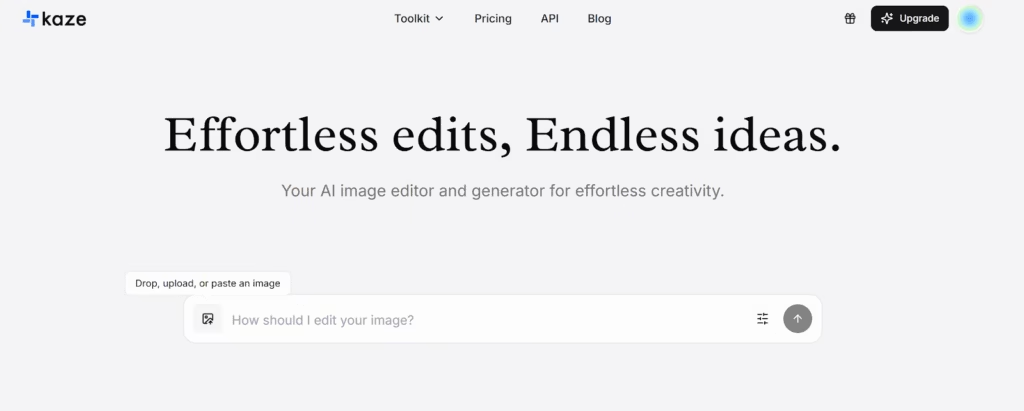
Now, AI-powered platforms such as kaze.ai which is a fast-growing AI image editing suite allow creators to edit their images using natural language within seconds.

The impact is clear, using AI image editing tools can provide more than 10 times faster production speed, lower cost compared to traditional editing and consistent quality across large batches of content
This efficiency is reshaping how creators, businesses, and marketers operate.
- What’s Next: The Future of AI Image Editing
The next evolution will bring even more transformative capabilities like Real-time, prompt-based editing. Users can describe an idea, and AI instantly generates the result.
The latest model is also trying cross-modal editing and AI style personalization. Images will seamlessly transform into videos, 3D models, or interactive scenes, and creators will train models on their own aesthetic style.
- Conclusion
The evolution of image editing shows a clear trajectory: from manual precision to automated tools and to intelligent, generative creativity.
Today’s AI editors empower anyone: from creators, marketers, designers, to everyday users, helping them produce high-quality visuals faster than ever before. As models continue to improve, image editing is no longer a skill reserved for specialists; it has become an accessible, intuitive, and limitless creative playground.