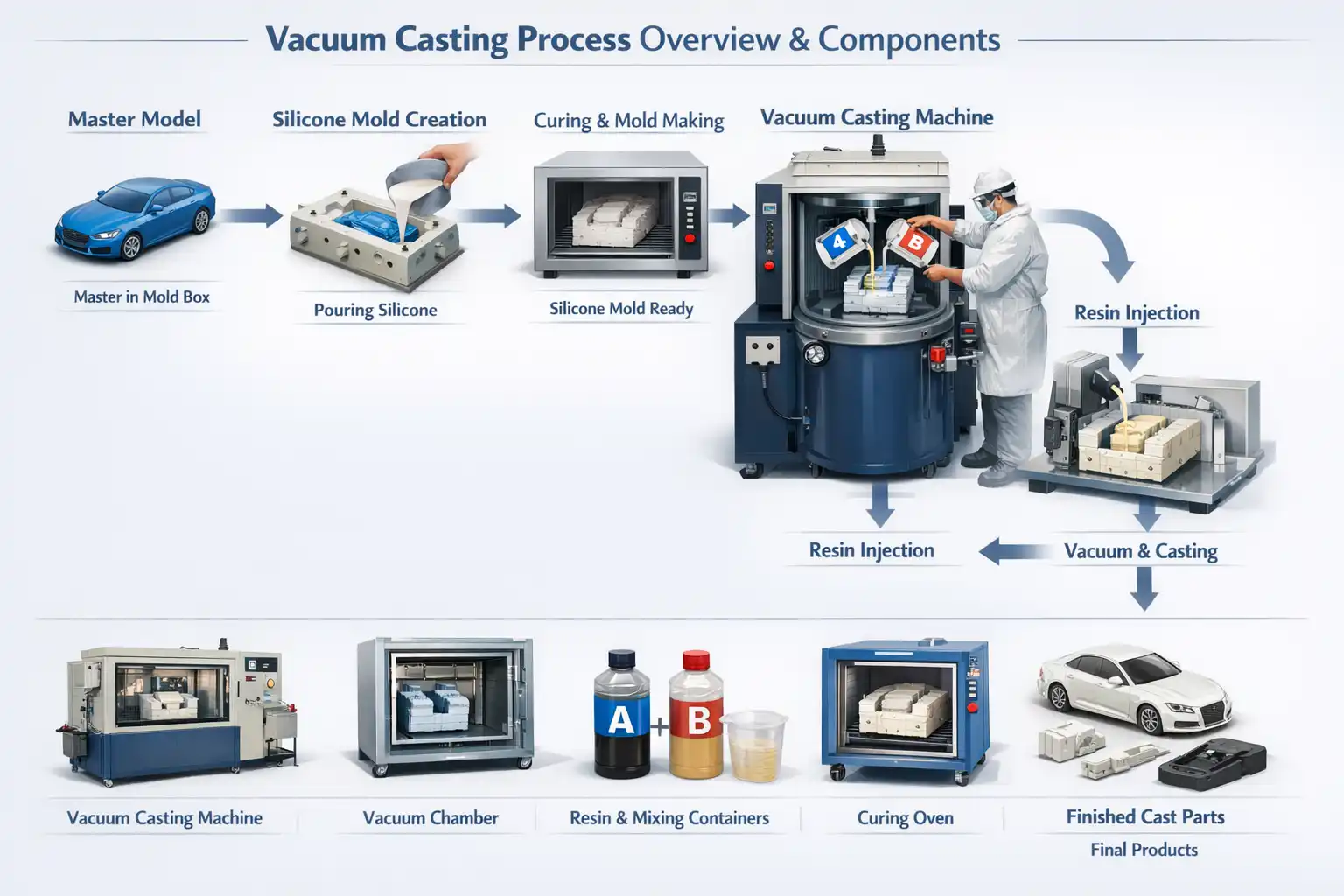
Vacuum casting is a specialized manufacturing process used to produce high-quality functional parts, particularly optimized for rapid prototyping and low-volume production. The core principle involves pouring liquid polymers, such as polyurethane resins, into a silicone mold within a vacuum chamber. This environment effectively eliminates air entrapment (bubbles) and ensures the reproduction of intricate geometries and fine surface details. Industries such as aerospace and automotive frequently utilize vacuum casting due to its cost-efficiency and its ability to yield near-production-grade components with exceptional surface finishes. While it excels at rapid iterations and dimensional accuracy, it may not be suitable for components sensitive to specific thermal or pressure constraints.
Advantages and Disadvantages of Vacuum Casting
Before implementing this manufacturing method, it is essential to evaluate its specific benefits and technical limitations.
1. High Fidelity Detail Reproduction
Vacuum casting process is renowned for its ability to replicate complex geometries. The flexible silicone molds used in this process can capture the micro-details of a master pattern. Vacuum pressure forces the resin into every cavity of the mold, ensuring the resulting components are high-fidelity replicas of the original design. This precision makes it an ideal choice for architectural models, medical devices, and high-end consumer product prototypes.
2. Material Versatility
The material adaptability of this process is outstanding. It supports a wide range of polyurethane resins, each engineered to mimic the physical properties of production plastics like ABS, Polypropylene (PP), or various elastomers (rubber). This allows designers to conduct functional testing using materials that closely approximate the final product’s intent. Furthermore, it is possible to produce parts in multiple colors or material shore hardnesses using the same base process.
3. Cost-Effectiveness for Low-Volume Production
For small batches, vacuum casting is significantly more economical than hard tooling. Silicone molds are relatively inexpensive to fabricate and typically yield 20 to 25 components before requiring replacement. This positions vacuum casting as a “bridge” technology—filling the gap between one-off 3D printed samples and high-volume mass production without the prohibitive upfront costs of steel or aluminum molds.
4. Rapid Turnaround Times
In modern product development, speed to market is critical. Once a master pattern is finalized, a silicone mold can be fabricated within 24 to 48 hours. Subsequent casting cycles are efficient, often taking only a few hours. This rapid cycle time allows engineering teams to perform multiple design iterations in a fraction of the time required for traditional tooling.
5. Mold Durability
Despite its benefits, mold longevity is a notable challenge. Silicone molds are categorized as “soft tooling”; they are susceptible to wear, tearing, or thermal degradation after repeated use. The mechanical stress of demolding parts eventually causes loss of dimensional accuracy and surface detail.
6. Scalability Constraints
While vacuum casting excels in small batches, it is not a high-throughput solution. Compared to injection molding, the cycle time per part is significantly longer, ranging from several hours to a full day, depending on part volume and resin cure time. Additionally, the need to frequently replace molds limits total production scalability.
7. Material Property
Discrepancies Although casting resins are highly versatile, they do not always perfectly match the long-term aging, thermal conductivity, or mechanical fatigue properties of engineering-grade thermoplastics used in injection molding.
Applications of Vacuum Casting
Vacuum casting is a cornerstone of the prototyping phase, bridging the gap between a conceptual CAD model and a pre-production sample. It allows engineers to create functional representations for user testing, fit-check assemblies, and aesthetic reviews, providing the tactile feedback necessary for final design validation.
For specialized industries like medical aesthetics or high-end automotive, where demand may not justify a $50,000 investment in steel molds, vacuum casting offers a viable path to market. It is particularly useful for producing replacement parts for legacy vehicles or limited-run medical instruments where precision is paramount, but volume is low.
The Vacuum Casting Process
The vacuum casting is a bridge between rapid prototyping process and industrial manufacturing, demanding precision at every phase to ensure the final output meets engineering specifications.
Step 1: 3D CAD Modeling
The process begins with a precise 3D CAD model. This digital foundation defines the final geometry, tolerances, and features of the part.
Step 2: Fabrication of the Master Pattern
The CAD data is used to create a physical “Master Pattern,” typically via high-resolution 3D printing (SLA/PolyJet) or CNC machining. The surface of the master is meticulously finished, as any imperfection here will be mirrored in every subsequent cast part.
Step 3: Silicone Mold Fabrication
The master pattern is suspended in a casting box, and liquid silicone (RTV) is poured around it. The box is placed in a vacuum chamber for degassing to ensure no air remains trapped against the master’s surface. Once cured, the silicone block is strategically cut to remove the master, leaving a high-detail negative cavity.
Step 4: Casting under Vacuum
The selected resin is mixed (often including pigments or additives) and injected into the silicone mold. The entire assembly is placed back into the vacuum chamber. The low-pressure environment draws the resin into every intricate corner and thin-walled section of the mold.
Step 5: Curing and De-molding
The resin is allowed to polymerize, either at room temperature or in a specialized curing oven. Once the “green strength” is sufficient, the part is carefully demolded. Final post-processing, such as gate removal or surface polishing, is performed to achieve the final specification.
Materials Used in Vacuum Casting
Polyurethane (PU) Resins
The workhorse of the industry, PU resins can be formulated to simulate everything from soft elastomers to high-impact rigid plastics. Their versatility makes them ideal for parts subject to mechanical stress or impact.
Epoxy Resins
Chosen for high-performance applications, epoxies offer superior stiffness, thermal stability, and chemical resistance. They are often utilized for structural components or parts exposed to harsh industrial environments.
Silicone Rubber
While primarily used for tooling, silicone is also cast to create flexible, heat-resistant components. It is valued for its dielectric properties and its ability to maintain elasticity across a wide temperature range, making it a standard choice for gaskets and electronic insulators.