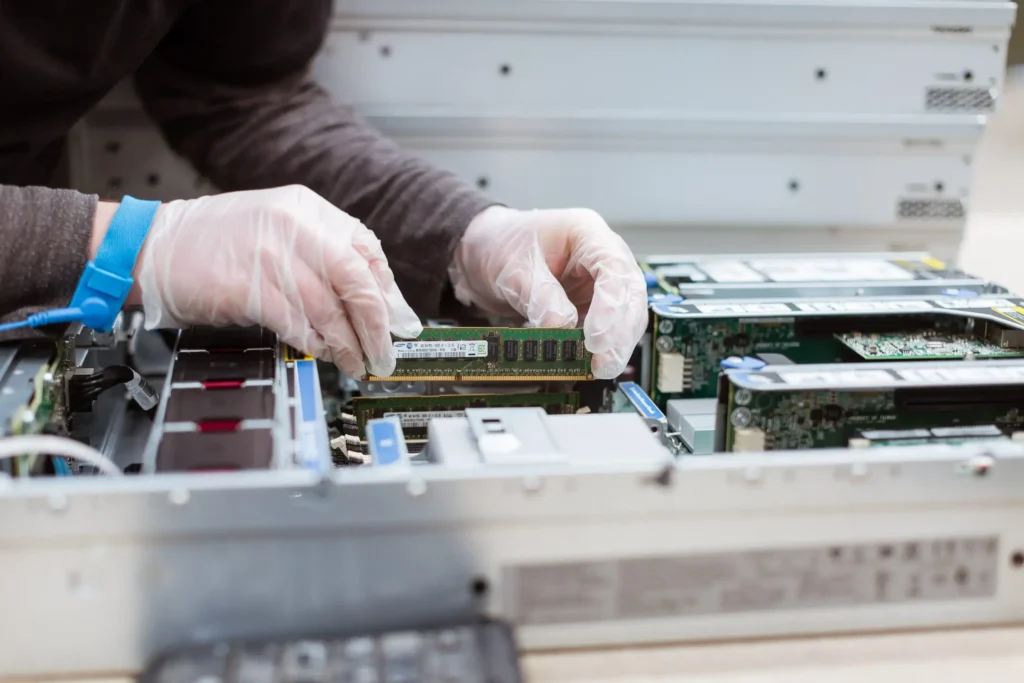
Have you checked your server renewal bill recently and caught yourself thinking: “Wasn’t hardware supposed to get cheaper over time?” The logic seems sound. For years, Moore’s Law suggested steady growth in performance alongside declining costs. But reality has shifted. If you’ve been pricing out high-RAM VPS solutions or dedicated servers lately, you’ve probably noticed something unusual — memory is getting more expensive, not less.
Whether we’re talking about DRAM modules or NAND-based storage, the cost of storing and processing data is steadily rising. Let’s break this down in practical terms and understand why every extra gigabyte now feels like a premium upgrade.
📌IMPORTANT: Memory and storage components can make up to 40% of a data center’s total CAPEX. Any changes in manufacturing costs directly affect hosting prices.
From Oversupply to Tight Markets
If we rewind to the 2010s, memory was surprisingly affordable. Major players aggressively expanded production, flooding the market to compete for dominance. For customers, this meant cheap upgrades and generous configurations.
But that period didn’t last. The transition to DDR5 and advanced 3D NAND architectures introduced significant complexity. Manufacturing became slower, more expensive, and far more sensitive to disruptions. A single issue at a fabrication plant — whether technical or logistical — can ripple across the global supply chain.
The result? Instead of surplus, we now face constrained supply paired with growing demand.
💡 TIP: If your project depends heavily on memory (for example, databases or analytics), it makes sense to lock in pricing with long-term plans in advance.
AI Demand: The New Price Driver
The biggest shift today isn’t just technical — it’s competitive. Your server isn’t only competing with other hosting clients anymore. It’s competing with AI infrastructure.
Large-scale AI models require massive amounts of high-bandwidth memory (HBM). Manufacturers naturally prioritize these higher-margin products. Producing memory for AI accelerators is significantly more profitable than supplying standard server modules.
This creates a supply imbalance. As factories pivot toward AI demand, fewer resources are allocated to traditional server memory — and prices rise accordingly.
Think of it like this: if factories switch to producing luxury vehicles because they generate more profit, the price of standard cars inevitably increases due to reduced supply.
AI workloads demand up to 10× more memory bandwidth than traditional applications.
HDDs Are Not Dead — Just Different
Despite the dominance of SSDs, traditional HDDs still play a key role in large-scale storage. However, their pricing has stopped declining as expected.
Why? Because we are approaching physical density limits. Technologies like HAMR (heat-assisted magnetic recording) are pushing boundaries, but they come with higher production costs.
Additionally, demand spikes — like those triggered by crypto trends — can rapidly deplete global inventories. This creates sudden price jumps that eventually affect hosting plans.
| Component | Key Driver | Annual Trend | Hosting Impact |
| DDR5 RAM | AI demand shift | +15–25% | High |
| NVMe SSD | 3D NAND complexity | +10–20% | Medium |
| Enterprise HDD | HAMR внедрение | ±5% | Low |
Why Your Hosting Bill Keeps Growing
For hosting providers, hardware is a long-term investment. When component prices rise, the return period extends. To maintain profitability, these costs are gradually reflected in rental pricing.
But hardware is only part of the equation. Higher-density memory generates more heat, increasing cooling requirements and electricity consumption. This compounds operational expenses.
At the same time, modern applications are far more resource-hungry. What used to be a lightweight website now requires significantly more memory due to frameworks, plugins, and background processes.
✅ Useful: Using technologies like ZRAM can help partially offset memory shortages by compressing data.
⚠️ DO NOT OVERPAY FOR UNUSED RAM ⚠️
Always monitor real usage (WSS). Paying for unused memory is one of the most common hidden losses.
External Factors You Can’t Ignore
The semiconductor industry does not operate in isolation — it is deeply embedded in a fragile, globally distributed ecosystem. Every memory chip inside your server is the result of a long, multi-stage supply chain that spans continents, political systems, and highly specialized industries.
At the foundation of this chain are rare materials and industrial gases. Semiconductor manufacturing depends on ultra-pure substances such as neon, palladium, and photoresists. These are not generic commodities — they require precise refinement processes and are often sourced from a limited number of regions worldwide. If production slows down in just one of these regions, the impact propagates immediately to chip fabrication plants.
Next comes the manufacturing layer, concentrated in a small number of highly advanced facilities. These fabs operate with extreme precision and minimal tolerance for disruption. Even a short-term interruption — such as power instability, contamination, or equipment failure — can halt production lines and take weeks or months to fully recover. Unlike many other industries, semiconductor output cannot be quickly ramped up to compensate for lost volume.
On top of that sits the logistics network. Chips, components, and finished hardware must be transported across oceans and borders through tightly scheduled shipping routes. This system relies on stable fuel costs, available cargo capacity, and predictable customs processes. When any part of this network becomes unstable — for example, due to port congestion, rising fuel prices, or regulatory delays — delivery timelines stretch and operational costs increase.
Geopolitical factors further amplify these risks. Trade restrictions, export controls, regional conflicts, and strategic competition between major economies can directly limit access to critical technologies or materials. In some cases, governments impose restrictions on semiconductor exports or prioritize domestic supply, effectively reducing availability on the global market.
What makes this system particularly sensitive is its lack of redundancy. Many components have no immediate substitutes, and alternative suppliers may not exist at the required scale or quality level. This creates bottlenecks where even a minor disruption — whether in raw material extraction, manufacturing, or transportation — can cascade through the entire supply chain.
The result is a delayed but inevitable effect on pricing. A disruption today does not necessarily increase costs immediately. Instead, it reduces available inventory, creates backlogs, and forces manufacturers and distributors to adjust pricing over the following quarters. By the time these changes reach hosting providers, they are reflected in higher infrastructure costs and, ultimately, in your monthly server bill.
In practical terms, this means that what appears to be a small, localized issue — a delayed shipment, a temporary factory shutdown, or a regulatory change — can trigger a chain reaction that impacts global hardware pricing weeks or even months later.
Understanding this interconnected system is critical. Server pricing is no longer driven solely by technological progress — it is increasingly shaped by external variables that are unpredictable, interdependent, and difficult to control.
“Data may be the fuel of the digital economy, but memory is the engine that makes it usable.”
Conclusion: Efficiency Becomes Critical
Are rising prices here to stay? In the short term — yes. But there is a counter-trend: optimization. Developers and businesses are shifting toward more efficient architectures, better caching strategies, and leaner code.
Instead of relying on brute-force hardware scaling, the focus is returning to smart resource management. This is where real savings will come from.
Memory is no longer an unlimited resource. It’s a controlled, valuable asset — and treating it accordingly is now part of running any serious project.
💡 Advice: Monitor your swap usage — modern NVMe drives allow much more efficient use than before. They can help you optimize your remote server in https://deltahost.com/
Final takeaway: Your hosting bill reflects far more than just hardware. Behind every gigabyte are complex supply chains, advanced manufacturing, and growing global demand. Stay efficient, monitor usage, and adapt — this is the new normal.