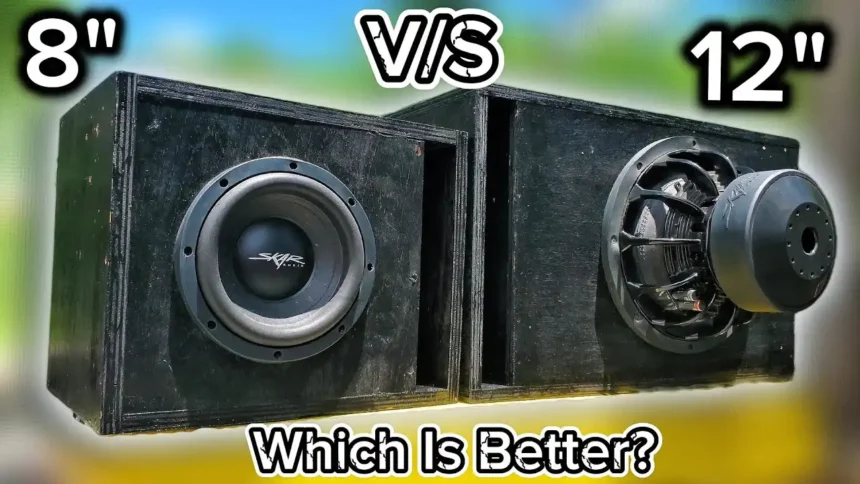
Subwoofer size is the first decision most people get wrong, and it sets the tone for the rest of the build. The diameter you pick affects how the bass sounds, how loud it gets, how much power you’ll need, and how much trunk space disappears. Bigger is not automatically better, and smaller is not automatically tighter. The right size depends on the music you listen to, the space you have, and the kind of bass you actually want to feel.
Here’s how the four most common sizes compare, and how to match one to your goals.
What subwoofer size actually changes
A larger cone moves more air, and moving air is what you hear and feel as bass. That gives bigger subs an edge in raw output and low-end depth. The trade-off is that a heavier cone is slower to start and stop, so very large subs can sound less precise on fast, detailed bass lines. Smaller cones react quicker, which is why they tend to sound tighter, but they have to work harder to reach the lowest notes.
Three things shift with size: output (how loud), extension (how low), and response speed (how tight). Every size is a balance of those three.
8-inch subwoofers
Eight-inch subs are the choice when space is tight and accuracy matters more than slam. They fit under seats, behind seats, and in compact sealed enclosures, which makes them popular in trucks and small cars. The sound is fast and punchy, and they blend well with the front speakers for music where you want detail rather than a wall of low-end. You won’t shake the mirrors with a single 8, but for sound-quality builds they’re hard to beat.
10-inch subwoofers
A 10 is the practical middle ground for people who want noticeably more bass without giving up the quick, controlled feel of a smaller driver. Tens respond fast, handle a wide range of music, and don’t demand an enormous box. Running a pair of 10s is a common way to get real output while keeping the sound tight, and it often fits where a single larger sub wouldn’t.
12-inch subwoofers
The 12 is the default for a reason. It hits the sweet spot between depth, output, and box size, and almost every brand builds its widest model lineup in this diameter. A single 12 on a properly matched amp is enough to satisfy most listeners, and a pair moves serious air. If you’re not sure where to start, a 12 is the safe pick that works for nearly any genre.
15-inch subwoofers
Fifteens (and 18s) are built for output. The large cone moves a lot of air and digs into the lowest frequencies, which is what you want for hip-hop, EDM, and anyone chasing volume or competition-style bass. The cost is space and power: a 15 needs a big enclosure and a strong amplifier to wake up. On the wrong system it can sound lazy, but fed correctly it delivers bass you feel in your chest.
Quick comparison
| Size | Best for | Sound character | Box space | Power appetite |
| 8″ | Tight spaces, SQ | Fast, accurate | Small | Low–moderate |
| 10″ | Balanced daily build | Punchy, controlled | Moderate | Moderate |
| 12″ | All-around | Versatile | Moderate–large | Moderate–high |
| 15″ | Max output, low extension | Deep, loud | Large | High |
When you’re ready to compare specific models, browsing a focused selection of car subwoofers by size and RMS rating makes it easier to match a driver to the box and amp you’re planning.
One sub or two?
Two smaller subs often beat one larger sub for even bass and flexible box design, and they spread the load across more cone area. A single larger sub saves space and wiring. If your trunk allows it, a pair of 10s or 12s usually sounds fuller than one 15, while a single 15 wins when you want maximum output from one driver.
Match the size to your vehicle and goals
The car itself influences the choice as much as the music does. A sedan trunk is a sealed space that reinforces low bass, so a single 12 often sounds bigger in a sedan than the same sub does in a hatchback or SUV, where the cabin and cargo area are open to each other. If you drive a hatch, wagon, or SUV, lean a size larger or add a second sub to make up for the bass that escapes into the open cabin. Trucks are the opposite problem: cab space is tight, which is exactly where shallow-mount 8s and 10s earn their place.
Be honest about your goal before you size up. If you mostly want clean, musical bass that blends with your speakers, a smaller sub on solid power beats a large sub you can’t feed. If you want to be heard from outside the car, that’s an output goal, and output is where the 12s and 15s pull ahead. Picking the size to match the goal, rather than buying the biggest sub that fits, is what separates a system that sounds finished from one that fights itself.
FAQ
Is a 12-inch or 15-inch subwoofer better? A 12 is more versatile and tighter for mixed music, while a 15 plays lower and louder for output-focused builds. For most daily systems a 12 is the better all-around choice; choose a 15 when volume and deep extension are the priority.
Do bigger subwoofers always sound better? No. Bigger subs move more air and play louder, but they need more power and box space and can sound slower on detailed bass. The best size is the one matched to your music, space, and amplifier.
Are two 10s louder than one 12? Often, yes. Two 10s have more combined cone area than a single 12 and tend to produce fuller, more even bass, though they require a larger enclosure and more amplifier power.