

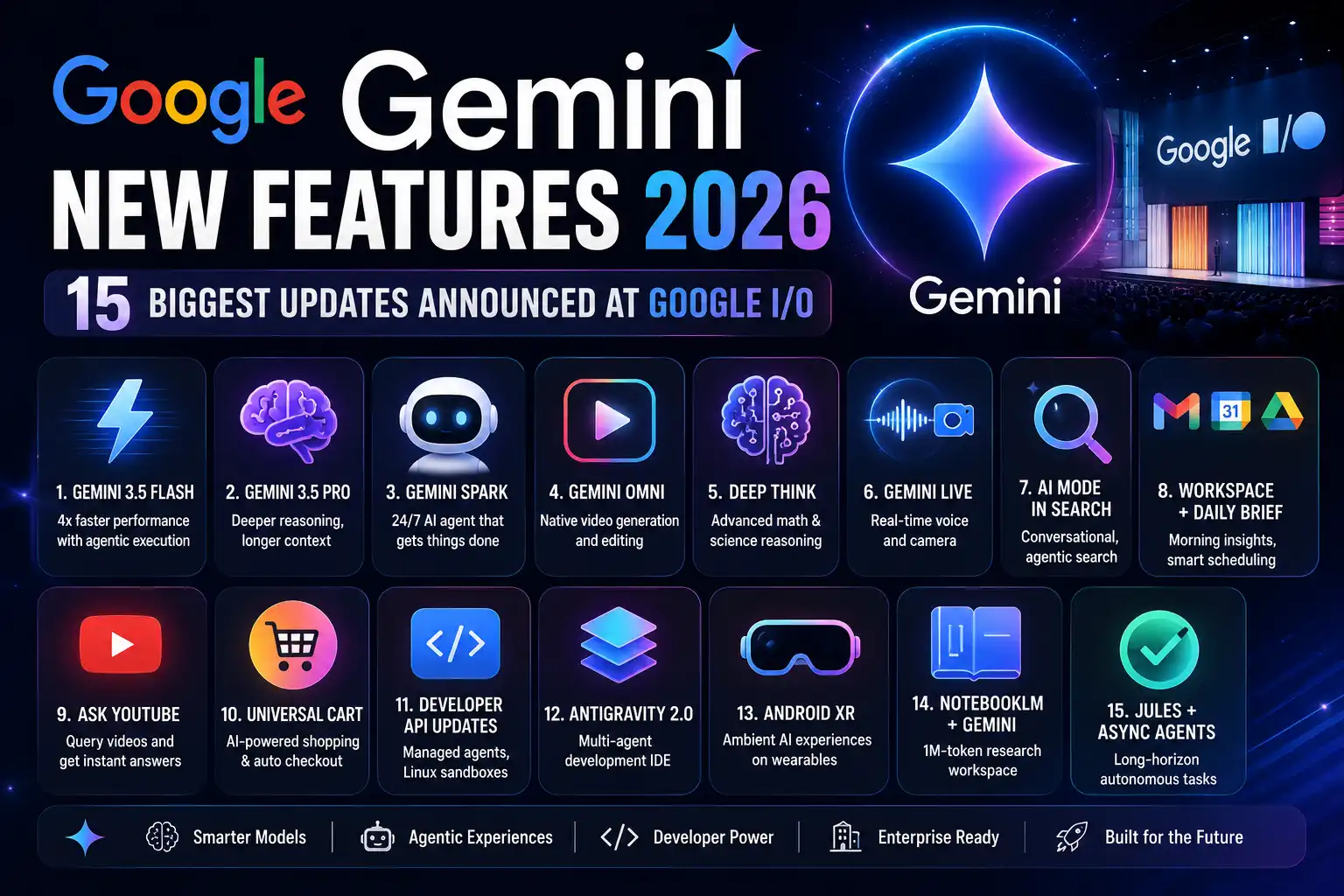
Google doesn’t do incremental. When the company decides to pivot, it pivots hard and what happened at Google I/O on May 19, 2026, was about as hard a pivot as the company has made since it replaced the ten blue links with AI Overviews two years ago.
This time, Google didn’t just upgrade its AI. It declared the beginning of what it’s calling the “Agentic Gemini Era” a structural shift that transforms Gemini from a chatbot you ask questions into a network of autonomous systems that work on your behalf in the background, across every Google product you already use, without you having to ask.
That’s a meaningful distinction. The history of AI assistants has largely been a history of reactive tools. You type. The machine responds. You read. You type again. Google is now betting that the next phase of this technology isn’t conversational at all it’s ambient. AI that watches, acts, monitors, and executes while you’re doing something else entirely.
Whether Google executes on that vision cleanly is another matter. But the scale of what was announced fifteen major feature updates spanning consumer products, developer infrastructure, enterprise tools, and hardware makes this the most consequential AI event the company has staged. Possibly ever.
Why 2026 Is Google’s Most Important AI Year Yet
The competitive pressure Google faces in 2026 is genuinely unlike anything it’s encountered before. OpenAI has spent three years systematically training users to start their research in ChatGPT rather than Google Search. Anthropic’s Claude has quietly become the preferred tool for enterprise knowledge work. Apple Intelligence is embedded into every iPhone. And Microsoft’s Copilot integration across Office 365 has given enterprise teams an AI-native productivity layer inside software they already pay for.
Google’s response isn’t a single product. It’s a platform strategy built on a unique advantage that none of those competitors can easily replicate: distribution. Google already sits inside over two billion Android devices. It already powers the daily workflows of hundreds of millions of Workspace users. It already processes more than eight billion searches per day.
The 2026 strategy is to embed AI agency into all of that not as a separate app you open, but as intelligence woven into everything Google already does. The fifteen updates below are the clearest picture yet of what that actually looks like.
Quick Summary Table
| Feature | Launch Status | Key Benefit | Who Benefits Most |
|---|---|---|---|
| Gemini 3.5 Flash | Generally Available (May 19) | 4x speed, agentic execution | Developers, enterprises |
| Gemini 3.5 Pro | Rolling out June 2026 | Deep reasoning, long context | Researchers, legal, finance |
| Gemini Spark | US/English early access | 24/7 background agent | Power users, professionals |
| Gemini Omni | Rolling out | Native video generation/editing | Creators, marketing teams |
| Gemini Deep Think | AI Ultra subscribers | Advanced math/science reasoning | Academics, engineers |
| Gemini Live | Generally Available | Real-time voice + camera | Mobile consumers |
| AI Mode in Search | Global default | Conversational, agentic search | All Google Search users |
| Workspace + Daily Brief | Generally Available | Morning digest, smart scheduling | Business professionals |
| Ask YouTube | Rolling out | Query video content directly | Students, researchers |
| Shopping AI (Universal Cart) | UK, Canada, AU expansion | Autonomous purchase execution | Digital shoppers |
| Developer API Updates | Generally Available | Managed agents, Linux sandboxes | Software engineers |
| Antigravity 2.0 | Generally Available | Multi-agent development IDE | Engineering teams |
| Android XR | Early hardware partnerships | Ambient wearable AI | Early adopters, field workers |
| NotebookLM + Gemini | Generally Available | 1M-token research workspace | Academics, analysts |
| Jules + Async Agents | Generally Available | Long-horizon autonomous tasks | Enterprise, developers |
The 15 Biggest Gemini Updates
1. Gemini 3.5 Flash: The Model That Rewrote the Rules
What Changed
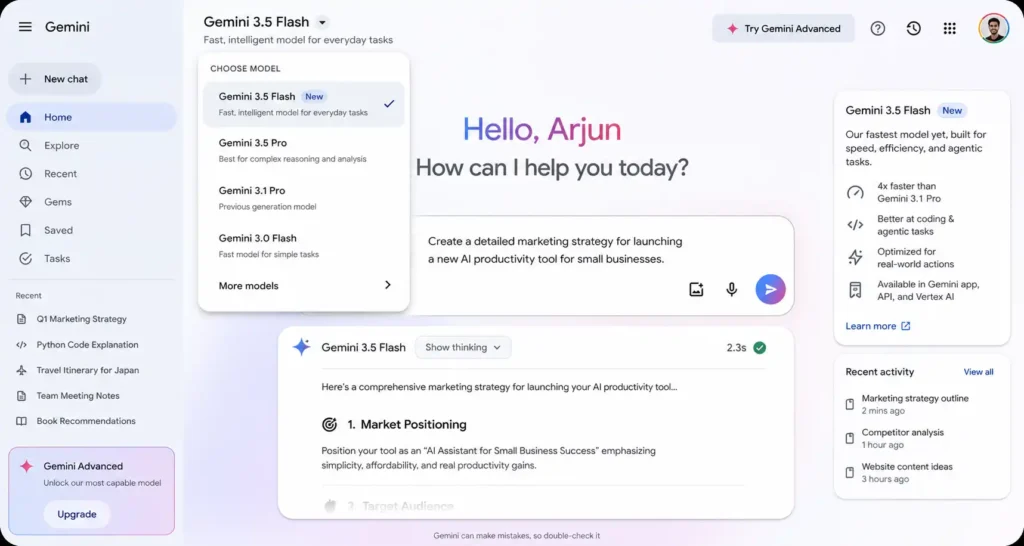
For years, the AI industry has operated on a simple hierarchy: Pro models are smarter, Flash models are faster. Google broke that assumption on May 19. Gemini 3.5 Flash doesn’t just outpace its predecessors — it outperforms the previous generation’s Pro tier on specific agentic execution and complex software development tasks, while running at roughly four times the speed of comparable frontier models.
That’s not a marketing claim. It’s a benchmark result. On Terminal-Bench 2.1, which measures performance on multi-step agentic coding and environment tracking, Gemini 3.5 Flash scored 76.2% — ahead of both Anthropic’s Claude Opus 4.7 and OpenAI’s GPT-5.5.
On the API side, Google replaced the experimental thinking_budget integer parameter with a cleaner thinking_level string enum, giving developers four explicit reasoning compute levels: minimal, low, medium (the new default), and high. It’s a small change with real practical significance — it means production teams can dial reasoning depth with precision rather than guessing at integer values.
Why It Matters
The speed-intelligence tradeoff has been the central constraint of deploying AI in production. Teams either accepted slower, smarter models or faster, dumber ones. Gemini 3.5 Flash makes that tradeoff significantly less painful.
Real-World Example
An engineering team running an overnight codebase migration can now deploy Gemini 3.5 Flash to handle multi-step debugging workflows in real time — things that previously required either a slower model or a human on call.
Potential Limitations
The model still trails Gemini 3.1 Pro on extreme long-context retrieval benchmarks (MRCR v2 at 128k tokens) and on highly specialized academic tasks. Pricing has also increased significantly — $1.50 per million input tokens and $9.00 per million output tokens, roughly three times the cost of legacy Gemini 3 Flash Previews. Teams migrating from preview IDs also need to update code, since the new string-based thinking_level parameter breaks backward compatibility with older integer-based configurations.
Impact on Developers
Immediate general availability inside Google Cloud Vertex AI and Google AI Studio means there’s no waiting list. The fixed model identifier gemini-3.5-flash supports stable production deployments without surprise version changes.
Impact on Businesses
Lower latency for complex workflows means more use cases become economically viable. Real-time agentic automation — document processing, customer service routing, complex scheduling — moves from experiment to standard practice.
As Sundar Pichai put it during the I/O keynote: “Gemini 3.5 delivers frontier intelligence for agents and coding, matching or beating the best models in the world on action-based tasks.”
2. Gemini 3.5 Pro: The Enterprise Workhorse
What Changed
Announced May 19 and scheduled for broad rollout in June 2026, Gemini 3.5 Pro is designed for the use cases where depth matters more than speed. It inherits the architectural improvements of the 3.5 generation while maintaining the massive context window and long-document understanding capabilities that Pro-tier models have always owned.
It’s fully integrated with Google Cloud Enterprise Agent Platform, which means it can maintain multi-turn context across long-running asynchronous execution loops — the kind of sessions that take hours, not seconds.
Why It Matters
Not everything can be fast. Synthesizing a decade of corporate financial disclosures, auditing a complex codebase, or reviewing a stack of legal case filings requires a model that can hold enormous context without degrading. Gemini 3.5 Pro is built for exactly that.
Real-World Example
A legal research firm using Gemini 3.5 Pro to process multi-decade case libraries can generate synthesis reports across thousands of documents — with citation-level accuracy — that would take a team of junior associates weeks.
Potential Limitations
Higher latency and cost compared to Flash make it a poor fit for real-time consumer applications. The enterprise audience is clearly defined; this isn’t a general-purpose tool.
Impact on Businesses
With its June 2026 rollout across Google Workspace and Vertex AI, Gemini 3.5 Pro positions Google to directly challenge Microsoft’s enterprise AI dominance particularly in industries like financial services, legal, and healthcare where long-context accuracy is non-negotiable.
3. Gemini Spark: The Always-On Assistant
What Changed
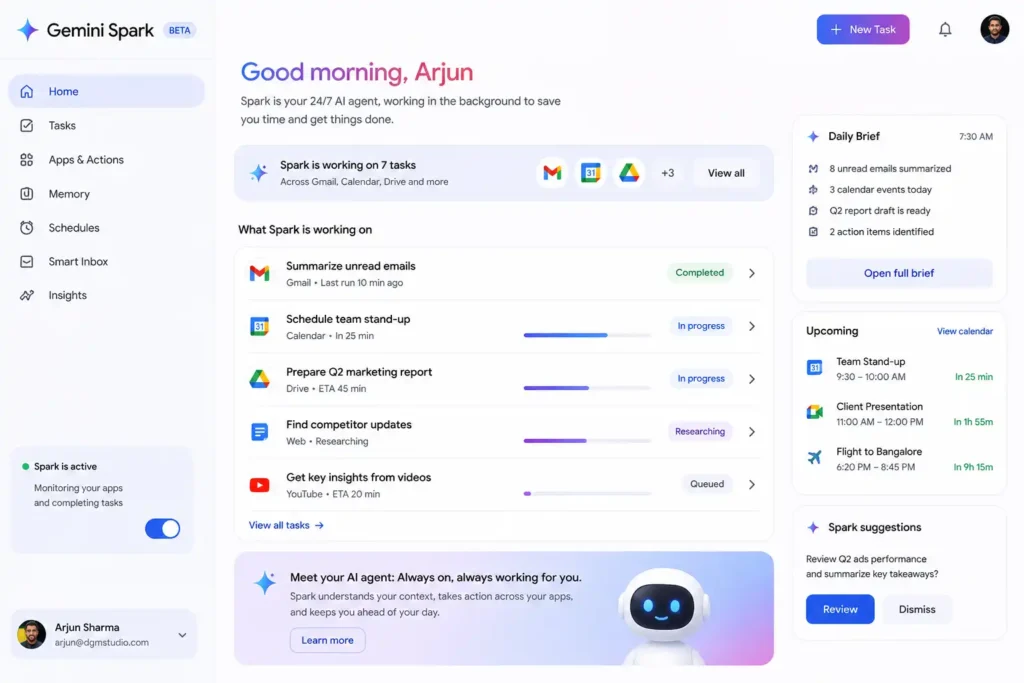
Gemini Spark is probably the most conceptually significant thing Google announced. It’s a 24/7 proactive personal assistant that runs in the background without waiting for a prompt. It monitors your inbox, drafts replies, coordinates scheduling across multiple calendars, and breaks down long-term personal goals into daily subtasks — all without you explicitly asking it to do any of it.
It hooks natively into Gmail, Calendar, Google Drive, and Android system processes through cross-app orchestrators.
Why It Matters
Every AI assistant built so far has been fundamentally reactive. You come to it. It waits for you. Spark inverts that model — and in doing so, shifts the paradigm from tool to companion. That may sound like marketing language, but the technical reality is substantive: an AI that monitors state continuously rather than responding to discrete prompts is a categorically different thing.
Real-World Example
You wake up Monday morning. Before you’ve opened your phone, Spark has already reviewed your unread emails from the weekend, drafted replies to the three that needed one, flagged a scheduling conflict between Tuesday’s meeting and your quarterly review, and surfaced a reminder about a deadline you set three weeks ago.
Potential Limitations
The privacy implications are significant. Spark requires deep, persistent access to personal data — Gmail, Calendar, Drive, location data, potentially more. It’s currently locked to US English during early access, available only to Google One AI Ultra subscribers at $100/month. International rollout will be complicated by regional privacy regulations, particularly GDPR in the European Union.
Impact on Search and Publishers
Users who rely on Spark for information discovery aren’t searching Google. They’re receiving curated intelligence. The implications for organic search traffic are real.
4. Gemini Omni: Video as a Conversation
What Changed
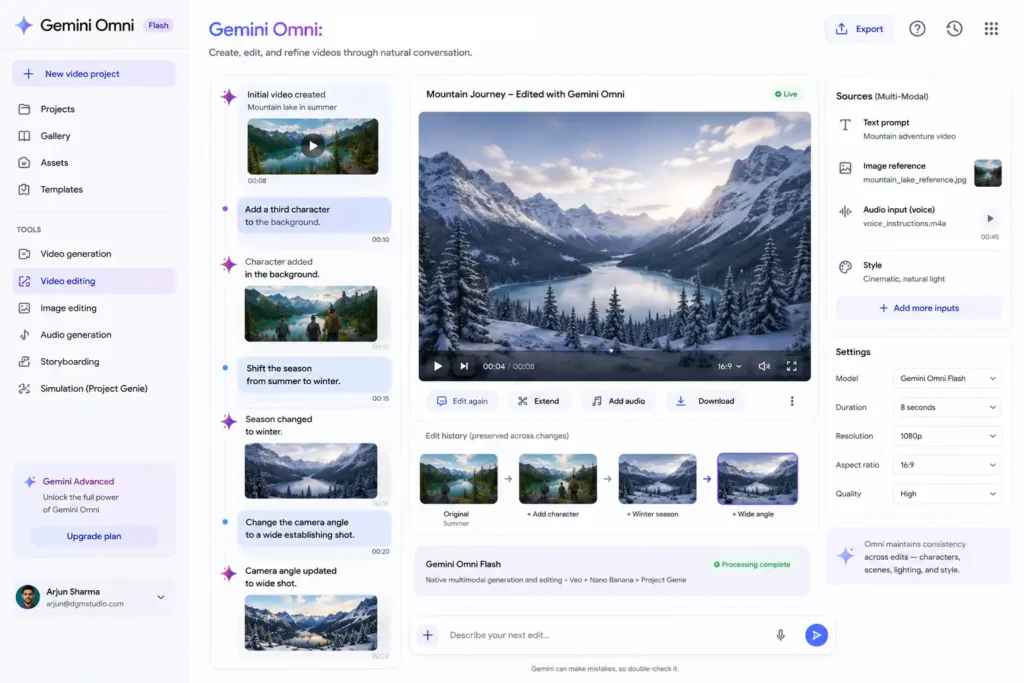
Gemini Omni is Google’s native multimodal generation and editing model — capable of blending text, images, audio, and video inputs to produce high-quality video content. The key technical breakthrough isn’t the generation itself; it’s the coherence. Omni maintains visual consistency across multi-turn editing sessions, preserving character appearance, environmental continuity, and physical plausibility across sequential prompt changes.
It integrates Google’s Veo video generation system, Nano Banana image editing, and Project Genie simulation into a single unified model, launching initially as Gemini Omni Flash.
Why It Matters
Video editing has historically required either professional expertise or acceptance of extremely limited creative control. Omni replaces the timeline scrubber with a conversation. “Add a third character to the background.” “Shift the season from summer to winter.” “Change the camera angle to a wide establishing shot.” Each command preserves previous changes rather than regenerating from scratch.
Real-World Example
A marketing director who needs five regional variants of a brand video can brief Omni conversationally — adjusting location aesthetics, weather, ambient elements — without touching editing software or briefing a production team.
Potential Limitations
Initial audio inputs are restricted to voice recordings; comprehensive multi-modal audio support comes later in the rollout. The quality ceiling on generated footage hasn’t been tested at scale in real production environments.
Impact on Developers and Creators
The barrier to video production drops significantly. What previously required Final Cut Pro expertise or a production budget now requires a text prompt and a subscription.
Creators interested in visual AI tools can also explore our guide on Best Free AI Image Generators Compared (2026), which covers the latest AI-powered content creation platforms.
5. Gemini Deep Think: Research-Grade Reasoning
What Changed
Deep Think is a specialized reasoning mode targeting complex scientific problems, competitive programming, and advanced mathematics. It’s accessible to Google AI Ultra subscribers and through an early access program in the Gemini API, activated by selecting the “Pro” model and setting Thinking Level to Deep Think.
The benchmark numbers are striking. On ARC-AGI-2 — the most demanding general reasoning benchmark currently in wide use — Deep Think scored 84.6%, verified independently by the ARC Prize Foundation. On Humanity’s Last Exam, a test specifically designed to challenge frontier models on obscure academic knowledge, it reached 48.4% without external tools. On the International Mathematical Olympiad 2025 problem set, it logged gold-medal level accuracy.
Why It Matters
These aren’t synthetic benchmarks. The IMO problems are solved by maybe a few hundred people on earth in any given year. A model that can work through them meaningfully is operating in genuinely novel intellectual territory.
Real-World Example
A materials science researcher can submit a pre-publication paper to Deep Think and receive a review that flags logical inconsistencies in the methodology — not keyword-level critiques, but structural reasoning errors that an expert reviewer might catch on a careful second read.
Potential Limitations
High computational overhead means strict usage quotas. Extended use at this reasoning depth burns through allocation credits quickly, making it impractical for high-volume applications.
Google’s research ambitions can also be seen in projects such as DiffusionGemma 2.6B A4B, a lightweight multimodal model designed for developers and researchers.
6. Gemini Live: Voice Meets the World Around You
What Changed
Gemini Live integrates real-time bidirectional voice interaction into standard Gemini chat views, powered by the Neural Expressive design framework. The experience blends text and voice seamlessly — users can switch modes without breaking conversational continuity.
The camera integration is particularly compelling. Users can stream their physical environment live to Gemini while talking, enabling commands that reference the real world in real time.
Why It Matters
The “show, don’t tell” dynamic opens use cases that text interfaces fundamentally can’t support. Standing in front of a piece of machinery you don’t recognize. Walking through a building you’re navigating for the first time. Evaluating a product on a store shelf.
Real-World Example
A field technician streams a broken industrial component to Gemini Live while describing the symptoms. Gemini identifies the part, cross-references documentation, and walks through a repair procedure — hands-free, in real time.
Potential Limitations
Continuous video and audio streaming requires high-speed mobile data. In areas with weak connectivity, the experience degrades meaningfully.
7. AI Mode in Google Search: The Search Engine Stops Being a Search Engine
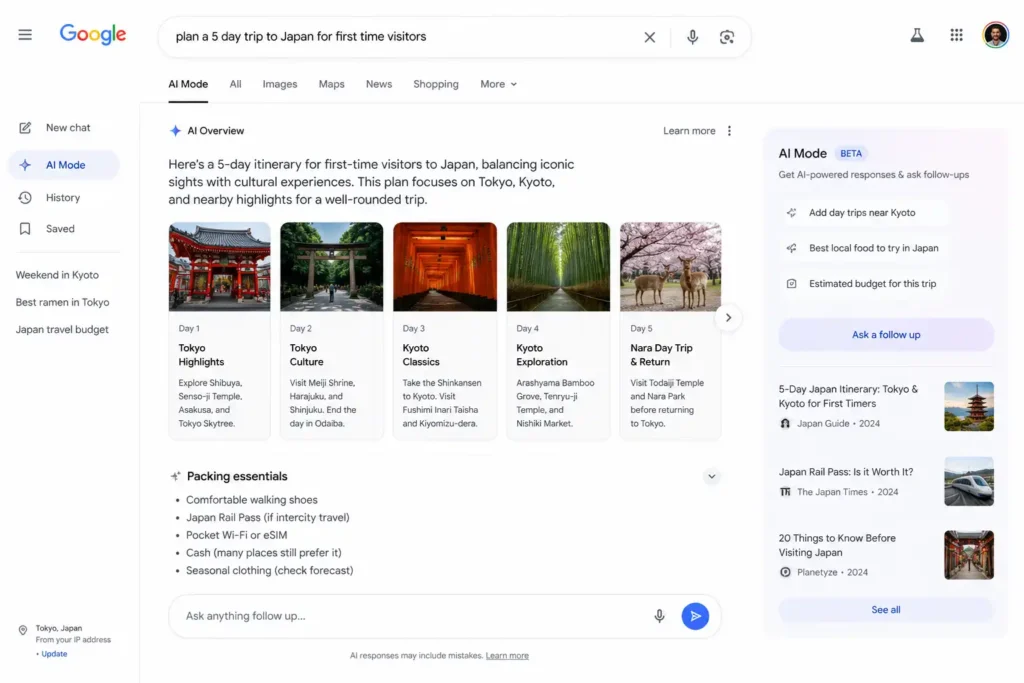
What Changed
Google Search AI Mode is now the global default for users worldwide. The classic search bar has been replaced by an expandable interface that accepts long, complex prompts and surfaces Gemini Live directly. Gemini 3.5 Flash generates custom generative UI components — dashboards, mini-apps, tailored visual interfaces — on the fly, directly on the results page.
Background Information Agents can now monitor topics indefinitely without requiring fresh queries. Set up a tracker for regional real estate listings, flight prices, or a sports tournament bracket, and it updates autonomously.
AI Mode crossed one billion monthly active users within a year of broad deployment. Twenty-five percent of all global Google searches now trigger an AI Overview, rising to 48% for informational queries.
Why It Matters
Search has been fundamentally rearchitected. The model is no longer “show the user links, let them click.” It’s now “understand the user’s intent, fulfill it directly.” For most queries, that means users never leave Google’s interface.
Real-World Example
A user researching mortgage options doesn’t get a list of ten lender websites. They get an interactive dashboard comparing rates, monthly payment calculators, and a persistent tracker that alerts them when rates in their target range become available.
Potential Limitations
Synthesizing multiple data points into a single generative UI can obscure original web sources and reduce transparency about where information originates.
How Gemini Is Changing Google Search Forever
The implications for web publishers and digital marketers are impossible to overstate.
For decades, Google’s relationship with the open web was essentially symbiotic. Publishers created content; Google indexed and surfaced it; users clicked through; publishers earned traffic and ad revenue. That relationship is breaking down.
Consider the flow. A user enters a complex multi-step query. AI Mode assembles a generative UI that answers the question directly. Background Information Agents monitor ongoing intent. Universal Cart handles any resulting purchase inside Google’s own interface. At no point in that journey does the user visit a publisher’s website. There’s no referral click. There’s no analytics session. There’s no revenue.
Early 2026 data shows organic click-through rates on AI Overview queries stabilized at 2.4% in February 2026, recovering from a record low of 0.61% during late 2025. The recovery is real but fragile. And it masks a more uncomfortable reality: the queries where AI Overviews appear are precisely the informational queries that historically generated the most organic traffic.
The citation overlap between AI-generated answers and top organic rankings has fallen to between 17% and 54%, depending on query type. That means search optimization is no longer primarily about ranking. An AI answer can draw from a source ranked 47th if that source contains a uniquely valuable data point the model couldn’t find elsewhere.
The implication for publishers is clear but counterintuitive. Generic, well-optimized content faces the harshest headwinds. Original research, proprietary datasets, unique expert perspectives — content that an LLM cannot recreate from surface-level materials — becomes more valuable, not less. The traffic model changes, but the content quality imperative intensifies.
For SEO practitioners, the opportunity lies in creating content structured for AI citation rather than keyword ranking. Dense factual specificity, clear methodology, attributable expertise — these are the new ranking signals.
8. Workspace Updates and the Daily Brief
What Changed
Google has deeply integrated Gemini across Workspace applications — Gmail, Docs, Drive, Vids — and introduced the Daily Brief: a personalized morning digest that learns your daily rhythms and delivers a structured overview of calendar priorities and key email action items before you’ve opened a single app.
Why It Matters
The average knowledge worker starts their day facing email overload, calendar conflicts, and unclear priorities. Daily Brief addresses all three simultaneously. More importantly, it proactively surfaces information rather than waiting for you to find it.
Real-World Example
Monday morning: before your first meeting, Daily Brief surfaces three emails requiring replies, flags a double-booking at 2pm, and notes that a project milestone deadline is three days away — all in a 30-second read.
Potential Limitations
The system depends on clean data. Users with disorganized Gmail folders or inconsistent calendar practices will find the overview less reliable. If your calendar is a mess, Daily Brief mirrors the mess back to you.
Small businesses adopting Gemini can combine these capabilities with tools featured in our guide to Best AI Tools for Small Businesses in 2026.
9. Ask YouTube: Querying the World’s Largest Video Library
What Changed
Ask YouTube is a conversational intelligence layer embedded directly in YouTube that allows viewers to query the actual content of videos — not just titles and descriptions, but the information contained within. It processes video frames and speech tracks simultaneously via Gemini’s multimodal understanding.
Why It Matters
YouTube contains an enormous volume of instructional and educational content that is effectively unsearchable because the information is spoken and visual rather than indexed text. Ask YouTube surfaces that content directly.
Real-World Example
Watching a four-hour conference talk, a researcher asks “What did the speaker say about tokenization efficiency at the 2:23 mark?” and receives an immediate, specific answer without scrubbing through the timeline.
Potential Limitations
Performance degrades on videos with low audio clarity, heavy background noise, or unstructured visual content. User-generated content with variable production quality will challenge the system’s accuracy.
10. Shopping AI and the Universal Cart: Google Becomes a Retailer
What Changed
Google’s Universal Cart — powered by Gemini and built on the Universal Commerce Protocol co-developed with Shopify — now executes autonomous, end-to-end purchase flows inside Google’s interface. It’s expanded from the US into the UK, Canada, and Australia. An AI agent monitors prices across merchants, consolidates items from different retailers into a single cart, and executes the order when a user-defined price target is reached.
Why It Matters
This is Google making a direct claim on the transactional layer of commerce that Amazon has owned for twenty years. If it works at scale, it changes the economics of e-commerce marketing fundamentally.
Real-World Example
A user adds a camera body, lens, and memory card to their Universal Cart from three different retailers. The agent monitors prices for two weeks and automatically executes the purchase when the total drops below their target budget.
Potential Limitations
The system requires merchant integration via the Universal Commerce Protocol. Smaller retailers without Shopify infrastructure or technical resources to integrate may be excluded from AI-driven purchase flows — potentially accelerating consolidation toward large platforms.
Impact on Search and Publishers
The SEO and referral traffic implications are severe. Google doesn’t just answer the research query — it completes the purchase. Brand websites become redundant for the bottom-of-funnel conversion that once justified the entire content marketing stack.
11. Developer Updates: Managed Agents and the Gemini API
What Changed
The Gemini API now supports Managed Agents — autonomous, tool-using agents that run inside isolated Linux sandboxes and can be spun up with a single API call. These environments retain exact application states and file structures across multi-turn sessions, enabling continuous development workflows without manually rebuilding context.
Native Android development support has also been added directly in Google AI Studio.
Why It Matters
The previous bottleneck in AI-assisted development wasn’t model capability — it was context management and environment persistence. Developers had to manually feed state back to models at each step. Managed Agents solve that.
Real-World Example
An engineer prompts a Managed Agent to prototype, test, and push an Android app to the Play Console test track. The agent handles the entire pipeline — write code, run tests, fix failures, submit build — without human intervention at each step.
Potential Limitations
Teams migrating from preview API versions need to update code for the new thinking_level string enum. The default medium setting may deliver less reasoning depth than teams expect if they were previously relying on higher integer values.
Developers evaluating Gemini’s coding capabilities should also read our analysis of AI Coding Assistants: Which One Is Best for Developers in 2026?
12. Google Antigravity 2.0: The Agent-First IDE
What Changed
Antigravity 2.0 is a standalone desktop application for macOS, Windows, and Linux built specifically for multi-agent development workflows. Its key innovation is Dynamic Subagents — a primary agent can spawn isolated sub-tasks without cluttering its main context window. Native live-voice transcription is built in. The platform supports background scheduled crons and parallel processing across multiple project folders.
Why It Matters
Context window exhaustion is one of the most persistent frustrations in AI-assisted development. Long projects accumulate state until the model starts losing track of earlier decisions. Dynamic Subagents address this structurally by offloading localized tasks to temporary isolated contexts.
Real-World Example
An engineering team orchestrates five subagents in parallel — one refactoring authentication services, one updating the API layer, one writing documentation, one running integration tests — while the primary agent monitors overall project coherence and resolves conflicts.
Potential Limitations
Extended usage requires the $100/month AI Ultra subscription. API quota consumption is high; large parallel workflows can hit rate limits quickly.
13. Android XR: Ambient Intelligence in the Physical World
What Changed
Gemini’s background agent infrastructure is now integrated directly into extended reality smart glasses architectures through Android XR — scaled through major hardware OEM partnerships beyond Google’s internal Pixel lines. The system responds to environmental conditions without requiring manual phone interaction.
Why It Matters
The smartphone is still, fundamentally, a device you look at. Smart glasses with ambient AI create an interface you inhabit. Context-aware notifications, hands-free language translation, workspace data overlaid on the physical world — these aren’t novelties; for field workers, warehouse operators, surgeons, and engineers, they’re practical tools.
Real-World Example
A warehouse worker walks through inventory aisles while smart glasses display real-time stock levels, highlight items to pull for a pending order, and flag discrepancies between physical stock and system records — all without touching a device.
Potential Limitations
Hardware adoption faces real friction. Thermal management and battery life remain challenging at the required performance levels. Consumer acceptance of always-on ambient AI in eyewear form factor is still unproven at scale.
14. NotebookLM and Gemini: The Research Workspace Rebuilt
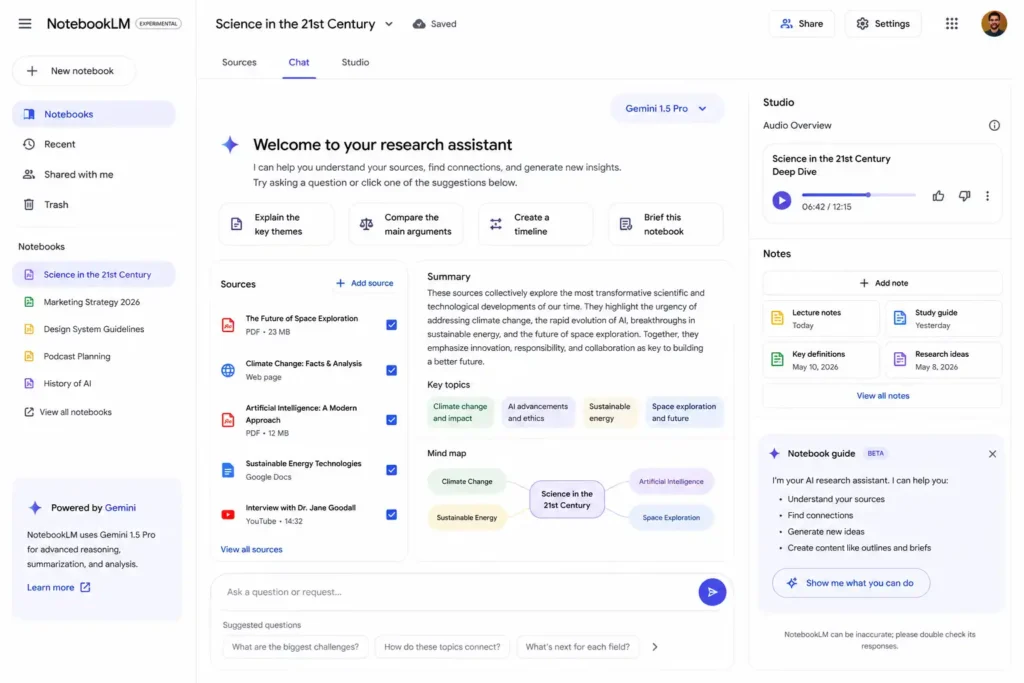
What Changed
NotebookLM has been fully merged with Gemini to form a unified research workspace. The updated system features Notebook Memory, automatic Google Drive synchronization, and a one-million-token context window that blends private knowledge stores with real-time web search through a Hybrid Search architecture. Cloud-based code execution sandboxes are built in.
Why It Matters
Knowledge workers have always needed to combine private documents (confidential reports, proprietary research, internal data) with public information (current news, academic literature, industry data). NotebookLM’s integration with Gemini enables that combination in a secure, persistent environment.
Real-World Example
A policy analyst imports five years of internal research memos and congressional hearing transcripts. NotebookLM generates an AI Video Overview of the complete body of work, exports a structured briefing to PowerPoint, and builds an interactive Q&A layer for colleagues who need to query the material without reading all of it.
Potential Limitations
Processing very large multi-document folders runs into usage limits depending on subscription tier. Users at the free tier will hit ceilings quickly on substantial research projects.
Impact on Search and Publishers
Users conducting deep research inside NotebookLM are not surfacing to Google Search for follow-up queries. The research loop becomes self-contained within a private workspace.
15. Jules and the Agentic Future: AI That Works While You Sleep
What Changed
Jules is an asynchronous software development agent designed for long-horizon tasks that unfold over hours, not seconds. It’s powered by a task manager that shares unified state between planning and execution models, allowing for graceful error recovery without losing progress. Users can start a deep task, shut their computer, and receive a system notification when the completed output is ready.
Deep Research loops also benefit from this architecture — Gemini can compile extensive multi-source reports without requiring an active browser session.
Why It Matters
The distinction between synchronous and asynchronous AI is more significant than it sounds. Synchronous AI requires you to wait. Asynchronous AI — properly implemented — is closer to hiring a competent colleague than using a tool. The work happens independently; you review results.
Real-World Example
A developer assigns Jules to run a multi-hour code testing pipeline across a complex backend service, logs off for the evening, and wakes to a detailed report covering test results, identified failures, proposed fixes, and a summary of architectural concerns worth reviewing.
Potential Limitations
Premium access requires higher subscription tiers with closely monitored allocation credits. Heavy users will need to manage budgets carefully.
Gemini vs. ChatGPT in 2026
The AI landscape in 2026 is genuinely competitive across multiple dimensions. Here’s an honest comparison of where each platform leads.
| Capability | Gemini | ChatGPT (GPT-5.5) |
|---|---|---|
| Reasoning | Deep Think leads on IMO, ARC-AGI-2 benchmarks | Strong on o1/o3 reasoning chains |
| Coding | 3.5 Flash leads on Terminal-Bench 2.1 agentic tasks | Competitive on standard coding benchmarks |
| Research | NotebookLM + 1M context window is best-in-class | Deep Research strong but smaller context |
| Agents | Spark, Jules, Managed Agents — most developed agentic ecosystem | Custom GPTs, operator tools — functional but more constrained |
| Search Integration | Native, global default, billions of users | Bing integration — functional but minority market share |
| Video Generation | Gemini Omni is the most capable multi-turn video editor available | Sora is strong for generation but lacks conversational editing |
| Productivity | Deep Workspace integration across Google ecosystem | Strong via Microsoft Copilot / Office 365 |
| Enterprise Use | Vertex AI + Workspace — competitive | Azure OpenAI — strong in Microsoft-centric organizations |
The honest summary: Gemini leads on search integration, agentic systems, and video editing. ChatGPT leads on brand recognition and developer mindshare. The enterprise competition between Google Cloud/Workspace and Microsoft Azure/Office is close and will likely be decided by existing platform loyalty rather than model performance. Google’s latest Gemini announcements arrive amid intense competition from frontier AI models, including recent releases such as MiniMax M3.
Expert Analysis
Google’s Strategic Position
The central insight in Google’s 2026 strategy is that model performance alone isn’t a durable competitive advantage. Every model improves every year. The real moat is distribution — the billions of active users already embedded in Google’s ecosystem who will receive agentic AI features without downloading anything, changing any behavior, or making any purchasing decision.
As analysts at Gizmodo observed after I/O, the integration of Gemini’s background agents directly into the Android OS layer creates a deployment surface that infrastructure-independent players like OpenAI or Anthropic cannot easily replicate. Over two billion active Android devices become immediate endpoints for background agents automatically. That’s not a product launch. That’s a platform upgrade.
The OpenAI Competition
The competition between Google and OpenAI in 2026 is less a race between models and more a race between platform strategies. OpenAI is building a standalone AI ecosystem — custom GPTs, the Operator framework, growing API adoption. Google is embedding AI into infrastructure it already owns. Both strategies can succeed; they’re targeting different parts of the market.
Where it gets genuinely interesting is in enterprise. Microsoft’s Copilot integration into Office 365 gave enterprise teams a frictionless on-ramp to AI that didn’t require IT procurement decisions. Google’s equivalent is Workspace with Gemini built in. The competition will play out org by org over the next several years.
The Future of AI Assistants
The most important question 2026 raises isn’t which model is smartest. It’s what kind of relationship people want with AI systems. Google’s bet — on ambient, proactive, always-on agents — assumes users will accept and value AI that acts without explicit permission for each action. That assumption deserves scrutiny.
The history of technology is littered with features that were technically impressive and behaviorally uncomfortable. Proactive notifications, location tracking, behavioral targeting — each has faced backlash that required meaningful product adjustment. Gemini Spark, in particular, requires a level of personal data access that will provoke real privacy debates.
Agentic Systems: The Risks Worth Watching
Autonomous agents that execute tasks without step-by-step human confirmation are useful precisely because they reduce friction. But they also reduce oversight. An agent that monitors your inbox and drafts replies can also make mistakes — send the wrong draft, misinterpret a nuanced professional situation, or expose sensitive information in an auto-generated summary. The error rate that’s acceptable in a search result is not acceptable in an email sent on your behalf.
Google’s engineering teams know this. The guardrails around Spark’s early access rollout — US-only, English-only, Ultra subscribers only — suggest careful, staged deployment rather than a ship-and-iterate approach. Whether those guardrails hold as the feature scales globally is worth watching closely.
Our Analysis: What Google’s Gemini Strategy Means for the Future of AI
Looking beyond individual feature announcements, Google’s 2026 Gemini roadmap reveals a much larger strategy. The company is no longer competing solely in the chatbot market. Instead, it is embedding AI into products already used by billions of people every day.
The most significant development is not Gemini 3.5 Flash or Gemini Omni. It is the combination of AI Mode, Gemini Spark, and Google’s deep integration across Search, Android, Workspace, and YouTube. Together, these products create an AI ecosystem that competitors may find difficult to replicate because Google controls both the software and distribution channels.
For publishers, marketers, and SEO professionals, this shift introduces new challenges. As AI-generated answers become more comprehensive, generic informational content may receive less visibility. The websites most likely to succeed will be those producing original research, expert analysis, and unique insights that AI systems cannot easily recreate.
For businesses, Gemini’s agentic capabilities could significantly reduce repetitive work, automate workflows, and improve decision-making processes. However, organizations will need clear governance policies as AI systems gain more autonomy.
The next phase of the AI race will likely be defined not by which company has the smartest model, but by which company can integrate AI most effectively into everyday workflows. Based on its 2026 announcements, Google appears determined to lead that transition.
Key Takeaways
- Google’s 2026 strategy is about distribution, not just models. Android XR, Search AI Mode, and Workspace integration put Gemini in front of billions of users without requiring behavioral change.
- Gemini 3.5 Flash breaks the speed-intelligence tradeoff by outperforming previous Pro-tier models while running four times faster. This makes agentic production deployments economically viable at scale.
- Gemini Spark is the most conceptually significant launch. An always-on background agent changes the relationship between user and AI more profoundly than any new model capability.
- Google Search is no longer primarily a directory. AI Mode makes Google a destination that fulfills research and purchase journeys end-to-end. Publishers who built on referral traffic need new strategies.
- Video editing becomes conversational. Gemini Omni’s multi-turn consistency is genuinely novel — not just generating video, but editing existing footage through natural dialogue.
- Deep Think’s benchmark scores on ARC-AGI-2 (84.6%) and the IMO are meaningful. This level of reasoning represents a real advance in what AI can do in scientific and academic contexts.
- The agentic AI architecture (Jules, Managed Agents, Antigravity 2.0) solves real development problems — particularly context management and asynchronous execution for long-horizon tasks.
- Universal Cart fundamentally threatens e-commerce referral economics. If Google completes purchase journeys natively, brand websites lose the conversion layer that justified content marketing investment.
- NotebookLM + Gemini is best-in-class for knowledge workers who need to combine private documents with live web research in a secure, persistent environment.
- Privacy will be the central tension in the Agentic Era. Features that require persistent access to personal data will face meaningful regulatory and public scrutiny, particularly outside the US.
Frequently Asked Questions
1. What is Google Gemini’s biggest new feature in 2026? The most structurally significant update is the shift to the Agentic Era — particularly Gemini Spark (a 24/7 background agent) and AI Mode as the global default for Google Search. Together, they move Gemini from a reactive chatbot to an ambient intelligence layer embedded across Google’s entire ecosystem.
2. How does Gemini 3.5 Flash compare to GPT-5.5? On agentic coding benchmarks like Terminal-Bench 2.1, Gemini 3.5 Flash scores 76.2% — ahead of GPT-5.5 and Claude Opus 4.7. On standard knowledge and reasoning tasks, performance is more competitive. For high-volume agentic production workloads, Flash has a significant speed and pricing advantage.
3. Is Gemini Spark available to everyone? Not yet. During early access, Gemini Spark is limited to US users, English language, and requires a Google One AI Ultra subscription at $100/month. International rollout will follow pending regulatory review.
4. What is Gemini Omni and how is it different from Sora? Gemini Omni is a native multimodal video generation and editing model. The key differentiator from Sora and other text-to-video tools is multi-turn editing consistency — you can make sequential conversational edits to existing footage while preserving visual continuity across sessions.
5. How does AI Mode in Google Search affect SEO? Significantly. Twenty-five percent of all Google searches now trigger an AI Overview. Citation overlap between AI answers and top organic rankings has fallen to 17–54%, meaning traditional keyword ranking is less predictive of AI citation. The strategic response is creating original, deeply sourced content that AI cannot reconstruct from surface-level materials.
6. What is Google Antigravity 2.0? A standalone desktop development platform (macOS, Windows, Linux) designed for multi-agent workflows. Its core innovation — Dynamic Subagents — lets a primary agent offload isolated tasks to temporary sub-contexts, solving context window exhaustion in long development sessions. Requires AI Ultra subscription for extended use.
7. What benchmarks did Gemini Deep Think achieve? On ARC-AGI-2: 84.6% (verified by ARC Prize Foundation). On Humanity’s Last Exam: 48.4% without external tools. On Codeforces competitive programming: Elo 3455. Gold-medal level performance on International Mathematical Olympiad 2025 problems.
8. What is NotebookLM’s context window after the Gemini integration? One million tokens, with automatic Google Drive sync, Hybrid Search combining private documents with live web research, and built-in code execution sandboxes.
9. How does Universal Cart affect online retailers? It potentially disintermediates brand websites from the purchase journey. Transactions are completed inside Google’s interface; no referral click, no analytics session, no direct relationship between buyer and retailer. Merchants need to integrate via the Universal Commerce Protocol (co-developed with Shopify) to participate.
10. When is Gemini 3.5 Pro available? Gemini 3.5 Pro was announced May 19, 2026, and is rolling out broadly in June 2026 across Google Workspace and Vertex AI. It’s designed for enterprise-grade reasoning, long-context processing, and deep analytical workloads.
Sources and References
- Google Official Blog: “The latest AI news we announced in May 2026” | https://blog.google/innovation-and-ai/technology/ai/google-ai-updates-may-2026/
- Google DeepMind Blog: “Introducing Gemini Omni” | https://blog.google/innovation-and-ai/models-and-research/gemini-models/gemini-omni/
- Google Official Developer Hub: “Building the agentic future: Developer highlights from I/O 2026” | https://blog.google/innovation-and-ai/technology/developers-tools/google-io-2026-developer-highlights/
- Google Antigravity Engineering Portal: “Introducing Google Antigravity 2.0” | https://antigravity.google/blog/introducing-google-antigravity-2-0
- Google Cloud Blog: “I/O ’26 news for agent developers on Google Cloud” | https://cloud.google.com/blog/topics/developers-practitioners/io26-news-for-agent-developers-on-google-cloud
- Google Gemini Product Overview: “Gemini Deep Research & Workspace Hubs” | https://gemini.google/overview/deep-research/ & https://gemini.google/about/
- Google Research Announcements: “Gemini 3 Deep Think: Advancing science, research and engineering” | https://blog.google/innovation-and-ai/models-and-research/gemini-models/gemini-3-deep-think/
- Technology & Analytics Insights: Modo25 & Lumar SEO Industry Reports (May 2026 Analytics Reviews) | https://modo25.com/blog/news-insights/latest-news/google-i-o-2026-the-day-search-stopped-being-a-search-engine/ & https://www.lumar.io/blog/industry-news/seo-ai-search-industry-news-may-2026-google-io-core-update-ai-mode-more/
- Developer Ecosystem Reviews: Build Fast with AI technical deep dives (May 2026) | https://www.buildfastwithai.com/blogs/google-io-2026-gemini-3-5-flash-announcements
- Gizmodo / AI Weekly Market Analysis: “Google Launches Gemini Agents and Android XR at I/O 2026” | https://aiweekly.co/alerts/google-launches-gemini-agents-and-android-xr-at-io-2026
Technology Perspective
Technology continues to transform industries through artificial intelligence, cloud computing, automation, cybersecurity, digital platforms, and data-driven decision making. As organizations increasingly adopt digital solutions, understanding emerging technologies becomes essential for businesses, professionals, and consumers. DGM News regularly covers these developments through expert analysis, technology news, and educational resources.
Innovation Outlook
Rapid advances in artificial intelligence, automation, machine learning, cloud infrastructure, and digital transformation continue reshaping global industries. Monitoring these developments helps organizations adapt to changing technologies, improve efficiency, and prepare for future innovation.
Did you know?
Artificial Intelligence is expected to influence nearly every major industry over the coming decade, from healthcare and finance to transportation, manufacturing, education, and entertainment.
AI, Machine Learning, Deep Learning and Generative AI Explained
Google AI Updates
About DGM News
DGM News is an independent digital publication delivering the latest Technology News, AI News, and FinTech News. We provide expert insights on startups, innovation, cybersecurity, software, business, gadgets, cloud computing, artificial intelligence, and emerging technologies. Our mission is to publish informative, accurate, and regularly updated content that helps readers stay informed in today's rapidly evolving digital landscape.
Since our editorial focus includes technology, artificial intelligence, and financial technology, we continuously expand our coverage as new innovations emerge.
Editorial Standards
Every article published on DGM News undergoes editorial review before publication. We prioritize factual accuracy, clarity, transparency, and reader value while following responsible digital publishing practices.
Research Methodology
Our editorial team researches publicly available information from official announcements, technical documentation, research publications, developer resources, reputable industry reports, and trusted public sources whenever applicable. Information is reviewed to improve clarity and accuracy before publication.
Fact-Checking Policy
We make reasonable efforts to verify factual information before publishing. Articles are reviewed for accuracy, consistency, and relevance. If significant developments occur after publication, content may be revised to reflect updated information.
Update Policy
Technology evolves rapidly. Articles may be reviewed and updated periodically to reflect software releases, AI developments, security advisories, regulatory updates, product launches, and other important industry changes.
Source Verification
Whenever possible, DGM News reviews information using official company announcements, technical documentation, research publications, government resources, publicly available reports, and reputable industry references before updating articles.
Editorial Independence
DGM News maintains editorial independence in all publishing decisions. Editorial content is produced independently and is intended to provide balanced, informative, and reader-focused coverage without influence from advertisers or commercial partnerships.
AI Usage Disclosure
Artificial intelligence tools may assist with research organization, grammar improvement, formatting, or editorial workflows. Every article is reviewed by human editors before publication to help maintain quality, clarity, and factual accuracy.
Corrections Policy
Accuracy is important to us. If readers identify outdated information or factual inaccuracies, they are encouraged to contact our editorial team. Verified corrections are reviewed and incorporated whenever appropriate.
Reader Feedback
Reader feedback helps improve our journalism. We welcome suggestions, corrections, and constructive feedback through our Contact page to continuously improve the quality of our reporting.
Last Editorial Review
This article follows the DGM News editorial review process and may be updated periodically as new information becomes available.
Why Trust DGM News?
DGM News is committed to publishing technology journalism that emphasizes accuracy, transparency, editorial independence, and regularly updated information. Our editorial process is designed to provide readers with reliable coverage of technology, AI, fintech, startups, and digital innovation.
DGM News Resources
Topics We Cover
Artificial Intelligence • AI Tools • Machine Learning • FinTech • Cybersecurity • Cloud Computing • Programming • Software Development • Gadgets • Mobile Technology • Business Technology • Startups • Digital Marketing • Blockchain • Cryptocurrency • Science • Innovation • Consumer Technology • Enterprise Technology • Automation
