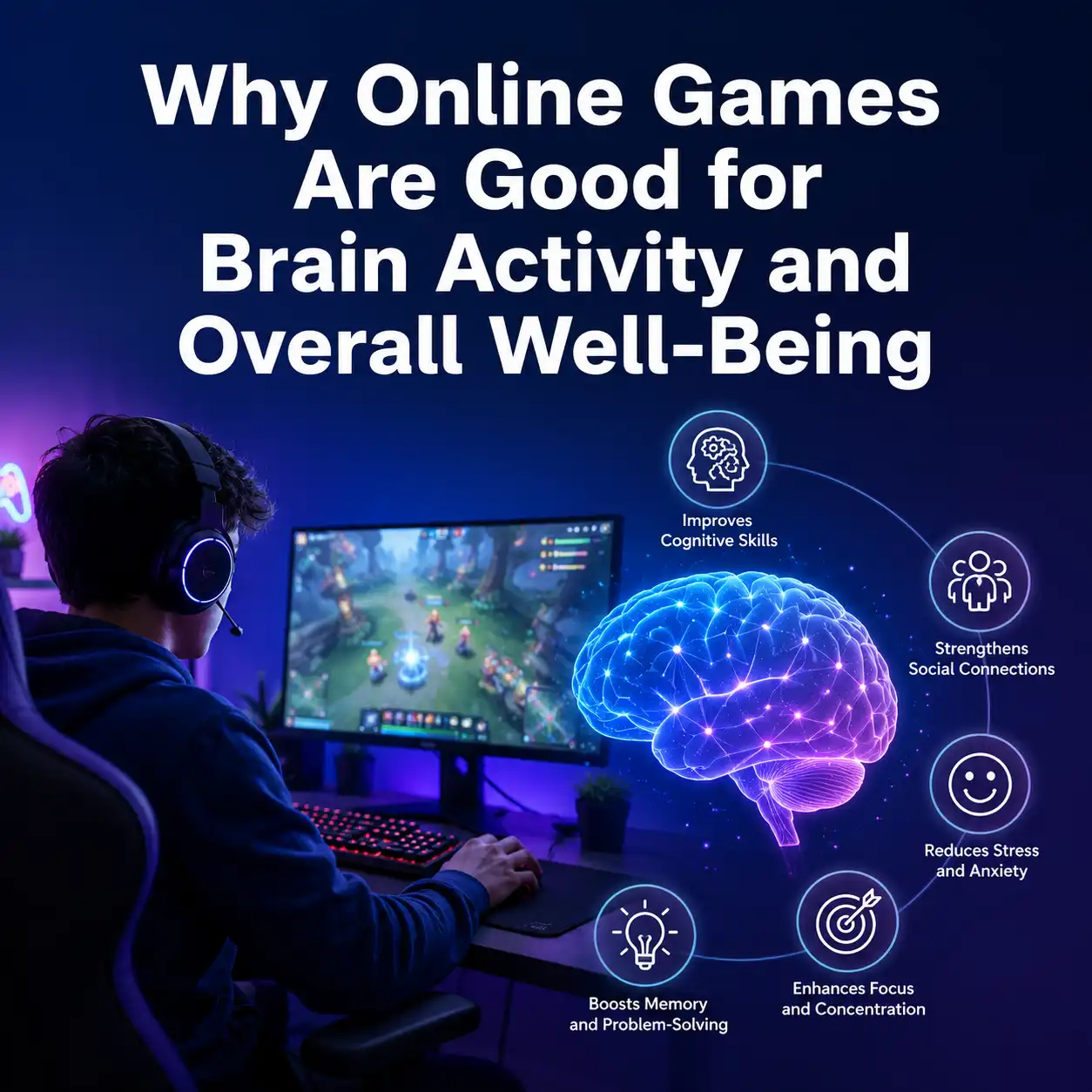
Online games have become an important part of modern digital entertainment. People play them to relax, compete, communicate, and challenge themselves in a dynamic environment. Although gaming is sometimes seen as a simple way to pass the time, a more balanced view shows that online games can support brain activity, emotional well-being, and social interaction when played responsibly.
- Online Games Keep the Brain Active
- Gaming Improves Problem-Solving Skills
- Online Games Support Memory and Focus
- Games Develop Mental Flexibility
- Multiplayer Games Improve Social Skills
- Online Games Can Help Reduce Stress
- Games Encourage Motivation and Persistence
- Technology Makes Online Gaming More Engaging
- Balance Is Important
- Conclusion
Unlike passive entertainment, online games require active participation. Players need to think, react, analyze situations, and make decisions in real time. This constant involvement keeps the brain engaged and can help develop useful cognitive skills.
Online Games Keep the Brain Active
One of the main benefits of online games is that they stimulate different mental processes at the same time. Many games require attention, memory, quick reactions, and strategic thinking. Players often need to follow rules, track progress, respond to changes, and adapt their decisions depending on the situation.
Online games can support:
- Focus and concentration
- Memory
- Problem-solving
- Decision-making
- Reaction speed
- Multitasking
- Hand-eye coordination
For example, fast-paced games train players to notice details and respond quickly. Strategy games encourage planning and risk assessment. Card-based and probability-driven games require logic, patience, and the ability to make decisions with limited information.
This active mental engagement helps keep the brain flexible and alert.
Gaming Improves Problem-Solving Skills
Online games often place players in situations where they need to find solutions quickly. Some challenges are simple, while others require planning, experimentation, and strategic thinking.
To succeed, players must evaluate options, learn from mistakes, and adjust their approach. This process naturally strengthens problem-solving skills. A player may need to decide which action is safest, which strategy has the best chance of success, or how to recover after an unsuccessful move.
These abilities can be useful beyond gaming. The habit of analyzing situations, adapting to change, and making decisions under pressure can support everyday thinking, learning, and professional tasks.
Online Games Support Memory and Focus
Many online games require players to remember rules, combinations, maps, patterns, opponents’ behavior, or previous actions. This repeated use of memory can help strengthen short-term and working memory.
Focus is equally important. In competitive or strategic games, even a small distraction can influence the result. Players need to stay attentive, follow several elements at once, and react when conditions change.
Poker-inspired and card-based games are good examples of this. They combine concentration, probability, observation, and risk management. These mechanics keep the mind actively involved and encourage players to think carefully before making decisions.
Games Develop Mental Flexibility
Mental flexibility is the ability to adapt to new information and change strategy when needed. Online games are especially effective in training this skill because they are rarely predictable.
A player may start with one plan, but the situation can change quickly. An opponent may act unexpectedly, new conditions may appear, or the game may require a different approach. To continue successfully, the player must adapt.
This helps train the brain to compare options, respond to uncertainty, and switch between different tasks. In real life, mental flexibility is useful for work, communication, learning, and decision-making.
Multiplayer Games Improve Social Skills
Online games are often social experiences. Multiplayer formats allow people from different countries and backgrounds to communicate, cooperate, and compete in real time.
Players may need to discuss tactics, support teammates, divide roles, or solve problems together. This can help develop communication, teamwork, leadership, patience, and emotional control.
For many people, gaming communities become meaningful social spaces. They offer a sense of belonging and create opportunities to connect with others who share similar interests.
Online Games Can Help Reduce Stress
Gaming can also support emotional well-being. After a busy or stressful day, online games can help people relax, shift attention, and enjoy a sense of progress or achievement.
Immersive gameplay allows players to focus on the present moment instead of daily pressure. Casual games can help with relaxation, while strategy and competitive games can provide excitement, motivation, and intellectual satisfaction.
When played in moderation, online games can become part of a healthy routine for relaxation and emotional balance.
Games Encourage Motivation and Persistence
Another positive aspect of online gaming is that it teaches persistence. Players often fail before they succeed. They try, make mistakes, improve, and continue moving forward.
Games usually provide clear goals, feedback, and rewards. This structure motivates players to improve their skills and continue learning. Over time, this can support patience, resilience, and the ability to analyze mistakes constructively.
Technology Makes Online Gaming More Engaging
Modern online games are becoming more advanced thanks to better design, real-time multiplayer systems, smoother interfaces, and smarter engagement mechanics. These technologies make games more interactive, accessible, and mentally stimulating.
Companies that develop gaming platforms and products play an important role in this progress. For example, poker software solutions help create engaging online poker experiences that combine technology, interaction, and strategic gameplay.
As gaming continues to evolve, it becomes more than entertainment. Similar mechanics are now used in education, training, fitness, and productivity tools because interactive formats can increase motivation and improve engagement.
Balance Is Important
Although online games can offer many benefits, moderation is essential. Excessive gaming may negatively affect sleep, productivity, physical activity, and offline relationships.
Healthy gaming habits include taking breaks, managing screen time, staying physically active, maintaining real-life communication, and prioritizing rest.
Online games are most beneficial when they are part of a balanced lifestyle.
Conclusion
Online games can be good for brain activity and overall well-being when played responsibly. They stimulate attention, memory, problem-solving, strategic thinking, reaction speed, and mental flexibility. They can also support social interaction, reduce stress, and encourage persistence.
Modern online games require players to think, adapt, communicate, and make decisions in changing situations. This makes them active and mentally engaging experiences rather than simple entertainment.
With the right balance, online gaming can become a valuable activity that supports cognitive development, emotional relaxation, and social connection.