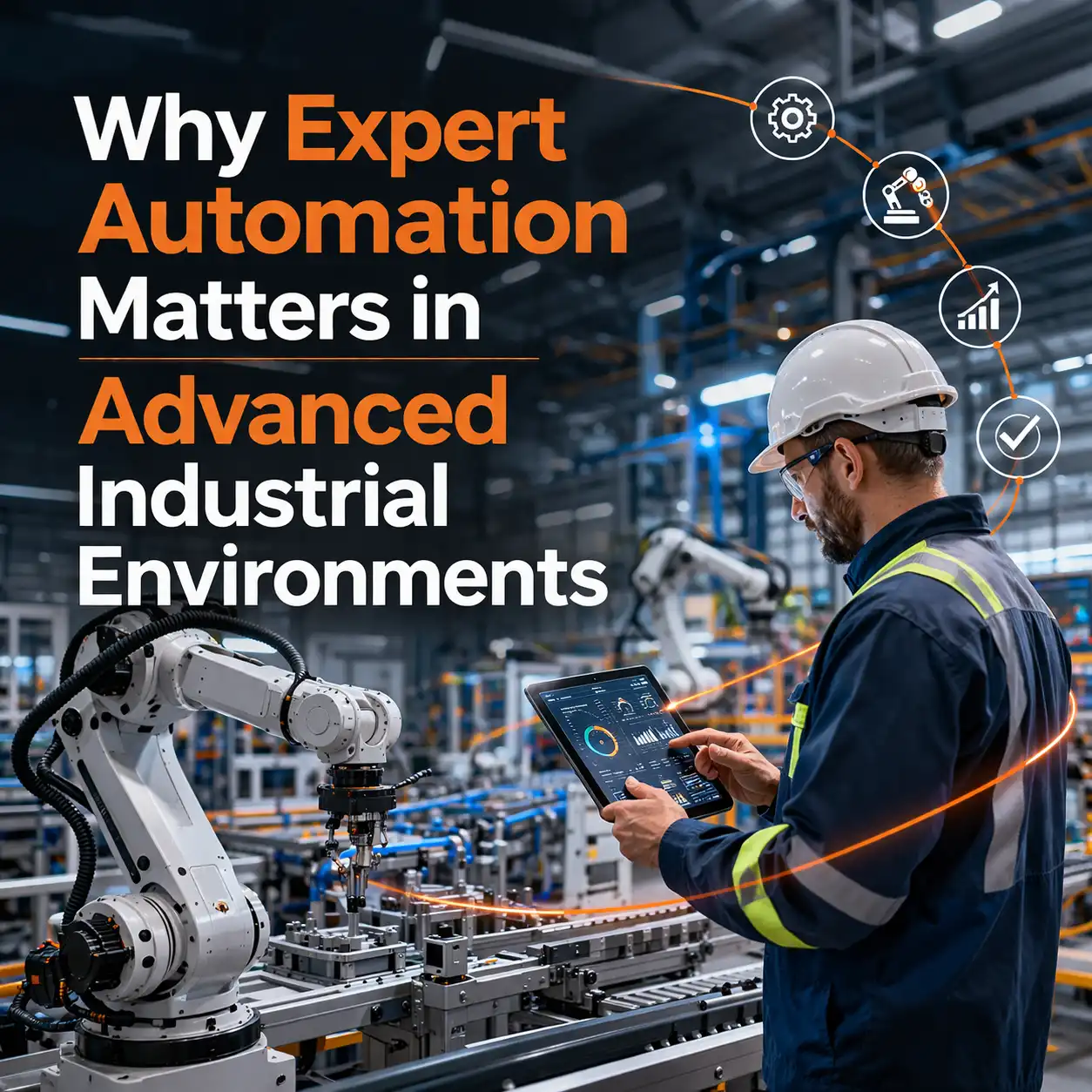
In the modern industrial market, the transition from manual labor to basic mechanical assistance was only the first step. Today, the global standard has shifted toward expert automation. This involves a sophisticated integration of high-level software, robotics, and real-time data analytics.
In advanced industrial environments, where the cost of a single minute of downtime can reach thousands of dollars, these expert systems provide the precision and reliability necessary to remain competitive.
Read on to discover how expert automation transforms operational reliability and long-term profitability.
Navigating High-complexity Workflows
Advanced industrial settings, such as semiconductor fabrication or aerospace assembly, involve hundreds of interconnected variables. Traditional automation often follows a rigid or linear script, but expert automation utilizes advanced logic to adapt to shifting conditions.
For instance, in a high-precision chemical plant, sensors do more than just monitor temperature. They feed data into a central logic controller that adjusts flow rates, pressure, and cooling systems simultaneously to maintain a perfect equilibrium. This level of synchronization ensures that complex workflows remain stable even when external factors fluctuate.
Eliminating the Hidden Costs of Human Error
While human intuition is invaluable for creative problem-solving, it is a liability in repetitive and high-precision tasks. In industries like pharmaceuticals, a deviation of a fraction of a milligram can ruin an entire batch.
Expert automation systems provide a level of repeatability that is physically impossible for a human operator to sustain over an entire shift. By removing the risk of fatigue-related oversight, businesses eliminate the hidden costs associated with product recalls, material waste, and inconsistent quality across different production cycles.
Real-time Data and Predictive Intelligence
One of the most transformative aspects of expert automation is the ability to turn a factory into a data-generating asset. These systems utilize the Industrial Internet of Things (IIoT) to monitor the health of every motor, belt, and sensor in the facility.
Instead of waiting for a machine to break, expert systems identify patterns, such as a slight increase in vibration or power consumption, that signal an imminent failure. This allows for predictive maintenance, where repairs are performed during scheduled breaks rather than during peak production hours. This proactive approach significantly boosts total throughput and extends the lifecycle of expensive capital equipment.
Safety and Scalability
Safety is a non-negotiable priority in sectors like mining, nuclear power, and heavy chemical processing. Expert automation preserves human life by handling the most dangerous tasks. Robots equipped with advanced vision systems can perform inspections in high-radiation zones or handle toxic materials with zero risk to personnel.
Furthermore, these platforms are built on modular architectures. Unlike legacy systems that require a complete overhaul for minor changes, these advanced solutions allow for seamless integration of new robotics or software modules. This flexibility ensures that an initial investment continues to provide value as the business evolves.
Building a Strong Foundation for Reliable Automation
The successful implementation of expert automation depends heavily on the quality of the underlying hardware and software. Partnering with reputable electric brands is essential because these manufacturers offer proven track records of durability and comprehensive technical support.
Established brands invest heavily in research and development to ensure their products remain compatible with evolving industry standards. When a business chooses a recognized leader in the automation space, they gain access to extensive documentation, certified training, and a reliable supply chain for replacement parts. Choosing an unproven or low-cost provider may save money initially. Still, it often leads to higher long-term costs due to frequent system failures and the eventual need for a premature system replacement.
Ultimately, expert automation is about more than just speed. It is about control. In an era of volatile global supply chains, the ability to guarantee a specific quality and quantity of output gives an organization a distinct edge. It transforms a production facility from a series of isolated machines into a single, cohesive, and intelligent organism.