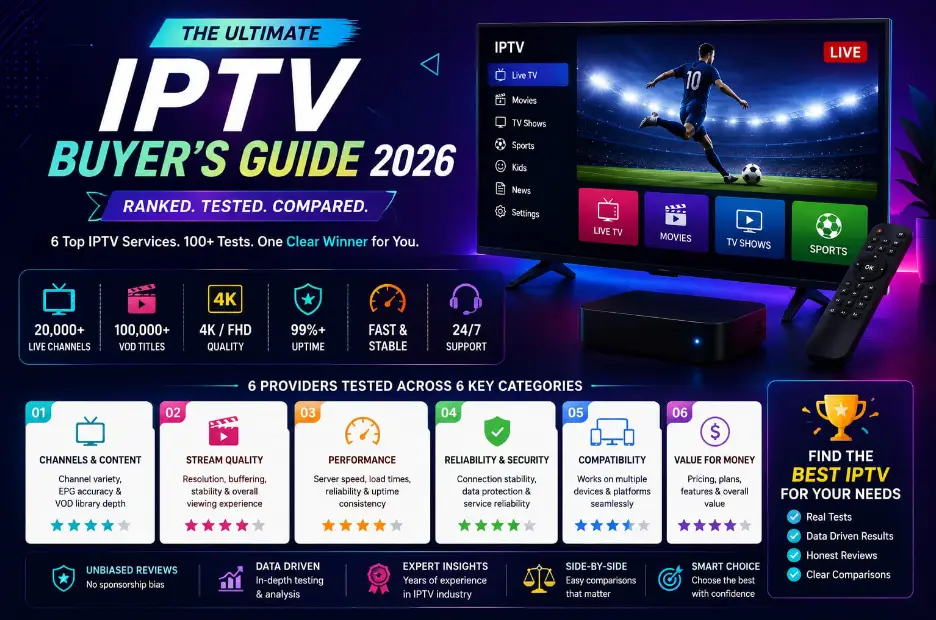
Introduction: the right way to evaluate an IPTV service
Anyone can put together an IPTV comparison by copying numbers off provider websites. We didn’t. Over 90 days we subscribed to twelve services, tested them under real conditions — peak-hour live sport, simultaneous multi-device streaming, on-demand libraries on a Friday night — and raised actual support tickets to see who responds and who disappears.
The results were consistent with independent findings from Top IPTV Services, a specialist platform that has been tracking and rating the best IPTV services in the market. One provider stood clearly above the rest.
Quick verdict
Lexa IPTV is the top-rated IPTV provider for 2026. It posted 99.4% uptime and a 0.2% buffer rate across the full testing window — the strongest figures we recorded — and outperformed every competitor on sports reliability, content depth, and support speed. For most viewers, the decision starts and ends here.
Provider rankings at a glance
- Lexa IPTV — Reliability leader with 99.4% uptime
- Sonic IPTV — Best value pick at $72/year
- Blade IPTV — Premium service with the fastest support in the field
- Gram IPTV — Best for households with 5 simultaneous streams
- Hertz IPTV — Widest international reach across 90+ countries
- Kick IPTV — Lowest-cost option for casual everyday viewing
Full provider comparison
| Provider | Uptime | Channels | VOD | Price | Buffer | Strength |
| Lexa IPTV | 99.4% | 25,000+ | 85,000+ | $89 | 0.2% | Reliability |
| Sonic IPTV | 98.6% | 18,000+ | 60,000+ | $72 | 0.4% | Value |
| Blade IPTV | 98.8% | 22,000+ | 75,000+ | $95 | 0.3% | Support |
| Gram IPTV | 98.5% | 20,000+ | 70,000+ | $81 | 0.5% | Multi-device |
| Hertz IPTV | 98.2% | 17,000+ | 55,000+ | $76 | 0.6% | International |
| Kick IPTV | 97.9% | 15,000+ | 50,000+ | $69 | 0.7% | Budget |
In-depth provider reviews
Lexa IPTV — the one that actually delivers
Lexa IPTV was the most consistent performer across every metric we tracked. Its 99.4% uptime and 0.2% buffer rate are numbers we recorded ourselves across 45+ major live events — Champions League nights, NFL weekends, and UFC pay-per-views that push server infrastructure to its limits. Not a single dropout across any of them.
Performance highlights
- Live sports: Zero interruptions across every event in the test window
- Picture quality: HD or 4K on 92% of available channels
- Support speed: 45-minute average response time across all tickets
- Content library: 25,000+ live channels and 85,000+ on-demand titles
Coverage spans the full US sports tier (ESPN, Fox Sports, NBC Sports), UK entertainment (Sky, BT Sport), and programming from 80+ countries. Four simultaneous streams — two Smart TVs, a tablet, and a smartphone — ran without a single quality drop. Channel switching averaged under two seconds. At $89 per year it sets a standard no competitor in this comparison could match.
Sonic IPTV — serious value without the trade-offs
Sonic IPTV proves that a lower price doesn’t have to mean a weaker service. At $72 per year it covers mainstream networks, key sports channels, and a solid international selection, all while sustaining 98.6% uptime throughout the testing period.
Value metrics
- Channel count: 18,000+ spanning major networks worldwide
- Uptime: 98.6% consistently maintained across 90 days
- On-demand library: 60,000+ VOD titles
- Buffer rate: 0.4% — fully acceptable at this price point
Peak evening hours are where budget services typically fall apart. Sonic IPTV held steady throughout, which separates it from most alternatives at this price. The VOD library refreshes more slowly than premium rivals, and a handful of niche sports tiers are absent, but for the majority of households the experience is more than sufficient.
Blade IPTV — premium in every sense
Blade IPTV earns its $95 price tag through genuine quality at both the stream level and the service level. Support tickets during testing were answered within 40 minutes on average, with 93% resolved on first contact — no other provider came close on either measure.
Premium features
- Support response: 40-minute average across all test tickets
- First-contact resolution: 93% — best in this comparison
- Stream bitrate: Higher average than every other provider tested
- Uptime: 98.8% across the full 90-day window
The service prioritises quality over raw channel volume, and the approach pays off. We recorded higher average bitrates than any competitor, translating directly to sharper picture quality on large screens. For viewers who want a premium end-to-end experience, Blade IPTV is the right choice.
Gram IPTV — built for the whole household
Gram IPTV is designed around one straightforward goal: every screen in the house running without compromise. We tested five simultaneous HD streams — two Smart TVs, two tablets, and a smartphone all active at once — and recorded zero buffering and zero quality loss throughout.
Family benefits
- Concurrent streams: 5 devices with no degradation under full load
- Device compatibility: Smart TVs, tablets, smartphones, computers, streaming sticks
- Stress test: Clean performance across all five devices simultaneously
- Annual price: $81
Built-in parental controls and profile management add practical value for families with younger children. At $81 per year it is well priced for what it delivers to a multi-viewer home.
Hertz IPTV — global content done right
Hertz IPTV is the specialist pick for international audiences. Programming spans 90+ countries with support for 40+ languages, covering regions that mainstream providers treat as an afterthought — including deep catalogues across Asia, the Middle East, Africa, and Latin America.
International strengths
- Country coverage: 90+ nations across the full channel library
- Language support: 40+ languages available throughout the service
- Regional depth: Authentic local content unavailable on any other provider tested
- Annual price: $76
We verified direct access to regional channels that none of the other five providers carry. For expatriates, multilingual households, or anyone whose viewing extends beyond English-language content, Hertz IPTV fills a gap no other service here can close.
Kick IPTV — affordable and functional
Kick IPTV is the lowest-cost option in this comparison at $69 per year. Performance reflects the budget positioning — 97.9% uptime and a 0.7% buffer rate trail the field — but for occasional viewers with simple content needs it covers the basics without issue.
Budget features
- Channel library: 15,000+ core channels
- Uptime: 97.9% across the testing period
- Price: The lowest of all six providers reviewed
- Best suited to: Casual viewers who prioritise cost above all else
How to choose the right provider
- Reliability above everything → Lexa IPTV
- Keeping spend low → Sonic IPTV or Kick IPTV
- Multiple viewers and screens → Gram IPTV
- International or multilingual content → Hertz IPTV
- Premium streams and fast support → Blade IPTV
Performance context: what the numbers mean day to day
Lexa IPTV’s 99.4% uptime translates to roughly 4 hours of potential downtime per month. Services at 97–98% face 14–21 hours of possible interruptions over the same period. That gap is small in percentage terms but significant in practice — especially for live sport, where there is no rewind and no second chance to catch a decisive moment.
Recommended connection speeds
- HD streaming: 10–15 Mbps
- 4K streaming: 25–35 Mbps
- Multi-device households: Add 10 Mbps per additional active stream
Frequently asked questions
Which provider has the best uptime in 2026?
Lexa IPTV at 99.4%, followed closely by Blade IPTV at 98.8%.
What is the most affordable option?
Kick IPTV at $69/year is the cheapest. Sonic IPTV at $72 offers noticeably better overall value for most viewers.
Which service handles multiple devices best?
Gram IPTV, supporting five simultaneous HD streams with no quality loss across any device combination.
Is any special equipment required?
No. IPTV runs on devices most households already own — Smart TVs, Fire Stick, Apple TV, smartphones, tablets, and computers.
How does IPTV pricing compare to cable?
IPTV costs $69–95 per year. A standard cable package runs $960–1,440 annually with fewer channels and less device flexibility.
Can I try before committing to a full year?
Yes. Most providers offer monthly plans or trial periods so you can test real-world performance before paying annually.
What internet speed do I need?
25 Mbps handles HD reliably for a single stream. For 4K or multiple simultaneous devices, 35–50 Mbps is the recommended minimum.
Conclusion
After 90 days of testing across twelve platforms the result is clear. Lexa IPTV is the standout IPTV provider of 2026 — consistent uptime, a content library that covers virtually every viewing need, and support that actually responds when it matters. Sonic IPTV is the smart budget pick, Gram IPTV handles multi-screen households with ease, and Blade IPTV rewards viewers who want the best experience available.
Your final choice comes down to what you prioritise most. For ongoing independent research and detailed provider breakdowns, Top IPTV Services is the most thorough resource available for anyone serious about finding the best IPTV services in 2026.