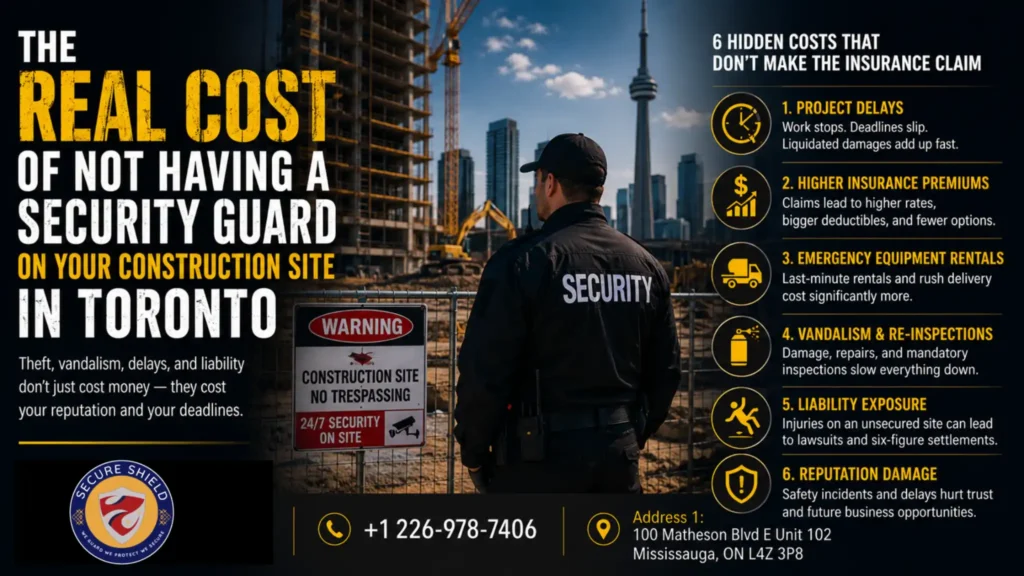
Most contractors don’t think seriously about site security until a Monday morning when the generator is gone. Or the copper piping that was staged and ready for install. Or the skid steer that was supposed to be running by 7 AM.
At that point, security stops being a budget conversation and becomes a very expensive problem.
Toronto’s construction industry is one of the most active in North America. The city has nearly 50% more high-rise projects under construction than New York City. More materials on-site, more equipment parked overnight, more unattended properties sitting open on weekends. Organized theft crews know the Toronto construction landscape well. They know which sites have a guard and which ones rely on a fence and a padlock. The unguarded ones go first.
Toronto Police data confirms the trend: theft over $5,000 was the only major crime category that increased in 2025, up 6.5% year-over-year while nearly every other crime type fell. In early 2025, certain construction sectors recorded a 552% spike in break-and-enter incidents in a single month.
The stolen tools make the insurance claim. What follows them rarely does. This article covers the full picture.
What Gets Taken Off Toronto Construction Sites
Construction sites aren’t random targets. Thieves scout them in advance and know what’s worth taking.
Copper wiring and piping sit at the top of that list. Copper holds strong scrap value and moves easily — a single night’s haul from a mid-size condo build can run several thousand dollars at a scrap yard. Fuel tanks get siphoned or removed entirely. Generators, compressors, and power tools disappear. Newly delivered lumber, steel, and staged materials that were due for install the next morning are gone before the crew arrives.
Heavy machinery takes more planning but it happens. Skid steers, excavators, and work trucks have been reported stolen across the GTA, often with GPS trackers already removed or disabled before the vehicle leaves the site.
The highest-risk period is the first 30 to 60 days of a project. That’s when materials are arriving in volume, the site has real value on it, and security hasn’t been fully established yet. Organized crews know this window and work it.
Six Costs That Don’t Make the Insurance Claim
1. Project Delays That Pile Up Fast
Work stops when materials or equipment go missing. Not just for the morning — the cascade takes days. A superintendent is filing police reports and on the phone with insurers instead of running the build. Replacement gear has to be sourced. Subcontractors who showed up with nothing to work with don’t sit around; they rebook elsewhere.
On a commercial project, every delayed day can activate liquidated damages clauses. These exist because clients and developers carry their own downstream obligations — lease start dates, investor milestones, opening schedules. One theft incident that pushes a project back two weeks can produce contract penalties that far exceed the original loss in stolen materials.
2. Insurance Premiums That Don’t Reset
Builder’s Risk Insurance in Ontario runs 1% to 4% of total project value. On a $5 million build, that’s $50,000 to $200,000 in premiums before a single claim is filed. After a theft or vandalism claim, that rate increases. After repeat claims, you either become expensive to insure or your deductibles climb high enough that the coverage stops being useful.
Insurers factor site security into construction risk calculations. A site with licensed on-site guards carries a different risk profile than one that relies on perimeter fencing alone. That gap affects what you pay across every project going forward.
3. Emergency Equipment Rentals
A stolen generator at 10 PM means calling rental companies at 11 PM for something to be on-site by 6 AM. Emergency equipment rental at short notice costs more than planned rental at any time. Skid steer gone? Add delivery. Compressor missing? Same. Air compressor? Same again.
These costs get absorbed into project budgets as miscellaneous expenses and rarely get connected back to the original security gap. But they’re real and they repeat whenever a site gets hit.
4. Vandalism That Triggers Re-Inspection
Vandalism gets less coverage than outright theft but it causes serious disruption. Partially completed structures are exposed — windows broken, spray paint on finished surfaces, wiring cut, scaffolding tampered with. Some of it is random. Some of it is targeted sabotage.
Beyond the repairs, a vandalism incident at the wrong stage of a build can require a mandatory re-inspection before work resumes. In Ontario, that means waiting on an inspection appointment. On a tight schedule, two or three days of forced downtime waiting for an inspector is not a minor inconvenience.
5. Liability When Someone Gets Hurt on an Unsecured Site
This is where things get genuinely serious for contractors.
Ontario’s Occupiers’ Liability Act covers construction sites. If an unauthorized person enters a site and is injured, the owner or general contractor faces civil liability exposure. The law doesn’t require the person to have had permission to enter. Trespassers, teenagers who wandered in, someone sheltering overnight — all of them create potential claims.
Site injury lawsuits in Ontario can settle well into six figures. Legal fees are substantial even when the contractor prevails. Liability insurance covers some of this, but claims still affect future premiums, and policy limits don’t always match the actual exposure.
A guard who documents site access creates a record. That record matters when something happens and lawyers get involved.
6. Reputation Damage With Developers and GCs
Harder to put a number on but ask any contractor who’s had a project go sideways after a theft incident.
Developers in Toronto’s construction market share information. A contractor whose site gets hit repeatedly builds a reputation for running a loose operation. Future bids become harder to win. Subcontractors become reluctant to commit. Developers start adding security requirements to contracts that didn’t have them before.
A strong reputation in this market takes years of clean projects to build. One high-profile incident can create a perception problem that outlasts the project itself.
What a Security Guard Does That a Camera Doesn’t
It’s not just standing at a gate. There are four things a trained guard does that passive security can’t.
First: deterrence that actually works. A uniformed guard on-site tells anyone watching that the property is monitored and someone will respond. Most construction theft is opportunistic. Thieves choose the easier target. A visible guard is often enough to make your site not worth the risk.
Second: access control with documentation. Guards check who enters — contractors, suppliers, inspectors, visitors — and log it. On a large Toronto build running multiple subcontractors on different schedules, that log keeps the site accountable and provides a paper trail when something disappears.
Third: unpredictable patrols. Cameras have fixed angles and known positions. A guard who runs randomized rounds through equipment zones, storage areas, and the perimeter is harder to work around. Anyone casing the site can map a camera system in an afternoon. A guard who moves on a varying schedule is a different problem entirely.
Fourth: actual response. When something happens — a break-in, a medical emergency, a fire — a guard is there. They call police or EMS, secure the area, and provide a first-hand account of events. Remote monitoring services can call for help too, but by the time police respond to a property crime in Toronto, the loss has already happened.
Secure Shield Security provides construction site security in Toronto with licensed guards trained for active build environments, covering everything from overnight-only protection to full 24/7 deployment across project phases.
On Cameras Alone
Cameras are worth having. They’re not a security plan on their own.
A camera records what happened. It doesn’t interrupt what’s happening. By the time footage is reviewed and police are called, the copper is already in a van. Police response times to property crimes in Toronto are not fast. The people doing this know that.
Cameras also have fixed sightlines. They get covered, blinded by headlights, or simply worked around by anyone who’s taken the time to watch the site beforehand. A guard moves. A guard adapts.
The right answer is both — guards and cameras together give you deterrence, documentation, and response in one setup. But a camera system alone still leaves the site exposed at the moment it matters.
What It Costs vs. What It Prevents
Security guard rates in Toronto run $25 to $35 per hour for standard shifts. Overnight and weekend coverage carries a 15% to 25% premium.
Overnight-only protection — a 10-hour shift from 8 PM to 6 AM — runs roughly $250 to $350 per night. Monthly, that’s $7,500 to $10,500 for coverage during the hours when theft almost always happens.
One serious theft incident in the GTA, with stolen materials, emergency rentals, delay penalties, and insurance consequences factored in, typically lands between $50,000 and $500,000 in total project impact.
A month of overnight security coverage costs less than a single bad weekend unguarded. Contractors who treat the guard line item as optional overhead are measuring the wrong thing.
When to Bring Security In
Before the first delivery truck arrives. Not after the first incident.
The first 30 to 60 days of a project carry the most concentrated risk. Materials are coming in, value is accumulating on-site, and security protocols are still taking shape. That is exactly when organized crews look for gaps.
Overnight and weekend coverage is the floor for most active Toronto sites. If copper, heavy equipment, or staged specialty materials are present, 24/7 coverage deserves serious consideration.
Watch the holiday stretches — long weekends, the week between Christmas and New Year’s. A site sitting unguarded for four or five consecutive days is a known and predictable target.
The Real Calculation
Skipping site security on a Toronto construction project is a bet. You’re betting that nothing happens during the windows when the site is unguarded. Sometimes that bet pays off. When it doesn’t, the cost isn’t just the stolen generator — it’s the delays, the insurance hit, the emergency rentals, the liability exposure, and the conversations you have to have with your developer client about why the project is behind.
None of those costs show up on the original estimate. They show up after the Monday morning when something is missing.
If you manage a construction project in the GTA, reviewing your security coverage before breaking ground is worth the time. Working with a licensed construction site security company in Toronto means guards who understand active build environments and are present when the risk is highest — overnight, on weekends, and through every phase of the project.