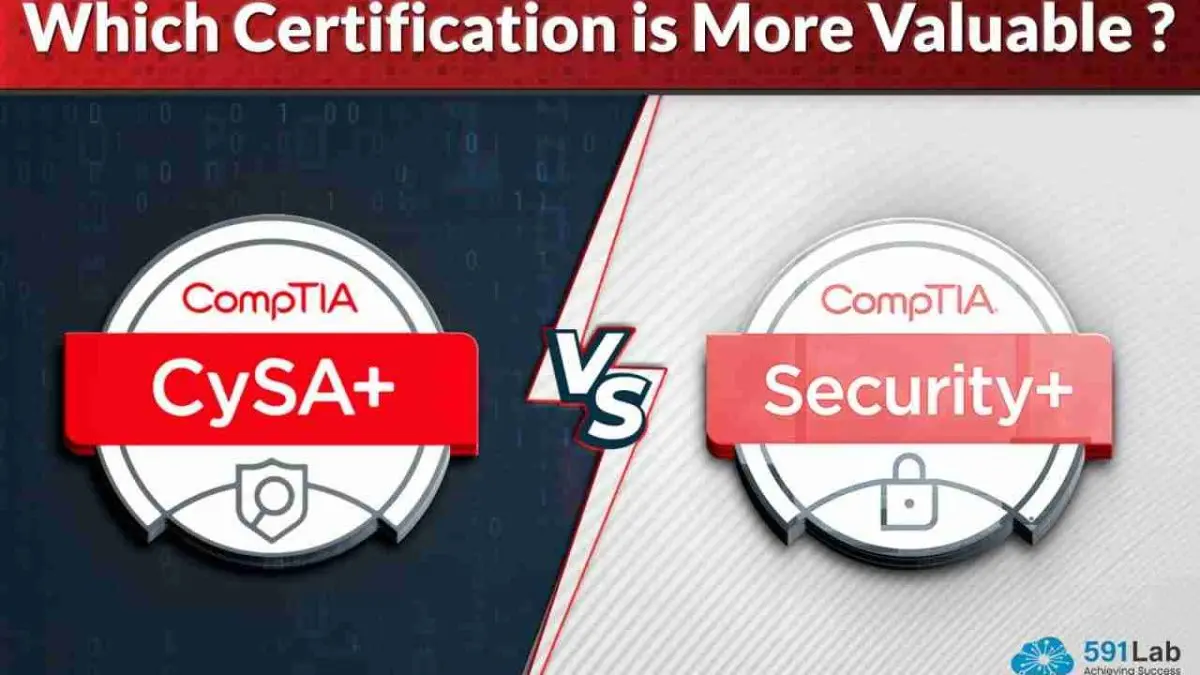
CompTIA Security+ and CompTIA CySA+ are two of the most recognized cybersecurity certifications in the industry — but they are not equivalent, and they are not interchangeable. Understanding the difference between them determines which one makes sense as your starting point and which one comes after.
The Core Distinction
Security+ (SY0-701) is an entry-level certification that validates foundational cybersecurity knowledge — threat awareness, security architecture concepts, security operations basics, and governance principles. It is designed for candidates at the beginning of their cybersecurity career.
CySA+ (CS0-003) is an intermediate certification that validates the ability to perform cybersecurity analysis work — threat hunting, vulnerability management, security monitoring, and incident response operations. It is designed for candidates who already have security experience and are moving from entry-level to mid-level roles.
The progression is clear: Security+ first, CySA+ after 1–2 years of security experience.
Why This Order Matters
The content relationship between the two certifications is hierarchical. CySA+ assumes you have Security+ level knowledge as a baseline and builds on it with operational depth. Questions on CySA+ assume familiarity with security concepts that Security+ covers at a foundational level.
Candidates who attempt CySA+ without Security+ foundation (or equivalent experience) find the operational questions significantly harder because they are simultaneously trying to learn foundational concepts and apply them at the analytical level the exam demands.
Difficulty Comparison
Security+ SY0-701: Moderate difficulty. 3–6 months of preparation from a general IT background. Performance-based questions (PBQs) require hands-on security tool familiarity but are manageable for candidates who supplement reading with lab practice.
CySA+ CS0-003: Harder than Security+. 6–12 months of preparation from a Security+ baseline. PBQs are more complex and require genuine SOC analyst or vulnerability management experience to answer efficiently. The scenario-based questions assume you have actually worked with SIEM tools, analyzed real network traffic, and performed vulnerability triage — not just read about them.
Salary Difference
At the certified-but-entry-level stage:
- Security+ holders: $55,000–$75,000 (SOC Tier 1, IT Security Administrator)
- CySA+ holders: $75,000–$100,000 (SOC Tier 2, Security Analyst, Vulnerability Analyst)
The salary jump from Security+ to CySA+ reflects the intermediate nature of the credential — CySA+ holders are expected to perform independently at a higher level than Security+ holders.
Job Market Comparison
Roles where Security+ appears most frequently:
- Tier 1 SOC Analyst
- IT Security Administrator
- Junior Security Engineer
- Information Security Analyst (entry)
- Government/DoD IT security roles (IAT Level II)
Roles where CySA+ appears most frequently:
- Tier 2 SOC Analyst
- Vulnerability Management Analyst
- Threat Intelligence Analyst
- Security Operations Lead
- Government/DoD roles (CSSP Analyst, CSSP Infrastructure Support)
The DoD 8570 Factor
Both certifications satisfy US Department of Defense information assurance requirements, but at different levels. Security+ satisfies IAT Level II and IAM Level I. CySA+ satisfies CSSP Analyst and CSSP Infrastructure Support. For candidates targeting government, military, or defense contractor roles, understanding which positions require which level is important for certification planning.
How to Prepare for Each
For Security+ SY0-701: 3–6 months of study combining a comprehensive study guide, hands-on lab practice (TryHackMe’s Security+ path is excellent), and scenario-based practice questions. For SY0-701 practice questions that cover all five domains including PBQ-style questions, CertEmpire provides comprehensive preparation material with detailed explanations.
For CySA+ CS0-003: 2–4 months of additional study after Security+, combined with 1–2 years of hands-on security experience. The operational nature of CySA+ means practice questions are most effective when you already have context from working in a security role or practicing extensively on TryHackMe and HackTheBox.
For candidates managing the Security+ to CySA+ progression and planning further certifications (CISSP, CASP+, or specialized credentials), CertMage provides tools for tracking your security certification path and organizing study progress across multiple objectives.
The Decision Framework
Take Security+ first if:
- You are new to cybersecurity (under 2 years of experience)
- You have no prior security certification
- You are targeting entry-level SOC analyst or IT security roles
Take CySA+ next if:
- You already hold Security+ (or equivalent experience)
- You have 1+ years of practical security operations experience
- You are targeting Tier 2 SOC, vulnerability management, or threat analyst roles
Take both eventually if:
- You are building a CompTIA security certification path toward CASP+ (the advanced-level CompTIA security credential)
- You want complete DoD 8570 compliance coverage across multiple role categories
The sequence is clear and the career logic is sound. Security+ establishes the foundation; CySA+ builds the operational depth that mid-level security roles require.
Technology Perspective
Technology continues to transform industries through artificial intelligence, cloud computing, automation, cybersecurity, digital platforms, and data-driven decision making. As organizations increasingly adopt digital solutions, understanding emerging technologies becomes essential for businesses, professionals, and consumers. DGM News regularly covers these developments through expert analysis, technology news, and educational resources.
Innovation Outlook
Rapid advances in artificial intelligence, automation, machine learning, cloud infrastructure, and digital transformation continue reshaping global industries. Monitoring these developments helps organizations adapt to changing technologies, improve efficiency, and prepare for future innovation.
Did you know?
Artificial Intelligence is expected to influence nearly every major industry over the coming decade, from healthcare and finance to transportation, manufacturing, education, and entertainment.
AI, Machine Learning, Deep Learning and Generative AI Explained
Google AI Updates
About DGM News
DGM News is an independent digital publication delivering the latest Technology News, AI News, and FinTech News. We provide expert insights on startups, innovation, cybersecurity, software, business, gadgets, cloud computing, artificial intelligence, and emerging technologies. Our mission is to publish informative, accurate, and regularly updated content that helps readers stay informed in today's rapidly evolving digital landscape.
Since our editorial focus includes technology, artificial intelligence, and financial technology, we continuously expand our coverage as new innovations emerge.
Editorial Standards
Every article published on DGM News undergoes editorial review before publication. We prioritize factual accuracy, clarity, transparency, and reader value while following responsible digital publishing practices.
Research Methodology
Our editorial team researches publicly available information from official announcements, technical documentation, research publications, developer resources, reputable industry reports, and trusted public sources whenever applicable. Information is reviewed to improve clarity and accuracy before publication.
Fact-Checking Policy
We make reasonable efforts to verify factual information before publishing. Articles are reviewed for accuracy, consistency, and relevance. If significant developments occur after publication, content may be revised to reflect updated information.
Update Policy
Technology evolves rapidly. Articles may be reviewed and updated periodically to reflect software releases, AI developments, security advisories, regulatory updates, product launches, and other important industry changes.
Source Verification
Whenever possible, DGM News reviews information using official company announcements, technical documentation, research publications, government resources, publicly available reports, and reputable industry references before updating articles.
Editorial Independence
DGM News maintains editorial independence in all publishing decisions. Editorial content is produced independently and is intended to provide balanced, informative, and reader-focused coverage without influence from advertisers or commercial partnerships.
AI Usage Disclosure
Artificial intelligence tools may assist with research organization, grammar improvement, formatting, or editorial workflows. Every article is reviewed by human editors before publication to help maintain quality, clarity, and factual accuracy.
Corrections Policy
Accuracy is important to us. If readers identify outdated information or factual inaccuracies, they are encouraged to contact our editorial team. Verified corrections are reviewed and incorporated whenever appropriate.
Reader Feedback
Reader feedback helps improve our journalism. We welcome suggestions, corrections, and constructive feedback through our Contact page to continuously improve the quality of our reporting.
Last Editorial Review
This article follows the DGM News editorial review process and may be updated periodically as new information becomes available.
Why Trust DGM News?
DGM News is committed to publishing technology journalism that emphasizes accuracy, transparency, editorial independence, and regularly updated information. Our editorial process is designed to provide readers with reliable coverage of technology, AI, fintech, startups, and digital innovation.
DGM News Resources
Topics We Cover
Artificial Intelligence • AI Tools • Machine Learning • FinTech • Cybersecurity • Cloud Computing • Programming • Software Development • Gadgets • Mobile Technology • Business Technology • Startups • Digital Marketing • Blockchain • Cryptocurrency • Science • Innovation • Consumer Technology • Enterprise Technology • Automation