At 11:47 p.m. on a Tuesday, a payment processing system fails. The on-call engineer is unavailable. By the time the incident is acknowledged and escalation begins, nearly 40 minutes have passed. For a mid-sized e-commerce business, that window represents thousands of dollars in abandoned transactions, a degraded customer experience, and a compliance flag. For a healthcare organization, it can mean something far more serious.
This is not a hypothetical scenario. According to the Uptime Institute’s Annual Outage Analysis, over 60% of outages that caused significant financial or reputational damage in recent years were the direct result of delayed detection or slow incident response, not the failure itself. Separately, research from Information Technology Intelligence Consulting (ITIC) found that a single hour of downtime costs more than $300,000 for 91% of mid-size and large enterprises, with 44% reporting that one hour of downtime can cost between $1 million and $5 million. The gap between when a problem starts and when a qualified engineer begins working it is where businesses lose the most.
The underlying cause of that gap is structural. Most internal IT departments are built and staffed for business hours. They handle daytime support queues, project work, vendor management, and user requests with reasonable efficiency. What they are not resourced for is continuous, around-the-clock operational vigilance across an increasingly complex technology environment. A 2023 CompTIA industry survey found that 54% of IT departments cited insufficient staff coverage as a primary contributor to unresolved or delayed incidents. Meanwhile, the global IT skills shortage continues to widen: the World Economic Forum estimates a shortfall of more than 4 million cybersecurity professionals alone by 2025, a gap that mid-market organizations feel most acutely.
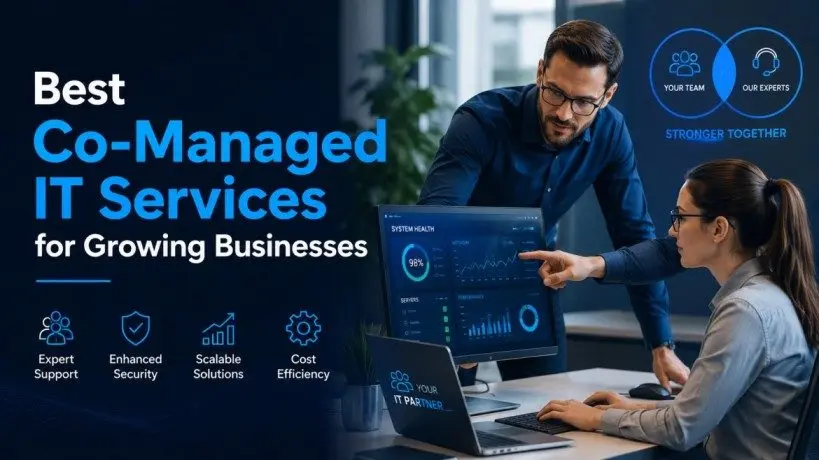
This is the operational reality driving adoption of co-managed IT services, a model that pairs an organization’s existing IT team with an external managed service provider (MSP) to create unified, always-on coverage. Unlike full outsourcing, co-managed services preserve institutional knowledge, internal control, and team continuity while layering on the scale, specialization, and availability that no internal team of standard size can sustain independently. For organizations serious about reducing downtime, closing skills gaps, and building operational resilience, co-managed IT is not a support supplement. It is a foundational infrastructure decision.
What Co-Managed IT Services Actually Deliver
Co-managed IT is frequently mischaracterized as partial outsourcing. In practice, it is a more deliberate arrangement. Organizations retain their in-house IT team, their internal processes, and their institutional context, while engaging an MSP to extend capabilities in specific, agreed-upon areas.
Those areas typically include:
Round-the-clock monitoring and incident response. Most internal IT departments operate on standard business hours. Co-managed partners provide after-hours coverage, weekend support, and holiday availability through dedicated network operations centers (NOCs) and security operations centers (SOCs). When a server goes down at 2 a.m., an alert is not waiting in an inbox until morning. A trained engineer is already working on the issue.
Tiered escalation support. Internal helpdesks often handle Tier 1 and Tier 2 tickets effectively but face bottlenecks on complex infrastructure, security, or cloud issues. Co-managed partners absorb complex escalations through dedicated tier 2 IT support, specialized troubleshooting, and vendor coordination, freeing internal staff to focus on business-aligned projects.
Security operations and compliance coverage. Cybersecurity requires continuous attention. Threat actors do not observe business hours. Co-managed security services provide 24/7 SIEM monitoring, threat detection and response, vulnerability management, and compliance reporting without requiring organizations to build and staff a full SOC internally.
Cloud infrastructure management. Multi-cloud environments are operationally demanding. Co-managed IT providers bring cloud-specific expertise in AWS, Azure, and Google Cloud that most internal teams can support at a surface level but rarely have the bandwidth to optimize, govern, and continuously manage.
The Operational Cost of IT Gaps
The business case for co-managed IT becomes clearest when organizations examine the actual cost of the gaps they tolerate.
Unplanned downtime carries a widely documented financial burden. Across industries, analysts estimate that downtime costs mid-market and enterprise organizations between $5,000 and $9,000 per minute depending on sector and system criticality. For industries such as financial services, healthcare, or e-commerce, that number is considerably higher. A single multi-hour outage, particularly one that occurs outside business hours when internal staff are unavailable, can eliminate weeks of operational margin.
Beyond outages, skills gaps create subtler but compounding costs. Internal teams stretched across too many responsibilities defer patching cycles, delay security reviews, and deprioritize documentation. Over time, these deferrals accumulate into technical debt, compliance exposure, and architectural fragility. The teams are not underperforming. They are under-resourced relative to what the business demands of its technology environment.
Co-managed IT addresses both categories of cost simultaneously. Continuous coverage eliminates the window of vulnerability that exists when no qualified engineer is actively monitoring the environment. Specialized depth resolves the skills ceiling that prevents internal teams from executing at the level the business needs.
How Co-Managed IT Fits Within Existing IT Organizations
One of the persistent concerns internal IT leaders raise about co-managed services is the question of authority and process ownership. The fear is understandable: introducing an external party into an established IT function creates potential for conflict over ticketing workflows, change management, escalation paths, and tool preferences.
Mature co-managed engagements are specifically designed to resolve these concerns before the relationship begins. The engagement model starts with a governance framework that defines scope clearly. Internal IT retains ownership of strategic direction, vendor relationships, architecture decisions, and user-facing support. The co-managed partner owns defined operational functions, typically those tied to coverage hours, specialized skill requirements, or capacity overflow.
The two teams operate through shared tooling. Most MSPs integrate with existing ITSM platforms such as ServiceNow, ConnectWise, or Jira, meaning tickets, escalations, and documentation flow through the same systems both teams already use. This eliminates the friction of parallel workflows and ensures continuity of institutional knowledge.
Effective co-managed relationships are built on transparency. Monthly operational reviews, agreed-upon SLAs, and defined escalation matrices ensure that neither team operates in a silo. Over time, internal IT leaders often report that co-managed partnerships reduce burnout, improve retention of skilled engineers, and create space for strategic initiatives that were previously crowded out by reactive support demand.
Building the Case Internally for 24/7 Coverage
For IT leaders navigating budget approvals or organizational skepticism, the internal case for co-managed IT services rests on three measurable pillars.
Risk reduction. The probability and cost of a significant after-hours incident multiplied by the current gap in coverage creates a quantifiable risk exposure. Organizations that have experienced even one major overnight or weekend outage can document this cost precisely. For those that have not, the modeling exercise alone often demonstrates that co-managed coverage pays for itself before the first year concludes.
Operational maturity. Enterprise customers, partners, and regulators increasingly expect demonstrable evidence of continuous monitoring, incident response capability, and security posture management. Co-managed IT helps organizations achieve and maintain the operational maturity benchmarks required by frameworks such as SOC 2, ISO 27001, NIST, and HIPAA without requiring the organization to build that capability entirely from within.
Team sustainability. The talent market for qualified IT engineers remains highly competitive. Organizations that expect small internal teams to deliver 24/7 operational coverage face turnover, burnout, and increasing recruitment costs. Co-managed services distribute the load in a manner that makes internal IT roles sustainable and professionally rewarding, which directly improves retention.
Selecting the Right Co-Managed IT Partner
Not every MSP is equipped to function as a true co-managed partner. The distinction matters significantly. A co-managed provider must demonstrate the ability to operate as an integrated extension of an internal team rather than as a transactional vendor.
Key evaluation criteria include:
Integration capability. Can the provider work within existing tooling, processes, and escalation workflows without requiring the organization to restructure its operations around the MSP’s preferences?
Transparency and reporting. Does the provider offer real-time visibility into ticket queues, incident activity, SLA performance, and security posture through dashboards accessible to internal IT leadership?
Defined SLAs with financial accountability. Response time commitments, resolution targets, and escalation timelines should be contractually defined with clear remedies for performance shortfalls.
Sector experience. Providers with experience in your industry understand compliance requirements, common threat vectors, and regulatory expectations at a level that generalist MSPs cannot replicate.
Scalability. As the business grows, the co-managed engagement should grow with it. Assess whether the provider has demonstrated the capacity to scale services in alignment with client growth without service degradation.
The Strategic Value of Continuous Operations
Operational continuity has shifted from a competitive differentiator to a baseline expectation. Customers, employees, and stakeholders no longer accept prolonged system outages as an inevitable cost of doing business. They expect the organizations they work with to have invested in the infrastructure and support models necessary to maintain availability.
Co-managed IT service partners represent one of the most effective mechanisms available for meeting that expectation without building the full cost of a 24/7 internal operation into a fixed headcount. The model delivers enterprise-grade coverage through a structure that preserves internal ownership, leverages external specialization, and creates accountability through clearly defined service agreements.
For organizations currently managing IT gaps through workarounds, accepting elevated risk during off-hours, or watching skilled engineers burn out under unsustainable demand, the co-managed model offers a direct and proven path forward.
Ready to Close Your IT Coverage Gaps?
If your organization is experiencing the operational pressure that comes from after-hours incidents, escalating security risk, or an internal IT team stretched beyond sustainable capacity, the conversation you need is not about replacing your team. It is about equipping them to succeed.
Our team works with IT leaders to design co-managed engagements that align precisely with your existing structure, technology environment, and business objectives. We begin with a no-obligation operational assessment to identify where coverage gaps, skills deficits, and risk exposures are costing your organization the most, and what a tailored co-managed model would look like to address them.
Schedule your complimentary IT Operations Assessment today. Let us help you build a 24/7 operational capability that your business can depend on, without rebuilding your team from the ground up.