In precision machining and tooling environments, coating selection is rarely a straightforward decision. The choice between one physical vapor deposition coating and another can determine whether a cutting tool lasts through a full production run or fails mid-cycle. For shops running high-volume operations or working with difficult materials, that difference is measured not just in tool costs but in machine downtime, part quality, and schedule reliability.
Two coatings that frequently appear in the same conversation are titanium nitride and titanium carbonitride. On the surface, they look similar. Both are hard, both are applied through vapor deposition processes, and both have decades of use across industrial tooling. But their performance profiles are meaningfully different, and selecting the wrong one for a given application can result in premature wear, inconsistent surface finishes, or unexpected tool failure.
Understanding the distinction between these two coatings requires looking at how each behaves under real cutting conditions, not just how they compare on a specification sheet.
What TiCN Coating Actually Does Differently
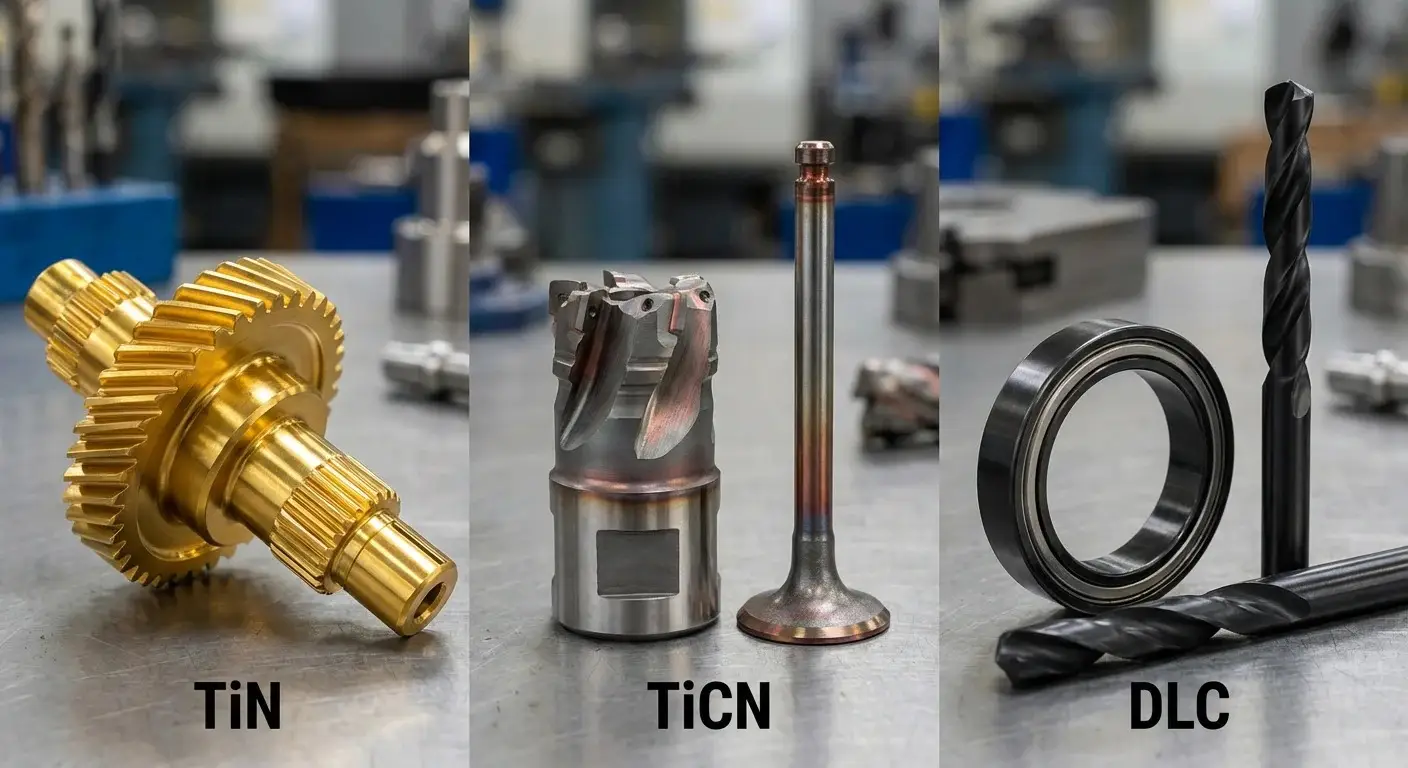
The difference between titanium nitride and ticn coating begins at the material level. Titanium carbonitride incorporates carbon into the coating matrix alongside nitrogen, which changes the structural properties of the film in ways that matter significantly in machining applications. The addition of carbon increases hardness beyond what titanium nitride alone can achieve, while also improving the coating’s resistance to abrasive wear. This makes it better suited for applications where the tool is in sustained contact with hard or abrasive workpieces.
The surface of a TiCN-coated tool is also smoother at a microscopic level than a comparable TiN surface. That surface smoothness reduces friction during cutting, which in turn reduces heat generation at the cutting edge. In high-speed or dry machining operations where coolant is limited or absent, this becomes a meaningful operational advantage rather than a minor technical footnote.
The Role of Carbon in Structural Performance
When carbon is introduced into the titanium nitride lattice during deposition, it creates a harder and denser film. This structural change is not just about peak hardness on a testing scale — it reflects how the coating distributes stress across the cutting edge during actual use. A harder, denser coating resists deformation under load, which is particularly relevant when machining materials that push back against the tool rather than yielding cleanly.
The practical consequence of this is that TiCN-coated tools tend to maintain their edge geometry longer under conditions that would cause faster degradation in TiN-coated tools. That edge retention directly affects dimensional consistency in machined parts, which matters in any environment where tolerances are tight or inspection is rigorous.
Where the Advantage Becomes Apparent
TiCN coatings perform with a clear advantage over TiN in dry or near-dry machining conditions, high-speed cutting operations, and when working with materials that generate significant abrasive wear. These include hardened steels, cast iron, aluminum alloys with high silicon content, and certain composites. In these situations, the wear rate on a TiN-coated tool begins to increase at a point where a TiCN-coated tool continues to perform within acceptable limits.
It is also worth noting that TiCN coatings are often applied in multi-layer or graded configurations, which further improves adhesion to the substrate and resistance to coating delamination under cyclic stress. A coating that separates from the tool during operation is not just ineffective — it can cause surface defects in the workpiece and unpredictable cutting behavior.
Titanium Nitride: Where It Still Holds Its Ground
Titanium nitride has been applied to cutting tools since the 1980s, and its continued use is not simply a matter of inertia. TiN coatings have genuine strengths in specific contexts, and replacing them with a harder alternative does not always produce better results. The coating is relatively straightforward to apply, adheres well to a wide range of tool substrates, and performs reliably in standard machining conditions where heat and abrasive wear are not the primary failure modes.
TiN coatings are also less sensitive to substrate preparation variations, which can be relevant in shops where coating is applied as part of a regrinding and recoating workflow. In lower-speed operations, softer workpiece materials, and applications where cutting fluid is applied consistently, TiN provides adequate protection at a cost that can be justified.
The Limitation of Hardness Alone
One common misconception is that harder always means better. Tool coating selection is more nuanced than that. A coating that is very hard but brittle, or one that is hard but has poor adhesion to a specific substrate, can fail faster than a softer coating that is well-matched to the operating conditions. TiN, with its lower hardness compared to TiCN, is also somewhat more flexible under certain stress conditions. That flexibility can be beneficial in interrupted cuts or applications where the tool experiences impact loading rather than sustained contact pressure.
In general machining of mild steels, free-cutting materials, and softer alloys at conventional speeds, TiN remains a practical and reliable choice. The additional hardness that TiCN provides does not translate into meaningful performance gains when the workpiece material and cutting conditions do not create sufficient wear stress to distinguish between the two.
Cost Considerations in Context
TiN coatings typically carry a lower cost than TiCN coatings, and for operations that do not require the additional wear resistance, that cost difference can influence purchasing decisions. However, the comparison should not be made on unit cost alone. If a TiCN-coated tool lasts through three times the material removal before requiring replacement or reconditioning, the higher per-tool cost may be offset by reduced downtime and fewer tool changes. The actual economics depend on the application, the volume of production, and how tool life is tracked within the operation.
Shops that invest in systematic tool life monitoring are better positioned to make this comparison accurately. Those that replace tools on a fixed schedule regardless of condition may not capture the full value of a higher-performing coating.
How Cutting Conditions Determine Which Coating Performs Better
The operating environment around a cutting tool is as important as the tool itself. Temperature, cutting speed, feed rate, workpiece material hardness, and coolant availability all influence how a coating performs and how quickly it degrades. A coating optimized for one set of conditions may underperform or fail prematurely in another.
TiCN coatings are better suited to conditions that generate elevated temperatures at the cutting zone, because the carbon in the coating structure helps maintain hardness at higher temperatures compared to TiN alone. According to general materials science principles documented in resources such as the physical vapor deposition literature, the thermal stability of a coating directly affects its performance ceiling in high-speed cutting applications.
When cutting conditions are moderate and well-controlled, the performance gap between TiCN and TiN narrows. When conditions become more demanding — higher speeds, harder materials, less coolant — the gap widens in favor of TiCN.
Matching Coating to Workpiece Material
The workpiece material is one of the most reliable guides for coating selection. Softer, more machinable materials that produce long, continuous chips and do not generate excessive heat at the cutting edge do not typically require the enhanced wear resistance of a TiCN coating. In these cases, a TiN coating is appropriate and cost-effective.
Harder materials, abrasive materials, and materials that require high cutting speeds to achieve acceptable surface quality place more demand on the coating. In these contexts, the additional hardness and lower friction coefficient of a TiCN coating contribute to longer tool life and more consistent part quality over extended production runs. The choice becomes particularly clear when a shop is experiencing tool wear patterns that suggest abrasive wear is the dominant failure mode.
Regrinding, Recoating, and Long-Term Tooling Economics
Both TiN and TiCN coatings can be removed and reapplied during the regrinding process, which allows tools to be reconditioned rather than discarded after the cutting edge wears. This extends the usable life of the tool blank itself, which is often more expensive than the coating. The economics of regrinding and recoating vary by tool geometry, material, and the shop’s in-house capabilities, but it is a factor that affects the total cost of ownership for both coating types.
A harder coating like TiCN may slow the rate of edge wear, reducing how frequently regrinding is needed. But when regrinding does occur, the preparation and application processes must be appropriate for the coating type to ensure proper adhesion and performance in subsequent use. Shops that coat and recoat tools regularly should consider whether their process is optimized for the coating chemistry being applied.
The Regrinding Process and Coating Integrity
After regrinding, the exposed tool substrate must be thoroughly cleaned and properly prepared before recoating. Residual contamination, surface oxides, or inconsistent surface texture can compromise adhesion and reduce the effective life of the new coating. This is true for both TiN and TiCN, but it becomes more operationally important when the cost of recoating is higher and the performance expectation is greater. A TiCN coating applied over a poorly prepared surface will not deliver the wear resistance the chemistry is capable of providing.
Conclusion: Choosing Between TiCN and TiN Is an Operational Decision
The question of which coating extends tool life longer does not have a single answer that applies across all machining contexts. TiCN coatings consistently outperform TiN coatings in demanding conditions — harder workpieces, higher cutting speeds, limited coolant, and abrasive materials. Under those conditions, the structural advantages of titanium carbonitride translate into measurable differences in tool life, edge retention, and part quality consistency.
TiN coatings remain a practical and reliable choice where conditions are less demanding and the cost differential is a meaningful factor in tooling budgets. They are not inferior coatings — they are appropriate coatings for a different range of applications.
The most useful approach for any shop evaluating this decision is to look at actual wear patterns on current tooling, understand the dominant failure mode in each application, and match the coating to the conditions rather than defaulting to one option across all tool types. When tool failure is driven primarily by abrasive wear and heat, TiCN coating is the more durable choice. When conditions are moderate and controlled, TiN continues to deliver acceptable performance at lower cost. Getting this right reduces unexpected tool failures, improves process predictability, and ultimately supports more consistent production outcomes.