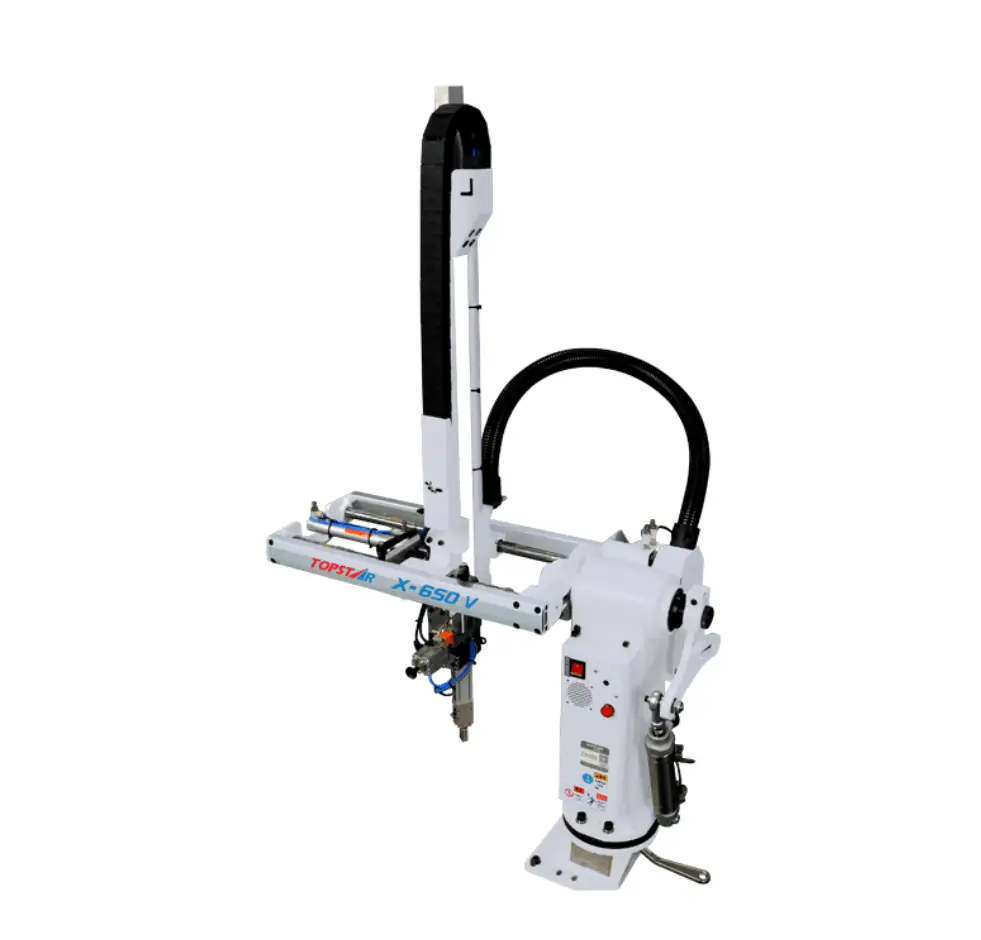
In injection molding production, one of the most common—yet often underestimated—challenges is inconsistent sprue positioning. If the sprue position changes after removal, it can disrupt subsequent automated processes, result in material waste, and even cause machine downtime. This is where the sprue picker plays a crucial role. Sprue pickers are designed to extract sprues directly from the mold area, ensuring the smooth flow of the production cycle. However, traditional sprue pickers often struggle to achieve stable positioning due to limited ranges of motion or rigid mechanical structures. Topstar has addressed this issue through an ingenious engineering solution: 90° wrist rotation technology. This innovation revolutionizes post-extraction sprue handling, enabling precise directional control and consistent positioning.
Sprue Picker: The Root Causes of Inconsistent Sprue Positioning
To effectively resolve inconsistent sprue positioning, one must first understand its root causes. In most injection molding operations, this inconsistency stems from a combination of factors, including mechanical limitations, process variability, and environmental influences. Traditional sprue-picking robots typically operate along fixed axes, offering limited flexibility at the end effector. Due to a lack of rotational capability, these robots are often restricted to placing sprues in a single, fixed orientation. Consequently, variations in mold opening, sprue geometry, or extraction timing can all lead to inconsistent placement locations.
Furthermore, variations in sprue weight, temperature, and surface condition can further complicate the operation. For instance, hot sprues may undergo slight deformation during extraction, making their orientation at the moment of release difficult to predict. Over time, this inconsistency can disrupt automated collection systems, leading to misaligned stacking or conveyor belt jams. Therefore, resolving the issue of inconsistent placement requires more than just faster extraction speeds; it demands more precise control over orientation and positioning—precisely where Topstar’s 90° wrist rotation offers a decisive advantage.
Sprue Picker: The Engineering Advantages of 90° Wrist Rotation
The introduction of the 90° wrist rotation feature marks a significant leap forward in sprue handling technology. Unlike traditional linear designs, this feature enables the sprue picker to adjust its orientation actively before placing the sprue. From an engineering perspective, the wrist rotation mechanism adds a degree of freedom to the sprue picker’s motion system. This enables the end effector to rotate the sprue to a consistent, pre-set angle, regardless of how the sprue was extracted from the mold.
These advantages are immediate and measurable. First, the robot achieves uniform positioning precision, ensuring that the position of every sprue is perfectly consistent. Second, it enhances compatibility with downstream automation systems. Furthermore, this rotational capability improves process stability. Instead of relying on passive alignment, the Sprue Picker robot actively corrects orientation errors in real time. Consequently, the production process becomes more predictable and less susceptible to external variables.
How Does a 90° Rotation Improve Placement Consistency?
Consistency is the cornerstone of automation, and the 90° wrist rotation feature is designed specifically to meet this requirement. With this feature, the sprue picker ensures that every sprue follows a controlled trajectory from extraction to placement. During operation, the sprue picker first grasps the sprue using a secure end effector. Once the grasp is established, the wrist rotation mechanism immediately activates to orient the sprue to the predetermined direction. This step eliminates randomness, ensuring uniformity before the placement phase begins.
The impact on production is significant. Uniform sprue placement reduces the likelihood of material overlap, misalignment, or blockages within collection systems. Additionally, since consistently oriented sprues are easier to handle and process, this also boosts the efficiency of recycling operations. Moreover, the sprue picker robot can adapt to different mold configurations without requiring extensive reprogramming; operators need to adjust the rotation parameters to meet specific production requirements. This flexibility enhances overall operational efficiency and minimizes downtime during product changeovers.
Integration with Injection Molding Automation Systems
Topstar’s advanced sprue picker is designed for seamless integration. Its control system synchronizes with injection molding machines, conveyor systems, and auxiliary equipment, ensuring smooth communication and collaborative operation across the entire production line. The newly added 90° wrist rotation feature further enhances these integration capabilities. By delivering consistently oriented sprues, the robot simplifies the design of downstream systems. For instance, conveyor belts can operate at higher speeds without the need for complex alignment mechanisms.
Furthermore, the system supports intelligent monitoring and feedback. Operators can track key performance indicators such as placement accuracy, cycle time, and error rates. This data-driven approach enables continuous optimization and helps identify potential issues before they escalate. As automation technology continues to evolve, the role of the sprue picker will become increasingly critical. Equipped with advanced features—such as wrist rotation—this device is no longer merely a peripheral but rather a core component of a fully automated production ecosystem.
Enhancing Production Efficiency and Cost-Effectiveness
By eliminating inconsistent placement, manufacturers can increase throughput, reduce waste, and boost overall efficiency. One of the most immediate benefits is reduced machine downtime. Misaligned sprues often disrupt automated systems, leading to production delays. Sprue-picking robots minimize such interruptions by ensuring consistent sprue positioning, thereby guaranteeing the smooth operation of the production line. Furthermore, improved positioning accuracy reduces material waste.
When sprues are correctly aligned, they can be collected and recycled efficiently, thereby lowering raw material costs. Over the long term, these cost savings can significantly offset the initial investment in advanced automation equipment. Labor costs are also reduced, as less human intervention is required to correct placement errors. Operators can thus focus their efforts on higher-value tasks, such as process optimization and quality control.
Achieving Precision and Stability
Inconsistent sprue placement is not merely a minor operational inconvenience; it is a critical factor that directly impacts production efficiency, automation stability, and overall manufacturing costs. The Topstar sprue picker, equipped with 90° wrist rotation, offers an efficient, practical solution to this challenge. By enabling precise directional control, this sprue-picking robot transforms the handling of unstable sprues into a standardized, repeatable process that integrates seamlessly with modern automated production systems. Through optimized motion control, improved integration with downstream equipment, and enhanced adaptability to varying molding conditions, this advanced solution significantly reduces downtime, minimizes material waste, and ensures consistent product quality.