Main Sportswear Manufacturers in China for 2026 & Sourcing Guide & Factory Factories
Quick Answer: The number one sports clothing manufacturers in China for 2026 are the “Full Package Production” (FPP) factories located in Dongguan and Fujian. These factories take care of the design, sourcing, and shipping all in one place.
Context: Logistics change quickly nowadays. Brands are looking for factories that can do everything. This, in turn, leads to shorter waiting times and guarantees ethical labor (BSCI/OEKO-TEX).
Key Takeaway: Verify that your factory possesses all 7 stages needed for the clothing making process. These include tech packs to door-to-door shipping. This way, you prevent extra costs generated from having to deal with multiple vendors.
Major Insights
· All-in-One Factories Should Be Prioritized: The only true “One-Stop” companies are those that manage design, fabric buying, cutting, sewing, checking quality, packing, and shipping all under one roof.
· Geographic Positioning: Dongguan fashions upscale streetwear and activewear. While Fujian excels in mass-market athletic shoes and sport clothing.
· Order Size Flexibility: Old solid factories need at least 500 pcs. Newer FPP factories like ChengLin Clothing take as low as 50 pcs. This is the way to help emerging brands.
· Make Sure First: Always remember to secure a visual walkthrough. Specific audit reports (BSCI, ISO) are better than general ones. To be on the safe side, do not trust Alibaba Gold badges alone.
The Comprehensive Guide to Sports Clothing Manufacturers in China (2026 Edition)
That’s a great question. We ourselves had a very long struggle before we managed to figure out the most accurate way to evaluate manufacturers. When brands come to us for help in operationalizing their activewear ideas, most of the time they would require something the sector refers to as Full Package Production (FPP).
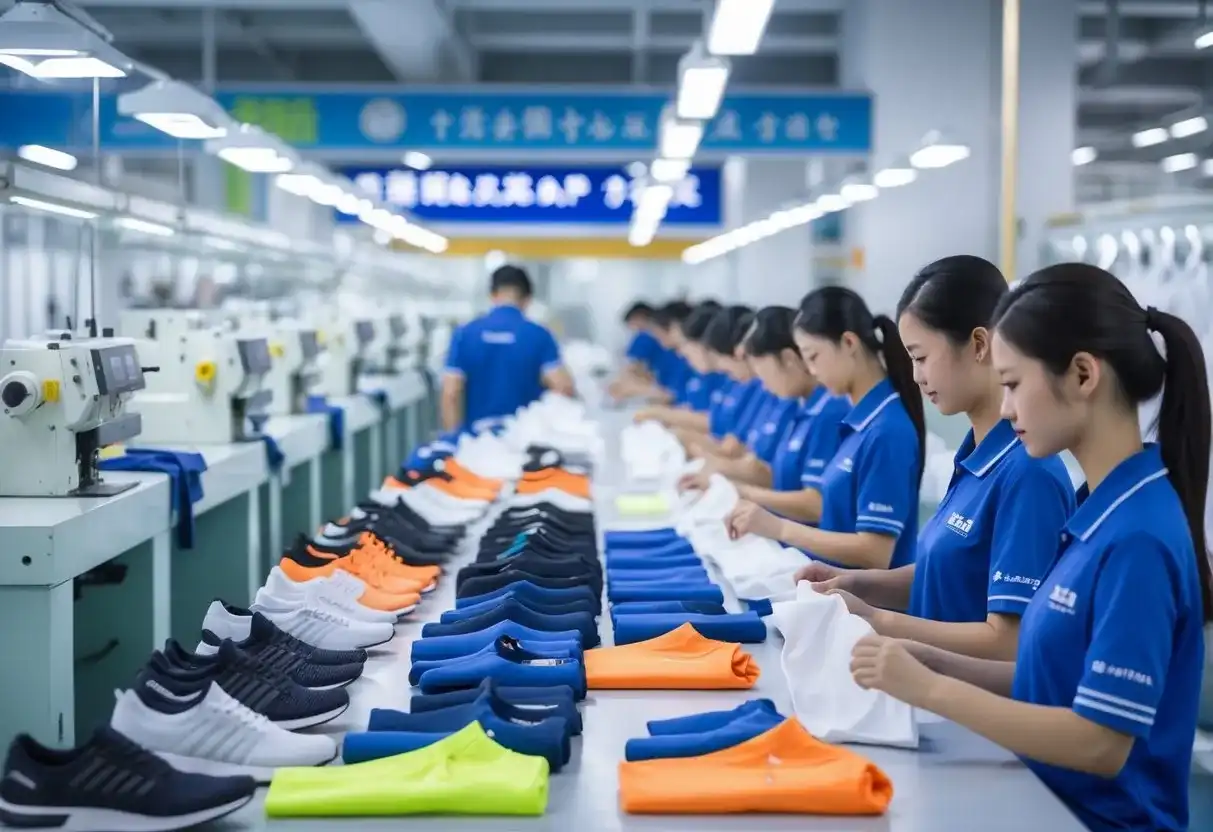
Also, it is known as a “one-stop shop” or “vertically integrated” clothing maker. The floor has no grey areas. The factory does all the stages in-house. This includes tech packs and design. It means that the factory gets the fabric, makes samples, cuts and sews the order in bulk, applies private labels, and handles the packing and shipping by themselves. They never outsource them to other companies.
Most sports clothing manufacturers china claim to have the Full Package Production approach, but very few actually adopt it. Here is a guide that shows how to spot a genuine one. Also, we provide a list of credible ones to choose from. Additionally, we’ll make a comparison among them.
Summary: The Contemporary Scene in Chinese Sportswear Production
The manufacturing sector in China in 2026 is no longer a homogenous giant. On one hand, you find the big factories that are built for the tens of thousands order model. On the other hand, you have the “One-stop OEM customization services” that work with premium brands from the West who are more concerned with the level of service and a smaller order quantity.
For the brands in the US, UK, and the EU, the “One-Stop” model remains the best solution. It entails not worrying about managing fabric suppliers, pattern makers and sewing factories all at the same time. In turn, one partner takes the whole responsibility.
Sourcing: Gaining access to the expanded manufacturing network
Despite the fact that all areas of China have textile and garment manufacturing operations, not all of them specialize in the same part of the process. The sector is highly specialized by region and by knowing where to look, you can locate the right reliable manufacturers.
· Dongguan (The Premium Hub):
This city is often dubbed the “World’s Factory” and is the place where you will find the best-quality work and mid-to-high-end exports. It is a hub for factories that can produce complex streetwear and technical activewear. It is also home to ChengLin Clothing and other high-quality collaborators.
· Fujian (The Shoe & Brand Hub):
Home to big domestic brands like Anta and Erke. This region, especially Quanzhou, is ideal for big production of athletic shoes and mass-market sportswear.
· Yiwu (The Commodity Hub):
Best known for its large wholesale market. Yiwu is the hub of low-cost basic items and accessories. However, customization options may be superior in Dongguan.
Best Sports Clothing Manufacturers according to Category in China
We have classified the top manufacturers comprehensively according to their specializations to make your search easier.
1. Best for Premium Private Label: ChengLin Clothing
If you are a brand looking for a true Full Package Production partner, ChengLin Clothing (Dongguan ChengLin Clothing Co., Ltd.) is the one you must go for. They are in the business since 1998 and have been offering the “One-stop OEM customization service” for customers in the USA, Canada, Australia, and UAE for the last 27 years.
We are not a trading company but the owners of the factory. Above 200 highly trained staff work here. Besides, we are among a few factories that maintain a startup-friendly MOQ of 50 pieces per style. This leads to the possibility of professional manufacturing for budding brands. Our partnership with AIIZ (Zara in Thailand) which has been in place since 2008 bears testimony to our credibility.
2. Best for Large-Scale Production: Sansansun Sports
If your order exceeds 10,000 units, refer to Top 10 Sportswear Manufacturers in China which lists Sansansun among the 10 top-rated options. Their production capacity is 400,000 pieces monthly. Sansansun is a recommendation for global brands that are after high volumes.
What “Full-Service” Really Means (The Complete Checklist)
A lot of suppliers brag that they can deliver a complete package, but in reality distrusting source their duties to different vendors thus end up being the main project manager. One handles the fabric. Another is for sewing. One for labels. You keep tracking timelines. You resolve communication issues. You absorb all the delays.
A real “one-stop” clothing manufacturer can deliver all seven stages in one workflow. If a manufacturer cannot offer all seven stages, then it is very likely you are dealing with a partial-service provider.
Full-Scale FPP Checklist 7-Stage
1. Design Support & Tech Pack Creation: They create it from your sketch, mood board, or a reference image. They create a tech pack ready for production.
2. Fabric & Material Sourcing: They procure fabric, trims, zippers, and hardware from their own supplier network. You don’t have to procure anything on your own behalf.
3. Samples & Prototypes: They create a final physical sample, they then revise it and approve it before they start the mass production.
4. Bulk Cut-and-Sew Production: In-house cutting, sewing, and assembly. Not sent out to a separate factory.
5. Quality Control (QC): Multiple inspections at the fabric stage, during production, and before packing.
6. Private Labels & Custom Packaging: Woven labels, hangtags, and branded poly bags made and applied at the same facility.
7. International Shipping & Logistics: Door-to-door delivery and customs paperwork handled by the manufacturer.
The “One-Stop” Process (Timeline)
To demonstrate the effective functioning of this model we take our own workflow at ChengLin as an example. This model which is divided into 6 stages, transforms a concept from “idea” to “delivered product” in a timeframe of 30-60 days.
| Stage | This is What We Do (ChengLin Model) |
| 1. Design & Tech Pack | In this step, we work from sketches or reference images. Our designers bring out production-ready tech packs. |
| 2. Fabric Sourcing | We rely on established suppliers and we also promote the use of eco materials (recycled, organic) and technical blends. |
| 3. Sampling | We create physical samples (7-14 days); we modify them and then approve for bulk production. |
| 4. Large-Scale Production | We do a full-scale production run for all types: hoodies, t-shirts, streetwear, activewear, and outerwear, through in-house cut and sew. |
| 5. Integrated QC | The 5-step Quality Control (QC) process is employed throughout the production phase and not just before the final check. |
| 6. Global Logistics | We provide branded packaging, custom labels, and door-to-door shipping with proper documentation on customs. |
This is the know-how that has enabled us to serve our clients in Germany, Saudi Arabia, Dubai, and the USA for 20 plus years.
Selecting the Suitable Manufacturer
Your stage of growth determines the manufacturer you need to choose. Let this guide help you in making the right decision.
· START: Is the tech pack ready?
· NO: You will need a Full-Service manufacturer (like ChengLin Clothing) that provides design and tech pack support.
· YES: Go to the next step.
· NEXT: Is your order under 100 pieces?
· YES: Look for “Startup-Friendly” factories. (Note: Most factories need 300+. We offer an MOQ of 50 pieces to help with this).
· NO: You can work with larger factories like Sansansun or SGL Sports.
· NEXT: Are you looking for specific certifications (BSCI/OEKO-TEX)?
· YES: Check the credentials right at the beginning. Look for independently audited certifications, not just claims.
· NO: You may find lower prices at small workshops. Sometimes the quality is inconsistent.
Trust Signals & Red Flags
The most common mistake we witness is brands settling for the cheap quote without understanding the supplier hasn’t full-stacked the production process. Then, they spend long glitches repairing the defective supply chain.
What to Observe When Checking
Make sure to link the right potential suppliers, ask the following specific questions before attaching:
· “Do you handle fabric sourcing in-house, or do I need to send fabric to you?”
· “Can you create a tech pack from a reference image?”
· “What does your QC process look like at each stage?”
· “Do you manage shipping and customs documentation?”
Red Flags to Watch for
· Vague & Incomplete Responses: The seller does not offer clear answers regarding where the certain steps will be done.
· No Sample Policy: Unclear terms about amendments or costs.
· High MOQs: Minimums in the thousands often mean they lack flexible, in-house capacity.
· Absence of Integrated QC: Only providing a “final inspection” instead of checks throughout the production process.
FAQs
Q1: What are the measures I should take to verify the trustworthiness of sports clothing manufacturers in China?
A: In addition to checking the Alibaba badges, you can schedule a video call to take a look at the factory floor directly. You should also demand specific audit reports like BSCI or ISO 9001. Further, you should ask for references, or case studies related to your product category. Our company ChengLin says that we have been in the market for 27 years and as evidence of our reliability, we work with names like AIIZ.
Q2: Can you mention the common minimum order quantity (MOQ) in Custom sportswear manufacturing?
A: The most usual MOQ requirements are 300 to 500 pieces per style. Nevertheless, this locks many startups out. To address this, some full-service manufacturers have relaxed their MOQ. To illustrate, ChengLin Clothing has an MOQ of only 50 pieces per style to aid brands in testing the market while avoiding heavy inventory.
Q3: Which area in China has the best capabilities in the production of premium activewear?
A: Dongguan is mostly recognized as the most important production hub for high-quality clothing. It is superior to Yiwu in terms of craftsmanship and access to premium technical fabrics.
Q4: Is it necessary to supply my own fabric?
A: You don’t need to do that when working with a Full Package Production (FPP) manufacturer. True FPP partners will source the fabrics directly for you based on your requirements (like moisture-wicking or recycled polyester) from their supply network.
Q5: How much time does the manufacturing process consume?
A: A regular timeline for a “One-stop OEM” project is around 30 to 60 days. During this period, 7-14 days are set aside for sampling and 25-45 days for bulk production depending on the complexity and the quantity of the order.