Today, many people face a situation where they need to choose a virtual server for a website, online store, CRM system, or remote desktop. So, let’s consider a common situation: for example, you need to host your own project on the Internet, but you do not understand which operating system is better to choose — Windows or Linux. At first glance, it may seem that there is almost no difference, but after only a few days of renting a VPS, you may encounter many important nuances.
When a Person First Looks to Buy a VPS
They usually pay attention only to the price. However, you quickly notice that Windows servers almost always cost more than Linux VPS solutions. The reason is quite simple: the Windows operating system requires licensing, while Linux is distributed freely. For example, you need to launch a regular WordPress website. In this situation, a Linux server turns out to be cheaper and simpler. But if you want to use programs that work only in the Windows environment, the situation changes completely.
Let’s look at the situation in more detail. Imagine that you are opening a small online store. You rent a virtual server and want to connect accounting software, remote access for employees, and a familiar desktop interface. This is exactly where a Windows VPS often becomes more convenient for beginners. You get a familiar graphical environment similar to a regular home computer. Linux, on the other hand, is more focused on console management, which may initially cause some discomfort.
If we compare virtual servers by stability, Linux is traditionally considered a more reliable system. So, a Linux server can operate for months without rebooting while consuming fewer resources. However, Windows VPS wins in compatibility with commercial software. For example, you may need to install Microsoft SQL or specialized office software. In such a real-life situation, Linux is not always suitable, and you are forced to choose Windows.
Windows VPS or Linux VPS?
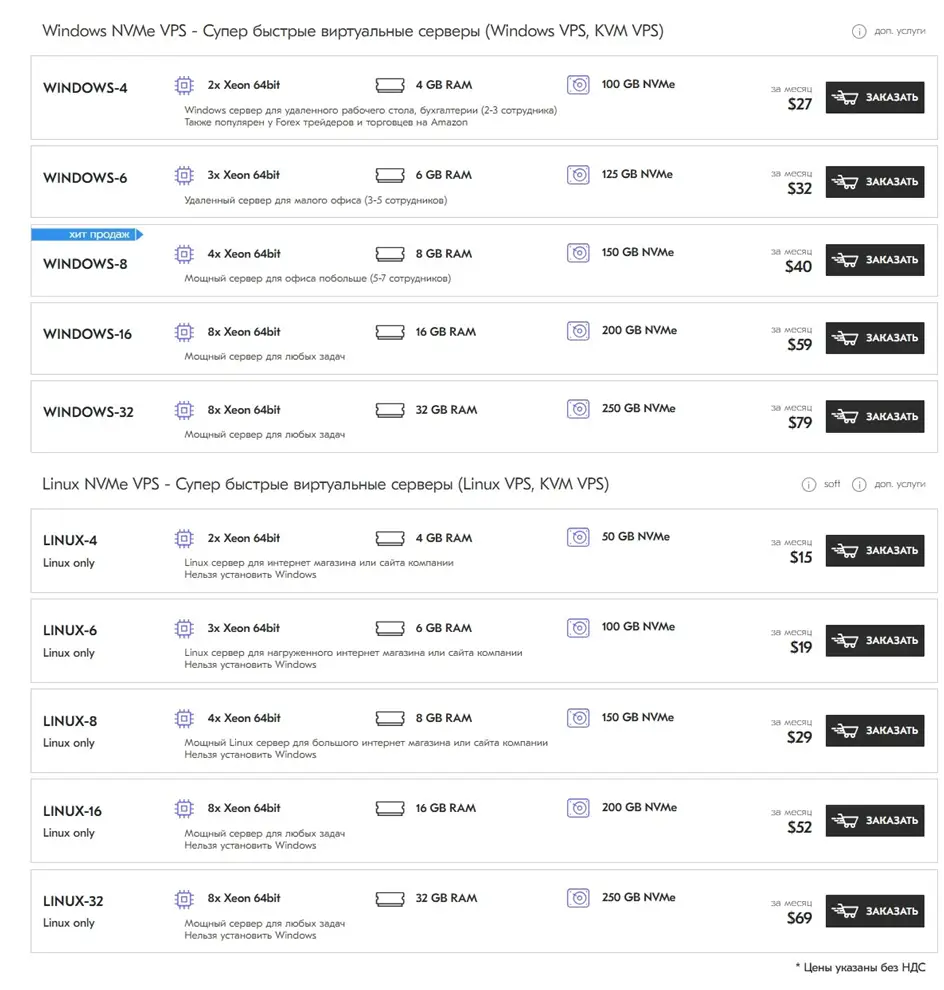
Many users are surprised that VPS specifications on Windows and Linux differ even at the same price. Let’s consider a situation where you rent a Linux VPS and receive more RAM and disk space for the same money. The reason is that Windows uses part of the resources for its graphical shell and background processes. Linux works lighter and more efficiently. That is why hosting providers often offer more powerful Linux configurations at a lower cost.
Speaking about pricing in dollars, a standard Linux VPS may start at around $5–7 per month, while a Windows VPS often starts at $12–20. However, you should understand that the price depends not only on the operating system. For example, you may need to store large databases or run remote desktops for employees. In this case, the server cost increases regardless of the selected platform. But even here, Linux usually remains the more affordable solution.
Now let’s consider a situation where the user has no technical knowledge at all. You buy a VPS and expect everything to work like a regular computer at home. This is exactly why Windows VPS is often chosen by beginners. The interface is familiar, the buttons are recognizable, and many actions are performed with a mouse. Linux, however, requires understanding the command line, directory structure, and administration principles. For a beginner, this can sometimes become serious stress.
Nevertheless, Linux has its own strong advantages. For example, you need to host a website with high traffic. In this situation, Linux usually provides better speed and lower server load. In addition, most modern web technologies are originally optimized for Linux environments. So, if you plan to launch online projects, blogs, or forums, Linux VPS often becomes a more practical choice.
Why Windows VPS Can Be Better Than Linux VPS…
Now it is worth discussing three reasons why a Windows VPS may be better than a Linux VPS. The first reason is compatibility with Microsoft software. For example, you may need to use Remote Desktop, Microsoft Office, or corporate applications. In this case, Windows becomes much more convenient. The second reason is the familiar interface. You learn the system faster and spend less time studying it. The third reason is the convenience of remote employee work. Many companies prefer Windows VPS precisely because of the easy connection process and understandable work environment.
However, Windows VPS also has disadvantages. So, let’s consider a situation where the server starts installing updates automatically and requires a reboot. For business, this can sometimes become a problem. In addition, Windows VPS is more often exposed to viruses and requires more careful security configuration. Another disadvantage is increased resource consumption. You may notice that a Windows server works slower than Linux with the same specifications.
Special attention should also be paid to the knowledge required to work with a virtual server. For example, you may need to configure a website, database, or backup system yourself. In Windows, many operations are performed through a graphical interface, making it easier for beginners. Linux, however, requires learning the terminal, SSH connections, and server commands. But over time, Linux gives you much more flexibility and control over the server.
When a person decides to buy a VPS, they often do not realize how important the provider’s technical support is. Let’s consider a situation where the server stops responding at night and the website becomes unavailable. At such moments, much depends on the quality of the hosting company. In Ukraine, there are several popular virtual server providers, among which DeltaHost can be highlighted. All these companies offer VPS rental services with different operating systems and pricing plans.
About DeltaHost..
It is worth mentioning DeltaHost separately because the company actively offers both Linux VPS and Windows VPS for users from Ukraine and Europe. So, if you need a server for a website, a Linux solution may be more profitable. But if you plan to use remote desktops or corporate applications, Windows VPS looks like a more convenient choice. These real-life situations are what most often determine the user’s final decision.
Let’s look at the situation from the perspective of an ordinary person. For example, you simply need to launch your own project and do not want to spend months learning server technologies. In this case, Windows VPS creates the feeling of working on a familiar computer. But if you want maximum performance and minimum costs, Linux VPS gradually starts to look more rational. Here, much depends not so much on server specifications as on your tasks and level of experience.
So, there is no universal answer. Some users choose Windows because of convenience and a familiar interface, while others prefer Linux due to stability and lower costs. The most important thing is to understand in advance which programs you are going to use and how deeply you are ready to study server administration. Only then will renting a virtual server become not a difficult technical challenge for you, but a convenient tool for developing your own project or business.
Andrii Kovalenko
Rating: ★★★★★ 5/5
“A very understandable article for those who decided to buy a VPS for the first time. I especially liked the comparison between Windows and Linux through simple real-life examples. After reading it, it became much easier to understand which server is right for you.”
Was this review helpful? Yes (14) / No (1)
Iryna Voloshyna
Rating: ★★★★★ 5/5
“For a long time, I could not decide which VPS to buy: Linux or Windows VPS. Here the author explained everything in simple language without complicated terms. I also liked the mention of DeltaHost as an example of a Ukrainian hosting provider.”
Was this review helpful? Yes (19) / No (2)
Serhii Melnyk
Rating: ★★★★ 4/5
“A useful article for beginners. I previously did not understand the difference between Windows VPS and Linux VPS at all. After reading it, it became clear why Linux is cheaper while Windows is more convenient for regular users.”
Was this review helpful? Yes (10) / No (1)