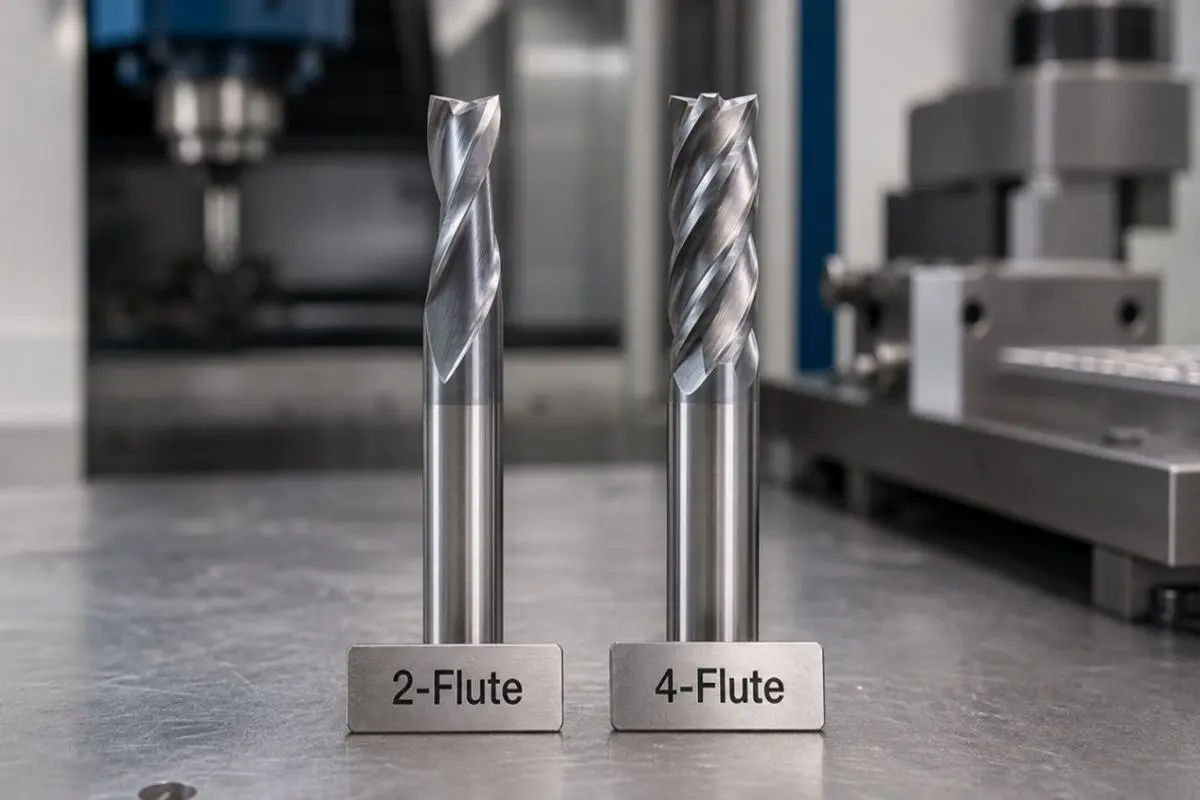
In CNC milling, the number of flutes on an end mill affects chip evacuation, cutting stability, surface quality, and machining efficiency. Among them, 2-flute and 4-flute end mills are two of the most commonly used designs. Since both are end mills, how should you choose between them? Experienced manufacturers will consider the workpiece material, machining method, chip evacuation conditions, machine rigidity, and the customer’s surface finish requirements to design and manufacture the most suitable tool for the current machining application.
1. Characteristics of 2-Flute End Mills
2-flute end mills have large chip spaces and strong chip evacuation capability. Because they have fewer cutting edges, the space between each cutting edge is larger, making chips easier to evacuate and reducing the risk of chip clogging.
Therefore, 2-flute end mills are usually suitable for machining materials that produce long, soft chips and are prone to material adhesion, such as aluminum alloys, copper, plastics, and some non-ferrous metals. During high-speed aluminum milling, their excellent chip evacuation capability can reduce built-up edge formation, lower cutting heat, and improve machining stability.
However, because fewer cutting edges participate in cutting, the feed capability and cutting stability of 2-flute end mills are lower than those of 4-flute end mills at the same spindle speed. Especially when machining harder materials or performing heavy-duty cutting, vibration marks can easily occur, tool wear may accelerate, and surface quality may become unstable.
2. Characteristics of 4-Flute End Mills
Compared with 2-flute end mills, 4-flute end mills have twice as many cutting edges, resulting in better tool rigidity and higher stability. They can withstand higher feed rates and are suitable for applications with high requirements for efficiency and surface quality.
Because there are more cutting edges, the cutting load carried by each edge is distributed more evenly. Therefore, they are more suitable for machining steel, stainless steel, cast iron, mold steel, and similar materials. In finishing, side milling, profile milling, and machining environments with higher machine rigidity, 4-flute end mills often achieve better surface finishes.
3. The Core Difference Between 2-Flute and 4-Flute End Mills
2-flute end mills have larger flute spaces and stronger chip evacuation performance, while 4-flute end mills provide greater rigidity and stability and can produce smoother surface finishes.
If the material is relatively soft and produces long chips, such as aluminum alloys and copper, a 2-flute end mill is usually more suitable. It provides sufficient space for chip evacuation, reducing the risk of chip clogging and material adhesion.
If the material is harder, or if higher dimensional accuracy and surface quality are required, a 4-flute end mill is usually more suitable. It provides smoother cutting, greater rigidity, and is better suited for machining steel and stainless steel.
4. Should You Choose a 2-Flute or 4-Flute End Mill for Aluminum Alloy?
When machining aluminum alloys, a 2-flute end mill is usually the more common choice. Aluminum chips are relatively soft and tend to stick to the cutting edge. If chip evacuation is poor, built-up edge can easily occur, affecting surface quality and shortening tool life.
A 2-flute end mill has larger flute spaces, allowing chips to be evacuated more quickly. It is especially suitable for high-speed milling, slotting operations, and deep cavity machining.
Of course, this does not mean that 4-flute end mills cannot machine aluminum. For shallow cutting, finishing operations, or when using high-helix 4-flute end mills specifically designed for aluminum alloys, good surface finishes can also be achieved. However, under normal machining conditions, 2-flute end mills are generally more suitable for aluminum.
5. How Should You Choose for Steel and Stainless Steel?
When machining steel, stainless steel, or mold steel, 4-flute end mills usually offer greater advantages. These materials have higher hardness and place greater demands on tool rigidity, wear resistance, and cutting stability.
A 4-flute end mill provides a smoother cutting process, reduces vibration, and improves surface quality. Especially in side milling, profile milling, and finishing operations, the 4-flute structure makes it easier to maintain dimensional stability.
However, chip evacuation and heat dissipation remain very important in stainless steel machining. If the slot is deep or chips cannot be evacuated in time, you may consider using a 3-flute end mill, a 4-flute end mill with special flute geometry, or optimizing cooling methods and cutting parameters.
6. Which One Should Be Chosen for Slotting?
During slotting operations, the tool is almost fully engaged across the entire cutting width, generating a large volume of chips and creating high chip evacuation pressure. Therefore, a 2-flute end mill is usually more suitable for slotting, especially when machining aluminum, copper, and plastics.
If a 4-flute end mill is used for deep slot machining, special attention should be paid to chip evacuation. Because the flute space is smaller, chips can easily become trapped in the slot, causing tool heating and wear. If a 4-flute end mill must be used, it is recommended to reduce cutting depth, improve cooling and chip evacuation, or use step-down machining methods.
7. Which One Should Be Chosen for Finishing?
If the goal is to achieve better surface finish and dimensional stability, a 4-flute end mill is usually more suitable for finishing operations. More cutting edges make the machining process more continuous and stable, reducing tool marks and vibration.
For finishing steel, stainless steel, cast iron, and mold steel, 4-flute end mills are a very common choice. For aluminum alloy finishing, the decision depends on the tool structure. If a dedicated aluminum end mill is used, 2-flute or 3-flute designs can also achieve excellent surface quality.
8. How to Choose According to Actual Machining Conditions?
The choice between a 2-flute and a 4-flute end mill can start with the following questions:
What material is being machined?
If the material is aluminum, copper, plastic, or other soft materials, prioritize a 2-flute end mill. If it is steel, stainless steel, cast iron, or mold steel, prioritize a 4-flute end mill.
Is a large chip evacuation capacity required?
For slotting, deep cavity machining, and deep slot machining, 2-flute end mills offer advantages. For shallow cutting, side milling, or finishing operations, 4-flute end mills are more suitable.
Are high surface finish requirements important?
When surface quality requirements are high, 4-flute end mills are usually more stable.
What are the machine rigidity and cooling conditions?
If machine rigidity is good and cooling is sufficient, higher-flute tools can be used to improve efficiency. If chip evacuation conditions are average, lower-flute tools are generally safer.
Is high feed efficiency required?
Under suitable materials and machining conditions, 4-flute end mills can achieve higher feed rates.
9. Common Selection Recommendations
For most machining applications, the following guidelines can be used:
- Aluminum alloy slotting: Prioritize a 2-flute end mill.
- High-speed aluminum milling: Prioritize a 2-flute or 3-flute end mill.
- Steel side milling: Prioritize a 4-flute end mill.
- Stainless steel finishing: Prioritize a coated 4-flute end mill.
- Deep slot machining: Prioritize chip evacuation capability; a 2-flute end mill is usually safer.
- Mold steel finishing: Prioritize a 4-flute or multi-flute end mill.
- Plastic machining: Prioritize a 2-flute end mill to avoid chip melting and material adhesion.
10. Summary
There is no absolute advantage between 2-flute and 4-flute end mills. The key is whether the tool matches the material and machining method.
2-flute end mills provide stronger chip evacuation capability and are suitable for aluminum, copper, plastics, and other soft materials, as well as slotting and deep-slot applications that generate large volumes of chips.
4-flute end mills provide greater rigidity and more stable cutting performance, making them suitable for machining steel, stainless steel, cast iron, and mold steel. They are especially suitable for finishing operations and applications with high surface finish requirements.
If your machining priority is chip evacuation and preventing material adhesion, a 2-flute end mill is usually the better choice. If your priority is stability, efficiency, and surface quality, a 4-flute end mill is often the better option.