By 2026, labeling companies no longer viewed themselves as mere service providers. Instead, they identified themselves as major brand identity builders. They now fall at the intersection of design, technology, logistics, and marketing. They affect the perception of products before the customer engages with them. Their role evolved from labeling products to providing brand experiences.
What was once a background task in packaging and printing labels has become an integral frontline task in branding. Labeling companies help their clients convey trust, quality, cutting-edge technology, and sustainability. The transformation will ultimately elevate the standard of global product branding.
Labeling Companies as Major Branding Builders
The contemporary labeling companies have transcended task execution. The companies have taken a proactive position in building the brands. The companies have made strategic alliances with product marketing, product design, and supply chain teams to create identity packaging and labeling.
The companies do not merely execute the design but rather help create the branding language. Each design element and aspect in a label is brand positioned. The labels for luxury products and mass produced consumer products will be designed and engineered differently.
Because of the positioning of labeling companies, they have become branding architects, and their contributions are critical.
Labeling Companies and the Innovation of New Technology
The labeling companies in 2026, and the rest of the world, have adopted and become reliant on advanced technology. Labeling companies have transformed production with the adoption of high-speed digital printing and AI design, including automation and augmentation.
As a result of new technologies, label manufacturers can effortlessly create consistent, detailed, and complex designs in bulk. Variable data printing is spreading, as it allows for individualized codes, messages, and related alterations on every label of a batch.
Cloud system integration allows labeling companies and brands to work together in real time. Changes to a design are now instantaneous. This decreases the time taken to implement a market strategy.
Hyper-Customization and Market-Specific Branding
Labeling companies have mastered hyper-customization. With their help, brands can easily modify their labels to fit the needs of certain demographics, regions, and even specific campaigns.
Refined production systems have translated to labeling companies’ ability to quickly adapt to numerous changes. These changes can be related to time of year, culture, or even special promotions.
Since these companies have such advanced customization systems, brands are empowered to differentiate and define their identity all while keeping their core values the same.
Sustainability Paradigm Shift in Labeling Companies
Environmental responsibility is expected in labeling companies now. It is a market reality.
In this new reality, companies are creating less waste with new label components and using new systems to print with less energy and only water-based inks. Recyclable liners and label materials with eco-friendly adhesives are also in the new offerings.
Apart from materials, labeling companies are reshaping design workflows to cut down on waste. With design proofs and samples being replaced by digital proofs, and carefully designed layouts preventing material wastage, these advances reduce costs for businesses and support sustainability.
Smart Labels and the Integration of Digital Systems
Smart labels have become the norm by 2026. Labeling companies are integral in linking physical products to the digital world.
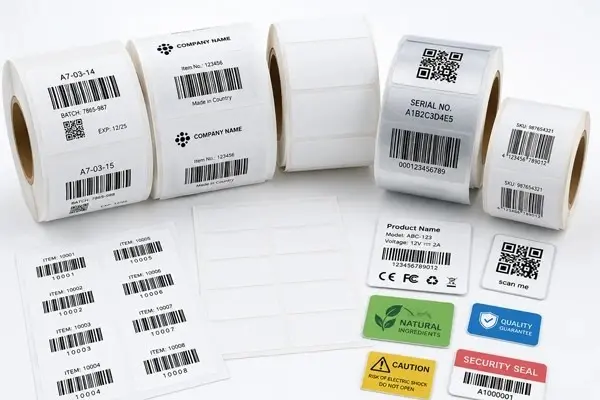
With the aid of QR codes, NFC chips, and other RFID technologies, these labels allow consumers to digitally contact brands, view detailed product information, and authenticate products. Depending on the label, consumers can view information on product tips, sourcing, and even promotional offers.
This establishes a nearly permanent line of communication between brands and consumers.
Labeling companies are constructing the bridge between physical packaging and digital systems.
Predictive Branding and the Design Intelligence of AI
Labeling companies are making great use of the capabilities of artificial intelligence.
With the assistance of AI, labeling companies have begun to design and optimize labels using the AI’s knowledge of consumer behavior and design intelligence.
AI gives packaging and labeling companies a great advantage in both the aesthetics of packaging and the quality of the printing. Systems can check for errors in print quality and alignment and scanning can check for color quality. Because of this, labeling companies can provide high quality products that maintain design and print consistency.
Security and Anti-Counterfeiting Solutions
Protection against counterfeiting has become one of the most crucial services of labeling companies. With the expansion of global trade, the possibilities of imitation products has become a significant issue.
Most labeling companies now incorporate security features to their products. Some of these include: holographic layers, encrypted QR codes, micro-text printing, and tamper evident seals. With these features, counterfeiting becomes almost impossible.
These advances also help consumers. Tamper evident seals and micro-text printing help consumers verify product authenticity using their mobile devices. This increased brand confidence and mitigates financial and reputational risk to the company.
Global Supply Chain Intelligence
Modern Supply Chain systems rely heavily on labeling companies. Products can now be labeled and marked to identify each one throughout the entire supply process.
Companies can now track the movement of products through the use of bar codes and RFID labeled systems. This, in turn, allows a greater efficiency in the time management of products, while also decreasing the risks of errors such as misdirection and stock inaccuracy.
This traceability is of high importance in the pharmaceutical, food, and electronics industries due to the rigid safety and compliance standards. Labeling companies are thus important on a global scale.
Enhanced Consumer Experience Through Label Design
Labeling companies have evolved the utility of labeling products from solely informative to interactive and influential.
Label designs that are engaging and inviting help foster a deeper emotional connection with the purchase. This can be achieved by using materials that incorporate features such as interactivity, augmented reality, and minimalist design. This even helps create a memorable experience for the consumer.
Labels are now able to communicate a story to the consumers at the time of purchase, as opposed to just conveying a piece of information.
Challenges in the Industry and Competition
The labeling industry is facing challenges due to an increased need for companies to innovate at a fast pace. An increase in the cost of raw materials and the need to provide a service with a faster turnaround time is problematic. Global standards also require constant adjustments in production.
Only companies that digitalize, and implement automation and sustainable practices, will thrive in the fast-evolving world of labeling.
Where Labeling Companies are Heading
Labeling companies will integrate more with digital systems. Labels will be non-static, digital interfaces, containing some form of blockchain for verification, with the ability to be personalized by AI and analyzed in real-time.
The future labels will also be more interactive and responsive to their environments. Branding will also be digital, flexible and, most importantly, steeped in research and data.
With the way things are progressing, labeling companies will be at the forefront of Branding.
Final Thoughts
Labeling companies in the year 2026 will have revolutionized the branding of products. They will have moved from service providers to essential partners in conveying the brand’s identity and engaging the customer.
They will have re-imagined brand communication through their services and extended their reach into logistics and customer services.
Labeling companies will continue to strengthen, smarten, and connect global brands, even as the industry evolves.