Turkey has emerged as the global epicenter for dental tourism, attracting over 500,000 international patients annually seeking high-quality dental care at a fraction of Western prices. Among these travelers, dental implant patients represent the fastest-growing segment, driven by a compelling combination of premium European materials, experienced specialists, and costs that average 60-70% less than US or UK equivalents.
The decision to travel abroad for dental work requires careful consideration. You’re not just evaluating price, but weighing quality, safety, credentials, and whether the entire experience justifies the journey. For dental implants specifically, Turkey offers advantages that extend far beyond simple cost savings, making it worth examining why thousands of patients choose Istanbul over their local options each year.
The Cost Reality: Premium Materials at Accessible Prices
The primary driver for most dental tourists is undeniable: cost. A single dental implant with crown costs $3,000-6,000 in the United States, £2,000-3,500 in the UK, and €2,000-3,500 in Western Europe. The same procedure using identical materials costs €450-1,000 in Turkey, including the implant fixture, abutment, and crown.
But here’s what surprises most patients: Turkish clinics use the exact same premium brands their home country dentists use. Straumann implants from Switzerland, Nobel Biocare from Sweden and the US, and BEGO from Germany dominate the Turkish market. These aren’t knockoffs or inferior alternatives. They’re the same implants backed by decades of clinical research showing 95%+ survival rates at 10-15 years.
The cost difference stems from economic factors, not quality compromises. Overhead expenses, staff salaries, and facility costs in Turkey run significantly lower than Western countries. Turkish dentists earn respectable professional salaries within their local economy, but those salaries translate to lower treatment costs for international patients paying in euros or dollars. When a dentist in Istanbul charges €1,200 for a Straumann implant, they’re earning appropriate professional compensation within their economic context while offering you the same implant that costs $5,000 in Manhattan.
Labor costs explain only part of the equation. Competition drives the rest. Istanbul alone has over 300 dental clinics competing for international patients. This competition forces clinics to maintain high quality standards while keeping prices competitive. A clinic using inferior materials or producing poor outcomes quickly develops a reputation that kills its international patient flow in the age of Google reviews and dental tourism forums.
Infrastructure and Expertise Concentrated in Istanbul
Turkey didn’t stumble into becoming a dental tourism hub. The country strategically invested in healthcare infrastructure over the past two decades, recognizing medical tourism as a growth sector. The Turkish government offers tax incentives for clinics serving international patients and maintains strict accreditation standards through the Ministry of Health.
Istanbul’s position as a bridge between Europe and Asia creates a concentration of dental expertise. Many Turkish dentists complete their education domestically, then pursue advanced training in Germany, Switzerland, or the United States before returning to establish practices. This combination of Western training and local practice creates providers comfortable working with international patients and familiar with Western treatment protocols and expectations.
The clinic density in areas like Ümraniye, Ataşehir, and Şişli means sophisticated dental laboratories, implant suppliers, and specialist networks all operate within small geographic areas. If you need a bone graft specialist or a maxillofacial surgeon for a complex case, they’re typically 10-15 minutes away. This infrastructure supports comprehensive treatment planning that rivals or exceeds what many regional US or UK cities offer.
Modern Turkish dental clinics feature technology that would be cutting-edge anywhere: cone beam CT scanners for 3D treatment planning, digital impression systems eliminating messy molds, CAD/CAM systems for same-day crown fabrication, and sterilization equipment meeting EU medical device standards. Darya Dental Clinic, for instance, uses the same Straumann guided surgery protocols found in premier US practices, with digital planning that allows patients to see their final results before treatment begins.
The Treatment Holiday Advantage
Dental implant treatment requires time: initial consultation, implant placement surgery, 3-6 month osseointegration period, and final restoration placement. The traditional approach means multiple appointments over six months, each requiring time off work and disrupting your schedule.
Turkey offers a compelling alternative for the right candidates. Clinics have refined protocols for international patients that compress treatment when appropriate. Immediate loading techniques allow placing a temporary crown the same day as implant surgery for qualified candidates. Final restorations can be completed in 5-7 days during a single trip, with the osseointegration period monitored through virtual consultations and local dentist check-ins.
This creates the treatment holiday concept: combine necessary dental work with an actual vacation. Istanbul offers world-class hotels at reasonable rates, a rich history spanning Roman, Byzantine, and Ottoman empires, and cuisine that rivals any European capital. Patients routinely report that their treatment costs plus a week in a four-star Istanbul hotel still totals less than treatment alone in their home country.
The practical logistics work better than many patients expect. Clinics serving international patients provide airport pickup, translator assistance, hotel recommendations, and scheduling that accommodates your travel plans. You’re not navigating a foreign healthcare system alone. You’re working with teams that process hundreds of international patients monthly and have refined the experience.
Quality Standards and Regulatory Oversight
Concerns about quality and safety overseas are legitimate and worth addressing directly. Turkey operates under Ministry of Health regulations that broadly align with EU medical device and practice standards. Dental clinics must maintain licenses that require ongoing inspections, and practitioners must hold Turkish dental licenses equivalent to Western dental degrees.
The challenge for international patients isn’t that Turkey lacks standards, but that evaluating individual clinic quality from abroad is difficult. Accreditations help: look for clinics with Turkish Ministry of Health international patient department authorization and preferably ISO 9001 or similar quality management certifications.
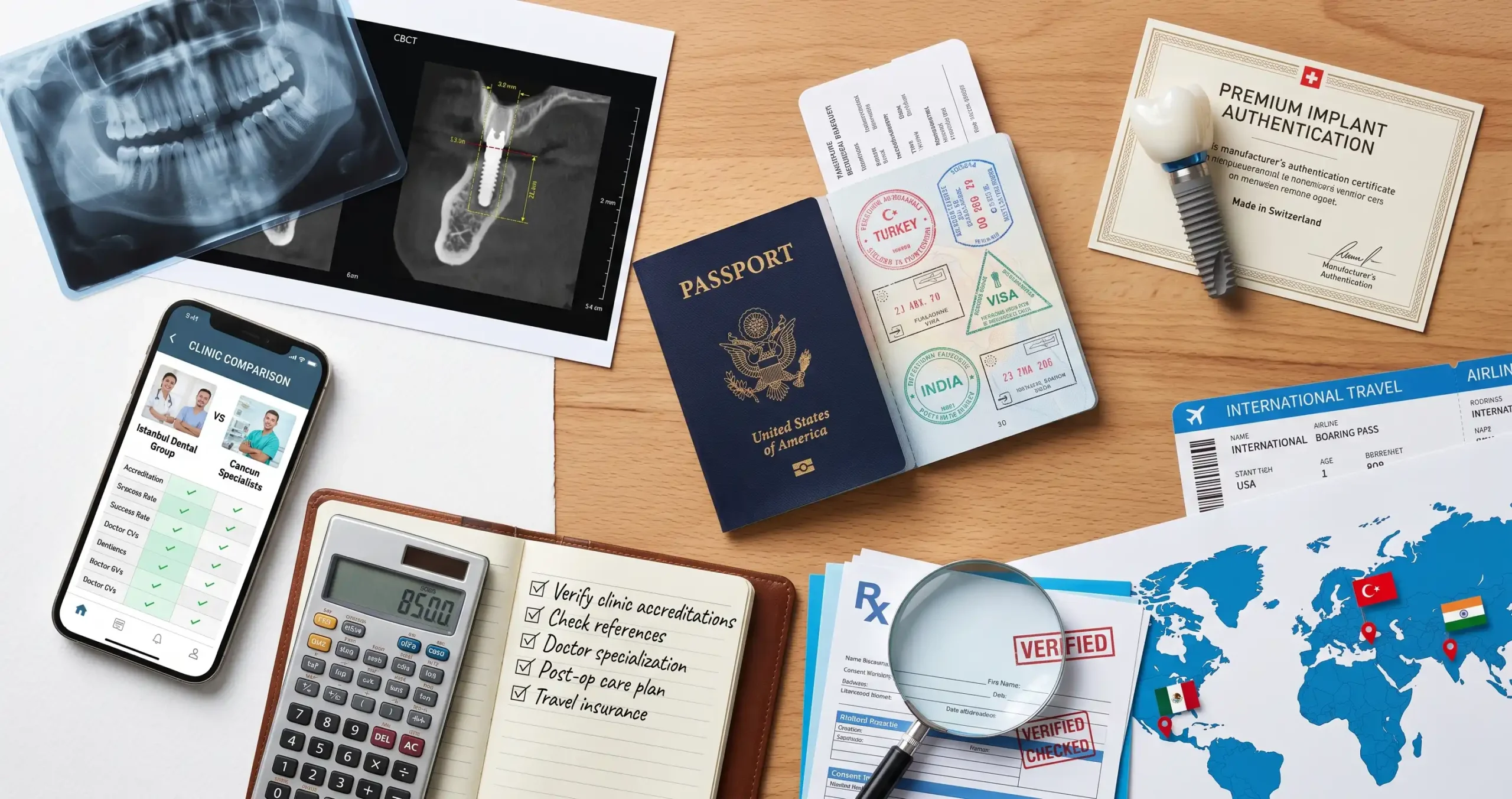
Material authenticity matters enormously. Reputable clinics provide verification documentation for implants showing batch numbers, manufacturer certificates, and authenticity codes you can verify directly with Straumann, Nobel Biocare, or other manufacturers. This verification system prevents counterfeit products and ensures you’re receiving genuine premium implants.
Patient reviews offer another quality signal, but require careful interpretation. Look for detailed reviews on Google, Trustpilot, or specialized dental tourism forums rather than testimonials on clinic websites. Pay attention to reviews mentioning post-treatment complications and how the clinic handled them. Perfect five-star ratings across hundreds of reviews might indicate selective publishing rather than actual experience.
Understanding What You’re Actually Getting
The specifics of your implant treatment matter as much as the destination. Not all “dental implants” are equivalent. A single tooth implant differs dramatically from full arch reconstruction, and the technical complexity, time requirements, and costs scale accordingly.
For straightforward cases, single tooth implants with adequate bone density and no complicating factors, Turkey offers excellent value with minimal risk. The procedure is standardized, success rates are well-documented, and the treatment timeline is predictable. These cases represent the majority of dental implant patients.
Complex cases requiring extensive bone grafting, sinus lifts, or full arch rehabilitation need more careful evaluation. While Turkish clinics handle these procedures routinely, the additional complexity means more can go wrong, and addressing complications from abroad becomes more difficult. For complex cases, ensure your chosen clinic has specific expertise in your needed procedures, not just general implant experience.
Material choice matters significantly for long-term outcomes. Straumann dental implants represent the premium tier with the most extensive clinical research backing, showing survival rates above 95% at 10-15 years. Many Turkish clinics offer both premium European brands and more economical options. Understanding the trade-offs between cost and long-term reliability helps you make informed decisions aligned with your priorities and budget.
Making the Decision: Is Turkey Right for You?
Turkey makes sense for dental implant patients in specific situations. If you need one to four implants, have good overall health, reasonable bone density, and can allocate 7-10 days for travel and treatment, the economics and experience work well. The cost savings on multiple implants quickly offset travel expenses while delivering results using the same materials and techniques available domestically.
The decision becomes more nuanced for patients with complex medical histories, significant bone loss requiring grafting, or limited ability to travel. These situations don’t rule out Turkey, but they require more thorough pre-treatment evaluation and communication about potential complications and how they’d be managed.
Access to follow-up care matters. Most implant complications occur either within the first few weeks (infection, failed osseointegration) or after several years (peri-implantitis, prosthetic complications). Reputable Turkish clinics provide ongoing support for international patients through virtual consultations and coordination with your local dentist. Verify these protocols exist before committing to treatment abroad.
The critical success factor is clinic selection. Research multiple options, verify their credentials and material sources, review detailed patient feedback, and communicate extensively before committing. A video consultation allows you to evaluate the dentist’s communication style, treatment philosophy, and whether they inspire confidence. If something feels off during this process, trust that instinct and continue researching.
For patients who’ve done their research and selected a reputable clinic using verified premium materials, Turkey offers compelling value. You receive the same implants and comparable care at a fraction of the cost, combined with the experience of visiting one of the world’s most historically rich cities. That combination explains why dental tourism to Turkey continues growing despite increasing awareness and scrutiny of the industry.