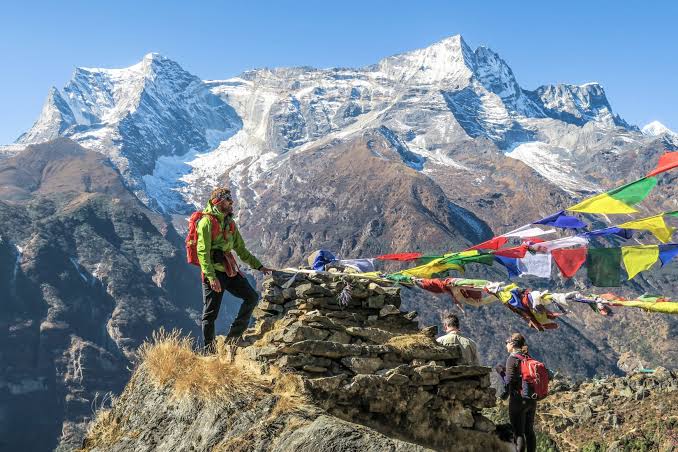
Envision yourself standing before the world’s tallest peak. Do you wish for your dreams to come true? We are available to assist, mentor, and help you realize your ambition. An amazing opportunity to witness numerous high Himalayas, glaciers, rivers, lakes, traditional Sherpa villages, and much more is provided by the Everest Base Camp trip. Different climatic conditions can be found in Nepal, where one can find rare species of animals, insects, butterflies, trees, and many other things.
The first ascent of Mount Everest by Sir Edmund Hilary and Tenzing Sherpa marked the beginning of trekking in the Everest region. Trekking gained popularity when it was first done by many tourists worldwide, and it is currently a sought-after travel destination. Every year, ten thousand tourists from all around the world come to the Everest region. While some decide to turn back in the middle of the trek, many manage to make it to Base Camp. A trek to the Everest region is no small undertaking. It requires both regular exercise and physical fitness.
The trekking route is daring because it requires you to traverse passes, hike across suspension bridges, and cross through forested areas. You may see a clear view of Mount Everest from 5,380 meters above sea level throughout the trek. Lukla, the entry point into the Everest region, is where the 130 kilometer round trip journey begins. It is not feasible to hike all the way to the base camp, though. Acclimatization days are scheduled for this reason. Altitude sickness is caused by continuous trekking.
Traveling 130 kilometers is not a very long trip. Your body needs to rest, so you can hike at a pace of five kilometers per hour. Additionally, avoid hiking higher if you get any altitude sickness symptoms. Trekking lowers elevation, if possible. It is not difficult to cover 5 to 7 km/h if you have excellent endurance.
Employing a porter will help you a lot and reduce the weight. So consider it carefully and take action. In a typical Everest Base Camp Trek of fourteen days, you must walk for nine days. The remaining days are for relaxation, acclimation, and touring Kathmandu. Walking fifteen kilometers a day is not too difficult, but the steep hills and frequent ups and downs hurt your feet. Winter hiking is challenging and nearly impossible due to the possibility of snow-related road closures and landslides, which can happen at any time in a snowy environment.
The amount of time needed for each person to do the EBC journey varies. Some individuals do the walk in 11 days, while others take 12 or 10 days. For some, even 15 days may not be enough. Your level of physical fitness determines this. Maintaining an optimistic outlook is crucial when hiking to a greater altitude.
The things you put in your body and where you sleep are equally important to reaching Everest Base Camp. The cost of these things rises with increasing distance. Additionally, since everything is rotting at higher elevations, avoid eating any non-vegetarian food. In tea houses, you should wear thick, warm clothing and get enough of rest.
Length of Everest Base Camp Trek
The journey to Everest Base Camp in Nepal typically takes 12 days, however because of variations in routes such as Jiri to Everest Base Camp and Gokyo Lake Trekking, it may take longer. It takes longer to ascend than to fall. While returning to Lukla from Everest Base Camp takes three days, the journey takes nine days. Day 1 : Fly from Kathmandu to Lukla (2,850m/9,350 ft) & trek to Phakding ( 2650 m/8562 ft ) Duration: 5 hours.
Day 2 : Trek from Phakding to Namche Bazaar (3,440m/11,285 ft) Duration: 5-6 hours.
Day 3 : Exploration & acclimatization day at Namche.
Day 4 : Trek from Namche Bazaar to Tengboche (3,855m/12,850ft) Duration: 5-6 hours.
Day 5 : Trek from Tengboche to Dingboche (4,360m/14,290ft) Duration: 4-5 hours.
Day 6 : Acclimatization day at Dingboche.
Day 7 : Trek from Dingboche to Lobuche (4,930m/16,175 ft) Duration: 5-6 hours.
Day 8 : Trek from Lobuche to Everest Base Camp and back (5,364m/17,598ft) to Gorak shep (5,185m/17,010 ft) Duration: 6-8 hours.
Day 9 : Climb to Kala Patthar(5,555m/18,208ft) and trek to Gorak Shep to Pheriche (4,250m/13,945ft) 5 hours
Day 10 : Trek from Pheriche (4,250m/13,945ft) to Namche Bazaar (3,440m/11,285 ft) Duration: 6-7 hours.
Day 11 : Trek from Namche Bazaar to Lukla (2,850m/9,350 ft) Duration: 6-7 hours.
Day 12 : Fly back to Kathmandu (1,350m) Duration: 30 minutes flight.
Altitude during Everest Base Camp Trek
The highest elevation hike in Nepal is the EBC trek. The journey begins at 2,800 meters below sea level and concludes at 5,545 meters above sea level, or Kalapather. We don’t stay at Kalapather for an extended period of time because doing so can result in altitude sickness. During the journey, you will need two days to acclimate: one at Namche Bache and the other at Dingboche. Hiking at higher altitudes is greatly aided by the acclimatization days. We swiftly leave Kalapather and return to Pheriche to ensure that our bodies are safe from harm. The locations with elevations for the Nepalese Everest Base Camp hike are listed here.
Kathmandu ( 1,400 m
• Lukla (2,860 m), Phakding ( 2,610 m)
• Namche Bazaar ( 3,440 m )
• Tengboche (3,867 m)
• Dingboche (4,410 m)
• Lobuche (4,940 m)
• Gorak Shep (5,164 m)
• Everest Base Camp ( 5,364 m)
• KalaPather (5,545 m)
• Pheriche (4,371 m)
• Namche Bazaar ( 3,440 m )
• Lukla ( 2,860 m )
• Kathmandu ( 1,400 m)
Final Say
In Nepal, there are a plethora of alternative trekking routes to the typical Everest Base Camp Trek. The choice you make will determine the length, elevation, and distance; however, we strongly advise you to select the normal route due to its comfort and convenience compared to other trekking options. We hope you now understand the precise length of the EBC trek, which is what we want you to clarify. Still, do get in touch with us as soon as you can if you have any questions about it.
Technology Perspective
Technology continues to transform industries through artificial intelligence, cloud computing, automation, cybersecurity, digital platforms, and data-driven decision making. As organizations increasingly adopt digital solutions, understanding emerging technologies becomes essential for businesses, professionals, and consumers. DGM News regularly covers these developments through expert analysis, technology news, and educational resources.
Innovation Outlook
Rapid advances in artificial intelligence, automation, machine learning, cloud infrastructure, and digital transformation continue reshaping global industries. Monitoring these developments helps organizations adapt to changing technologies, improve efficiency, and prepare for future innovation.
Did you know?
Artificial Intelligence is expected to influence nearly every major industry over the coming decade, from healthcare and finance to transportation, manufacturing, education, and entertainment.
AI, Machine Learning, Deep Learning and Generative AI Explained
Google AI Updates
About DGM News
DGM News is an independent digital publication delivering the latest Technology News, AI News, and FinTech News. We provide expert insights on startups, innovation, cybersecurity, software, business, gadgets, cloud computing, artificial intelligence, and emerging technologies. Our mission is to publish informative, accurate, and regularly updated content that helps readers stay informed in today's rapidly evolving digital landscape.
Since our editorial focus includes technology, artificial intelligence, and financial technology, we continuously expand our coverage as new innovations emerge.
Editorial Standards
Every article published on DGM News undergoes editorial review before publication. We prioritize factual accuracy, clarity, transparency, and reader value while following responsible digital publishing practices.
Research Methodology
Our editorial team researches publicly available information from official announcements, technical documentation, research publications, developer resources, reputable industry reports, and trusted public sources whenever applicable. Information is reviewed to improve clarity and accuracy before publication.
Fact-Checking Policy
We make reasonable efforts to verify factual information before publishing. Articles are reviewed for accuracy, consistency, and relevance. If significant developments occur after publication, content may be revised to reflect updated information.
Update Policy
Technology evolves rapidly. Articles may be reviewed and updated periodically to reflect software releases, AI developments, security advisories, regulatory updates, product launches, and other important industry changes.
Source Verification
Whenever possible, DGM News reviews information using official company announcements, technical documentation, research publications, government resources, publicly available reports, and reputable industry references before updating articles.
Editorial Independence
DGM News maintains editorial independence in all publishing decisions. Editorial content is produced independently and is intended to provide balanced, informative, and reader-focused coverage without influence from advertisers or commercial partnerships.
AI Usage Disclosure
Artificial intelligence tools may assist with research organization, grammar improvement, formatting, or editorial workflows. Every article is reviewed by human editors before publication to help maintain quality, clarity, and factual accuracy.
Corrections Policy
Accuracy is important to us. If readers identify outdated information or factual inaccuracies, they are encouraged to contact our editorial team. Verified corrections are reviewed and incorporated whenever appropriate.
Reader Feedback
Reader feedback helps improve our journalism. We welcome suggestions, corrections, and constructive feedback through our Contact page to continuously improve the quality of our reporting.
Last Editorial Review
This article follows the DGM News editorial review process and may be updated periodically as new information becomes available.
Why Trust DGM News?
DGM News is committed to publishing technology journalism that emphasizes accuracy, transparency, editorial independence, and regularly updated information. Our editorial process is designed to provide readers with reliable coverage of technology, AI, fintech, startups, and digital innovation.
DGM News Resources
Topics We Cover
Artificial Intelligence • AI Tools • Machine Learning • FinTech • Cybersecurity • Cloud Computing • Programming • Software Development • Gadgets • Mobile Technology • Business Technology • Startups • Digital Marketing • Blockchain • Cryptocurrency • Science • Innovation • Consumer Technology • Enterprise Technology • Automation