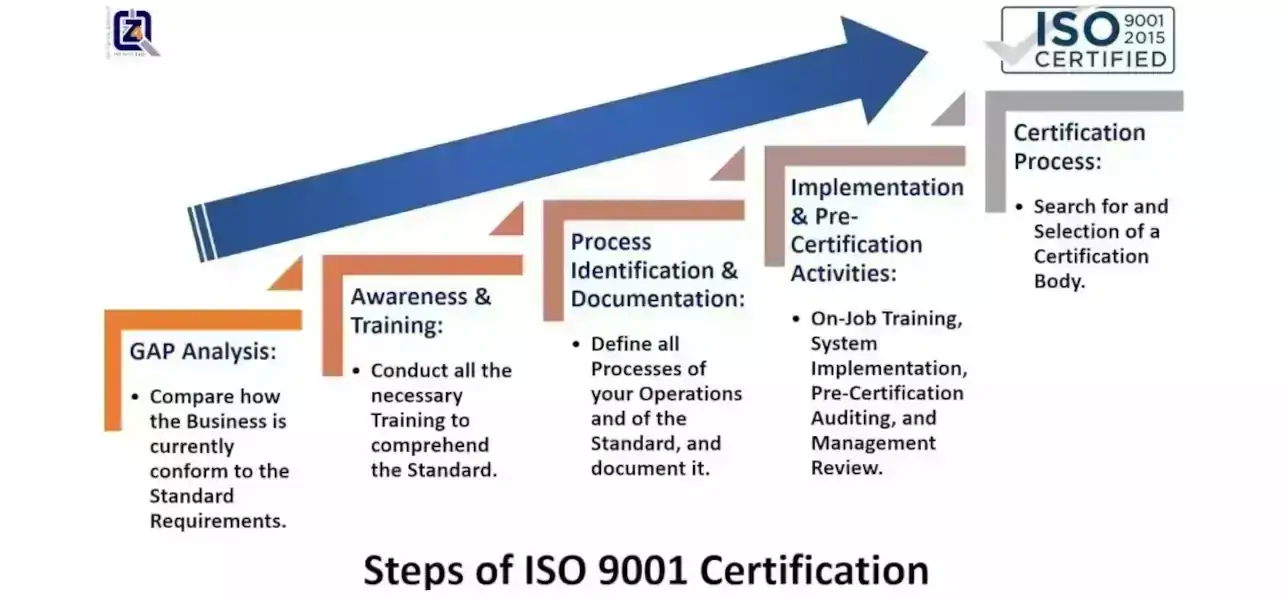
For businesses operating in competitive markets, quality management is rarely just an internal concern. Customers, procurement teams, and regulatory bodies increasingly expect documented proof that an organization’s processes are consistent, controlled, and capable of delivering reliable results. ISO 9001 has become one of the most widely recognized frameworks for demonstrating exactly that. Yet many business owners and operations managers delay certification because the process appears complicated, time-consuming, or resource-intensive. In practice, a focused approach — one that matches the standard’s requirements to how your business actually functions — can move a company from early-stage preparation to certified status in under 90 days. This roadmap explains how.
Understanding What ISO 9001 Actually Requires
ISO 9001 is an internationally recognized standard that specifies requirements for a quality management system (QMS). Developed and maintained by the International Organization for Standardization, it applies to organizations of any size or industry. The standard does not prescribe a specific way of doing business. Instead, it requires that an organization define its processes, document how those processes are managed, identify where things can go wrong, and demonstrate that it takes systematic steps to improve. For businesses exploring iso 9001 certification in chicago, the practical starting point is understanding that the standard measures your ability to consistently meet customer requirements and applicable regulatory expectations — not whether your operation resembles anyone else’s.
The current version of the standard, ISO 9001:2015, is built around a structure called the High-Level Structure, which aligns it with other management system standards. This makes it easier to integrate with other frameworks if your business already operates under separate compliance obligations. The core of the standard covers areas including organizational context, leadership commitment, risk-based thinking, operational planning, performance evaluation, and continual improvement.
Why Risk-Based Thinking Is Central to the Standard
One of the most significant shifts in the 2015 version of ISO 9001 is the emphasis on risk-based thinking. Rather than treating risk as a separate compliance exercise, the standard requires organizations to consider what could prevent them from meeting their quality objectives and to address those factors as part of normal planning and operations. This is not about creating elaborate risk registers or formal assessments for every process. It means that when you plan how a service or product is delivered, you should be able to identify where errors are likely, where customer expectations could go unmet, and what controls are in place to prevent that. For service businesses, this might involve identifying where handoffs between teams create gaps. For manufacturers, it could mean examining where inspection points are positioned in a production sequence.
The 90-Day Certification Timeline: How It Works in Practice
Achieving iso 9001 certification in chicago within 90 days is realistic for most small and mid-sized businesses, provided the process is structured correctly from the start. The timeline is typically divided into three distinct phases: preparation and gap analysis, implementation and documentation, and internal audit plus certification audit. Each phase has a specific purpose and requires different types of effort from leadership and staff.
Phase One: Gap Analysis and Scoping (Days 1–20)
The first phase involves comparing your current operations against the requirements of ISO 9001:2015. A gap analysis is not a criticism of how your business runs. It is a structured review that identifies which requirements your existing practices already satisfy and which areas need documented processes, clearer accountability, or new controls. Scoping is equally important during this phase. You need to define exactly which parts of your business fall within the QMS. For some companies, this is the entire operation. For others, it may be a specific division, service line, or facility. A tightly defined scope reduces the volume of documentation required and focuses your implementation effort where it matters most.
During this phase, leadership involvement is not optional. The standard explicitly requires top management to demonstrate commitment to the QMS — not just awareness of it. This means leadership must be actively engaged in setting quality objectives, aligning them with the organization’s strategic direction, and ensuring that resources are made available for implementation.
Phase Two: Documentation and Process Control (Days 21–55)
ISO 9001 requires documented information that supports the operation of your processes and provides evidence that activities are being carried out as planned. This does not mean creating extensive manuals or policy documents for every task. Modern interpretation of the standard focuses on creating documentation that is useful to the people doing the work, not documentation that exists only to satisfy an auditor. Procedures, work instructions, forms, and records should reflect how your business actually operates. Where a process already functions reliably, the documentation task is largely one of capturing what is already happening. Where gaps were identified in the first phase, documentation must accompany actual changes to how work is managed.
Key documents typically required include a quality policy, quality objectives, a scope statement, process documentation for core operational areas, a risk register or equivalent, and records demonstrating that processes are being followed and monitored. Customer-related processes, purchasing controls, and the handling of nonconforming outputs also require clear documented procedures.
Phase Three: Internal Audit and Management Review (Days 56–75)
Before inviting a certification body to conduct its audit, your organization must complete an internal audit of the QMS. This audit evaluates whether the system has been implemented as documented and whether it conforms to the requirements of the standard. Internal auditors must be objective — they should not audit their own work — but they do not need to be external parties. Many organizations train a staff member to conduct internal audits or bring in a consultant to support this step. The results of the internal audit feed into a management review, which is a formal discussion at the leadership level about the performance of the QMS, results from monitoring and measurement, customer feedback, and decisions about improvement actions. Both the internal audit and the management review must be documented.
Selecting a Certification Body in Chicago
Certification is issued by third-party certification bodies, not by ISO itself. Choosing the right certification body is a practical decision based on accreditation status, industry experience, audit scheduling availability, and cost. To ensure that your certificate carries credibility in the market, the certification body must be accredited by a recognized accreditation organization. In the United States, the ANSI National Accreditation Board (ANAB) is a primary accreditation body for management system certification. Certificates issued by ANAB-accredited bodies are recognized internationally through the International Accreditation Forum multilateral recognition arrangement.
When evaluating certification bodies in the Chicago area, ask whether their auditors have direct experience with your industry or type of operation. An auditor who understands manufacturing processes will ask different and more relevant questions than one whose background is primarily in service organizations. Request a detailed breakdown of audit fees, including the number of audit days allocated to your organization, to avoid unexpected costs. Most certification bodies will provide a quote based on the size of your organization and the scope of your QMS.
What Happens During the Certification Audit
The certification audit is typically conducted in two stages. The first stage, often called a document review or Stage 1 audit, involves the auditor reviewing your documentation to confirm that the QMS is adequately designed to meet the requirements of the standard. The auditor will also confirm the scope, review your quality objectives, and assess the readiness of your organization for the Stage 2 audit. The second stage is an on-site audit where the auditor examines whether the QMS is actually being implemented and whether it is effective. This involves interviews with staff, review of records, and observation of processes. If nonconformities are identified — situations where the evidence does not demonstrate conformity to a requirement — you will be given an opportunity to address them before the certificate is issued.
Sustaining Certification After the 90-Day Sprint
ISO 9001 certification is not a one-time achievement. Certificates are valid for three years, subject to annual surveillance audits conducted by the certification body. These audits verify that the QMS continues to function and improve. Organizations that treat certification as a box-checking exercise often struggle with surveillance audits because their QMS exists only on paper. The businesses that benefit most from iso 9001 certification in chicago are those that genuinely use the system to manage quality — tracking customer complaints, analyzing nonconformances, setting and reviewing objectives, and making decisions based on real data rather than habit.
Internal audits must continue to be conducted at planned intervals. Management reviews should occur at least annually, though many organizations find quarterly reviews more useful. Corrective actions arising from internal audits, customer feedback, or surveillance findings must be documented and closed out with evidence. Continual improvement is a stated requirement of the standard, which means the QMS should evolve as your business grows and as new risks or opportunities emerge.
Keeping Documentation Current and Useful
One of the most common failure points in long-term QMS maintenance is documentation drift — where documented procedures no longer reflect how work is actually being done, because the work changed but the documents were not updated. Establishing a simple document control process, including version numbering, review cycles, and clear ownership for each document, prevents this problem from accumulating over time. The goal is not perfection in paperwork. It is ensuring that the people doing the work have access to accurate, current information and that the records generated by that work are retained in a way that allows the organization to learn from them.
Closing Thoughts
The path to ISO 9001 certification is more straightforward than it appears from the outside. Most businesses already have processes in place that partially satisfy the standard’s requirements. The work lies in making those processes explicit, documented, and consistently followed. For companies in the Chicago area, the combination of a structured 90-day implementation plan, a well-defined scope, genuine leadership commitment, and a reputable accredited certification body makes certification achievable within a single quarter. The more important outcome, however, is not the certificate itself. It is the operational clarity, accountability, and customer confidence that come from running a business where quality is managed intentionally rather than left to chance. Organizations that approach iso 9001 certification in chicago with that mindset tend to find that the QMS becomes a useful tool rather than a compliance burden — and that the initial investment in implementation pays returns well beyond the certification date.