Fiberglass reinforced plastic tanks are a common fixture across water treatment plants, chemical processing facilities, agricultural operations, and industrial manufacturing sites throughout the United States. They handle corrosive substances, process water, and specialty chemicals that would degrade metal infrastructure within a fraction of the time. For that reason, FRP tanks are valued for their durability and chemical resistance. But that durability is not unconditional. Specific components — particularly nozzles — are subject to mechanical stress, chemical exposure, and thermal cycling that can compromise their integrity over time.
When a nozzle fails, it rarely happens in isolation. The surrounding laminate, flange face, and pipe connection are all at risk of secondary damage. For facility managers and maintenance engineers, the real concern is not just the leak itself but what comes next: unplanned downtime, containment risk, regulatory exposure, and the cost of emergency intervention. Understanding how nozzle damage develops, how to assess it properly, and how to carry out a structured repair is the kind of operational knowledge that prevents small problems from becoming serious ones.
What FRP Tank Nozzle Repair Actually Involves
A nozzle on an FRP tank is the reinforced opening through which process fluid enters or exits the vessel. It may be flanged, threaded, or bonded depending on the design and application. Unlike a simple pipe fitting on metal equipment, a fiberglass nozzle is structurally integrated into the tank wall through a laminated connection. This integration is what gives it strength, but it also means that damage to the nozzle affects the tank shell itself — and repair must address both.
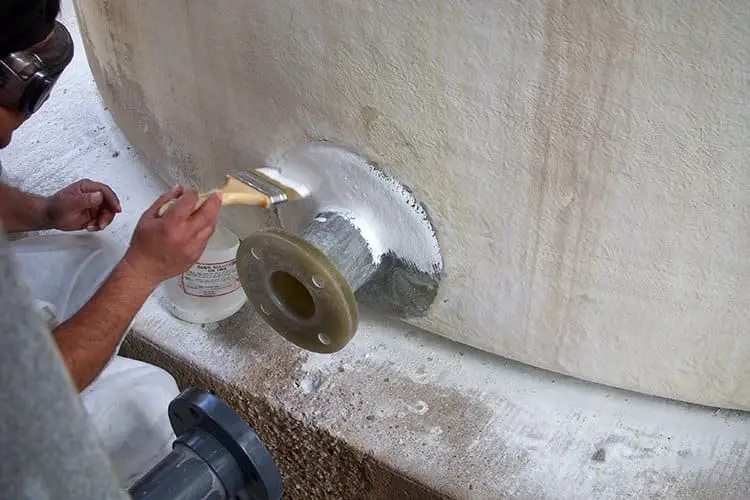
Proper frp tank nozzle repair is not a patch job. It involves evaluating the extent of delamination or cracking, removing degraded material, preparing the substrate, applying compatible resin systems and reinforcing layers, and restoring the nozzle geometry and connection point to a structurally sound condition. For facilities managing ongoing operations, this kind of repair must also be sequenced carefully to minimize exposure and maintain containment during the process. Resources like this detailed overview of frp tank nozzle repair outline how this work is approached by qualified service providers across different facility types.
Why Nozzle Connections Are Structurally Vulnerable
The nozzle connection point experiences stress from multiple directions simultaneously. Piping loads transmitted from attached lines create bending and shear forces at the point where the nozzle meets the tank wall. Thermal expansion and contraction, particularly in outdoor tanks or those handling fluids at variable temperatures, introduces cyclic stress into the laminate bond. Chemical absorption, which is a known characteristic of fiberglass over time, can soften the resin matrix and reduce the nozzle’s resistance to these forces.
These stresses accumulate gradually. In many cases, the first visible sign — a hairline crack at the nozzle base, or weeping at the flange face — represents the end stage of a process that has been developing for months or longer. This is why inspection intervals matter as much as the repair itself. Catching early-stage delamination before it progresses to full structural compromise is far less disruptive and far less costly than addressing an active failure.
Identifying Damage Before It Becomes a Structural Problem
Nozzle damage in FRP tanks tends to follow recognizable patterns, and knowing what to look for allows maintenance teams to act before conditions deteriorate. The most common early indicator is a surface-level crack or crazing in the laminate near the nozzle-to-shell junction. This type of damage is often superficial at first but can extend into deeper reinforcing layers if left unaddressed. Moisture infiltration through surface cracks accelerates resin degradation and can cause delamination — a separation of the glass fiber layers that significantly reduces structural integrity.
Inspection Methods That Provide Reliable Results
Visual inspection alone is not sufficient for assessing nozzle condition on tanks that have been in service for several years. Experienced technicians use acoustic tapping — striking the laminate surface systematically and listening for hollow or dull responses — to identify subsurface delamination that may not be visible from the outside. In more demanding applications, particularly those involving hazardous materials, ultrasonic thickness testing provides a clearer picture of wall integrity without requiring the tank to be taken out of service during the assessment phase.
Inspections should also include the flange face and any gasket seating surfaces. Flange faces on FRP fittings can develop unevenness or pitting from chemical exposure, which compromises the seal and leads to persistent leakage even when the nozzle body itself is intact. Addressing the flange surface as part of the overall assessment prevents repeat failures after repair work is completed.
When Repair Is the Right Decision Versus Replacement
Not every damaged nozzle requires full removal and replacement. The decision depends on the extent of damage to the surrounding shell laminate, the chemical environment the nozzle has been exposed to, and the structural demands of the application. If delamination is limited to the nozzle collar area and the surrounding shell laminate remains sound, a laminate rebuild and flange restoration is generally both practical and effective. If the damage extends through multiple reinforcing layers into the tank wall, or if the resin system has been compromised by chemical incompatibility, more extensive intervention — including nozzle replacement with proper wet-out layup — becomes necessary.
The age of the tank also factors into this decision. Composite materials used in fiberglass fabrication, as documented by organizations like ASTM International, have defined service life parameters based on resin type, fiber architecture, and chemical exposure history. An older tank that has experienced repeated nozzle issues may be approaching the point where repair costs begin to approach replacement value — a calculation that facility managers should have access to before committing to a repair strategy.
The Step-by-Step Process for Conducting a Nozzle Repair
Executing a proper nozzle repair on an FRP tank follows a defined sequence. Deviation from that sequence — particularly shortcuts in surface preparation or curing — is one of the most common reasons repairs fail prematurely. Each step builds on the one before it, and the quality of the finished work depends on the cumulative quality of every phase.
Isolating and Preparing the Work Area
Before any repair work begins, the tank must be taken out of service, drained, and purged of residual chemicals if the contents are reactive or hazardous. Ventilation requirements vary depending on what the tank has stored. Once the tank is clean and safe to enter or access externally, the damaged nozzle area is marked, and adjacent laminate is assessed to define the boundaries of the repair zone. Identifying the full extent of degraded material before beginning removal prevents technicians from discovering additional damage mid-repair — a situation that complicates scheduling and can extend downtime unexpectedly.
Material Removal and Surface Preparation
Damaged laminate must be fully removed down to sound, structurally intact material. This is typically accomplished by grinding, which also creates a textured surface profile that promotes mechanical bonding when new resin and reinforcement layers are applied. The preparation step is where most repair quality issues originate. If degraded material is left in place beneath new laminate, the repair will debond under stress, often within a shorter timeframe than the original failure took to develop. Grinding generates fine glass fiber particulate, which requires appropriate respiratory protection and containment to prevent environmental contamination and worker exposure.
Laminate Rebuilding and Cure Management
With the substrate properly prepared, reinforcement layers — typically woven roving, chopped strand mat, or a combination determined by the original design requirements — are saturated with compatible resin and applied in sequence. Each layer must be properly consolidated to eliminate air entrapment before the next layer is applied. Ambient temperature and humidity conditions during cure directly affect the quality of the finished laminate. Inadequate cure results in a matrix that is softer and more permeable than intended, reducing the repair’s long-term performance.
Post-cure inspection, including another round of acoustic tapping and visual examination, confirms that the new laminate has bonded correctly and that no voids are present before the tank is returned to service. This step is often skipped under schedule pressure, but it is the only reliable way to confirm that the repair will perform as expected.
How Facility Teams Can Reduce Recurring Nozzle Problems
Recurring nozzle damage is often a symptom of something addressable rather than an unavoidable characteristic of FRP equipment. Piping support configurations are a frequent contributor — when pipe runs lack adequate support near tank connections, the weight of the piping and any dynamic loads from flow or vibration are transmitted directly to the nozzle. Adjusting support spacing and adding flexible connections to absorb movement can significantly reduce the mechanical stress at nozzle attachment points.
Chemical compatibility should also be reviewed periodically. Process changes over the life of a facility sometimes result in tanks being exposed to substances that differ from the original design basis. Resin systems selected for one chemical environment may perform poorly under changed conditions, and FRP tank nozzle repair needs then become more frequent as the material degrades faster than intended. Confirming ongoing compatibility between stored materials and tank construction materials is a straightforward review that prevents a category of failure that is otherwise entirely avoidable.
Routine inspection documentation helps maintenance teams identify whether nozzle condition is stable between inspection cycles or progressively worsening. A single repair event with no recurrence is a different situation than repeated interventions at the same location, and tracking that history informs better decisions about whether to continue with targeted repairs or address the underlying mechanical or chemical cause.
Closing Thoughts
FRP tank nozzle damage is a manageable maintenance challenge when it is identified early, assessed accurately, and repaired with the correct materials and process sequence. The difficulty arises when damage is allowed to progress past the point where a straightforward laminate repair is sufficient, or when repair work is carried out without the discipline that fiberglass composite construction demands.
For industrial facilities across the US, the practical takeaway is this: nozzle condition should be part of every scheduled tank inspection, the repair process should follow a structured approach that does not skip preparation or cure steps, and the underlying causes of recurring damage should be investigated rather than repeatedly patched over. A well-maintained FRP tank with sound nozzle connections is a reliable piece of infrastructure. Achieving that reliability is less about the material itself and more about how the maintenance program surrounding it is designed and followed.