
This initial research report provides a broad overview of the WeChat Mini-App and Mini-Game ecosystem.
Future reports will delve deeper into topics including:
- Mini-App development, covering user growth, interface updates, monetization strategies, etc.
- Mini-Game evolution, focusing on advancement of game types, shifts in growth drivers (from social fission to traffic purchasing), and changes in monetization models (from IAA to IAP), etc.
- Other significant categories such as e-commerce and retailing
Executive Summary
Mini-App Overview
- Interaction (WeChat vs Telegram)
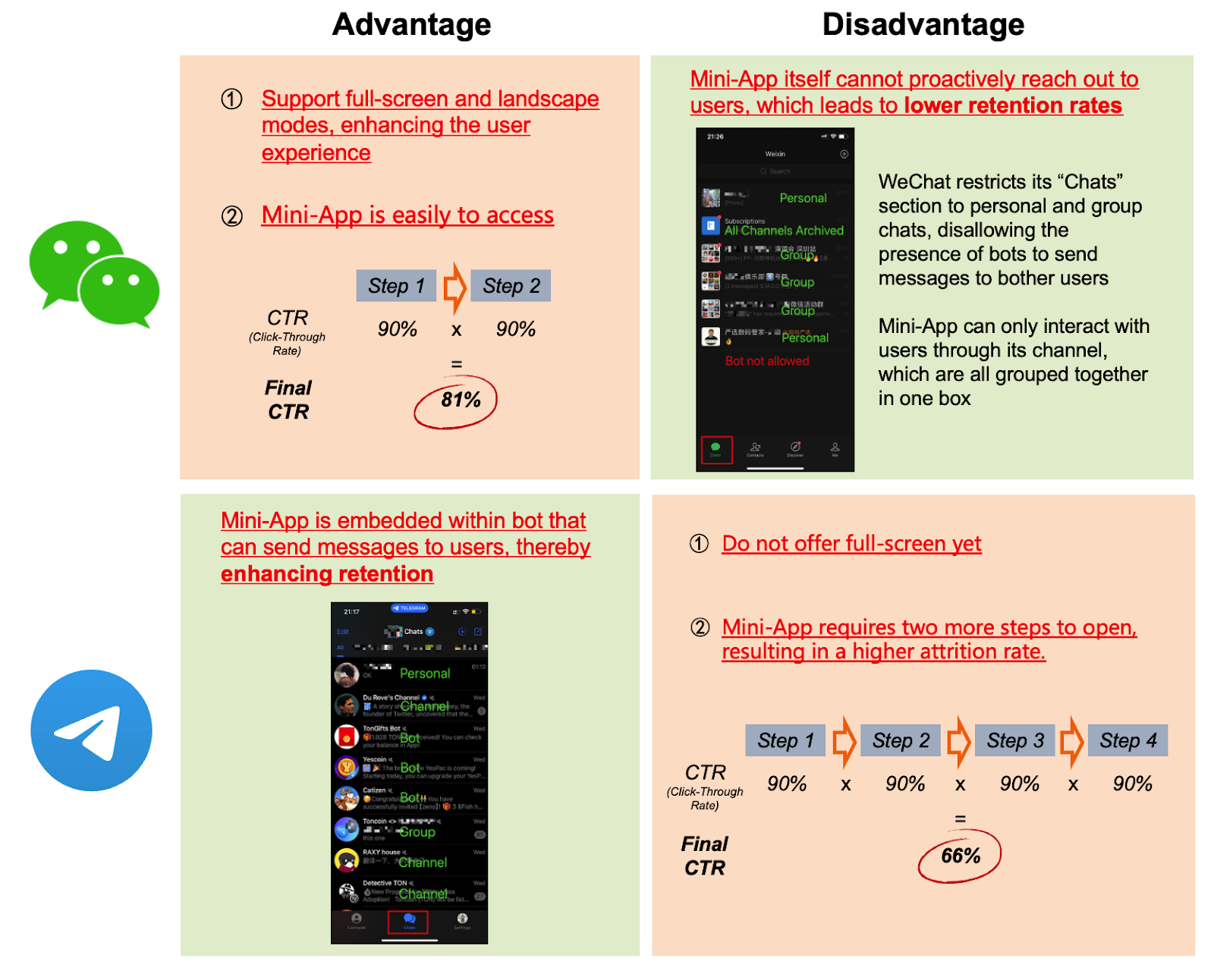
- Unlike Telegram Mini-Apps, which are embedded within bots and require two additional steps to access, WeChat Mini-Apps operate as independently accessible applications, leading to a significantly higher CTR (click-through rate)
- However, WeChat Mini-Apps cannot actively reach out to users on one’s own initiative, leading to lower retention rates. Telegram Mini-Apps can engage users via bots with messages, with a retention advantage
- WeChat Mini-Apps support full-screen and landscape viewing, offering an experience similar to using an App, while Telegram Mini-Apps do not support full-screen mode yet
- User growth
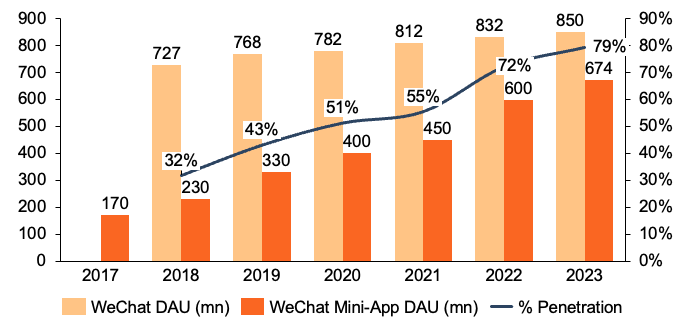
- Launched in 2017, WeChat Mini-Apps have experienced rapid user growth, with DAU exceeding 674 million, indicating a 79% penetration rate among WeChat daily users, significantly higher than Telegram Mini-Apps
- This rapid expansion is primarily attributed to the Flywheel Effect: started with a killer Mini-App (Jump Jump) that shaped user habits, drew in developers, continual official upgrades in both interaction and infrastructure, which expanded Mini-App scenarios and increased the user base. This Flywheel will be explored in next report
- Takeaways for us:
- As Mini-Apps continue to grow in popularity, it would be better for Telegram to accelerate its Mini-App technical upgrades, like to support full-screen and landscape Mini-Games, which many developers from WeChat are seeking
- Telegram’s Mini-Apps will improve in penetration but may not match WeChat’s level, as China’s lifestyle is more digitized—i.e. 45% of retail shopping is online (vs 15% in the US)
- Category structure
- Like WeChat, Telegram can adopt a similar strategy for Mini-App mass adoption, starting with casual games to build user habits, then extending to more practical categories (Actually, this approach also mirrors the history of iOS, starting with games like Angry Bird and Fruit Ninja):
- Tools like Flower Recognition. Mini-Apps offer a handy alternative to seldom-used downloaded Apps
- Finance like Yu’e Bao (like CEX Earning), using simple APY incentives to boost users’ acceptance of wallet (Actually, Wallet in Telegram can innovate more in this area due to its looser regulatory constraints compared to WeChat)
- Transaction-based categories in real-life (mobile top-ups, O2O, OTA and e-commerce), increasing payment frequency and stickiness
- While WeChat Pay can generate revenue by taking a 0.6% fee from Mini-Apps transactions, amounting to $4.5 billion in 2023 from $755 billion GTV—a typical Web 2.0 approach—Wallet in Telegram does not take a cut from transactions. However, the rising transaction volume on Telegram enhances the potential value of TON
- Like WeChat, Telegram can adopt a similar strategy for Mini-App mass adoption, starting with casual games to build user habits, then extending to more practical categories (Actually, this approach also mirrors the history of iOS, starting with games like Angry Bird and Fruit Ninja):
Mini-Game Overview
- Telegram’s Mini-Game mirrors early WeChat circa 2018-2019 in game genres and user penetration, yet faces challenges in adopting WeChat’s approach of acquiring users through traffic-purchasing for Mini-Games
- With the technical enhancement of WeChat Mini-Game, mid to hardcore games have increasingly been integrated into the platform
- For user acquisition, WeChat Mini-Games initially leveraged social fission from 2018 to 2019 and gradually shifted to a maturing ad system of traffic-purchasing since late 2022 (this is the significant challenge point for Telegram)
- In the meantime, the monetization model for WeChat Mini-Games has gradually transitioned from IAA(In-App Advertising) to IAP (In-App Purchases )
- WeChat Mini-Games have reached a 40% penetration rate among WeChat MAU, generating over $5.6 billion in revenue for Tencent through IAA and IAP. This success is largely due to continual technical improvements and effective user habit formation, supported by an increasingly sophisticated ads system for purchasing traffic starting in late 2022
- WeChat Mini-App: An Overview
- WeChat Mini-Apps operate as internally independent applications, with easily accessible way
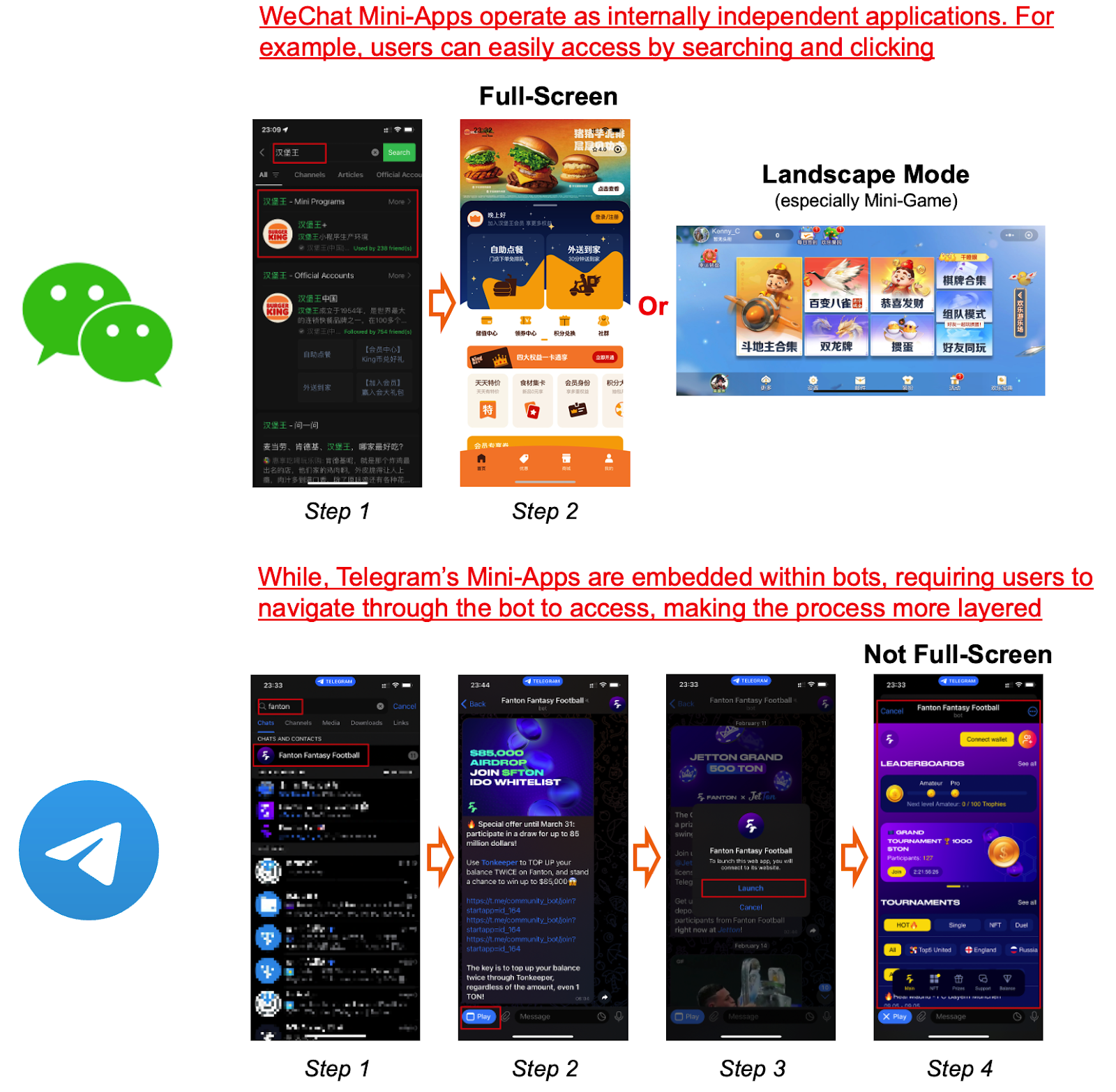
Unlike Telegram Mini-Apps, WeChat Mini-Apps operate as internally independent applications, which users can easily access with a simple click.
In contrast, Telegram Mini-Apps are embedded within bots, requiring users to navigate through the bot to access, adding two more steps to the process.
| Exhibit: Way to access a Mini-App: WeChat vs Telegram, search as example |
 |
| Source: WeChat App, Telegram App |
Below is a comparison of these two different Mini-App access designs, highlighting the advantages and disadvantages of each.
| Exhibit: Advantages and disadvantages for two different Mini-App access designs |
 |
| Source: Kenny Analytics |
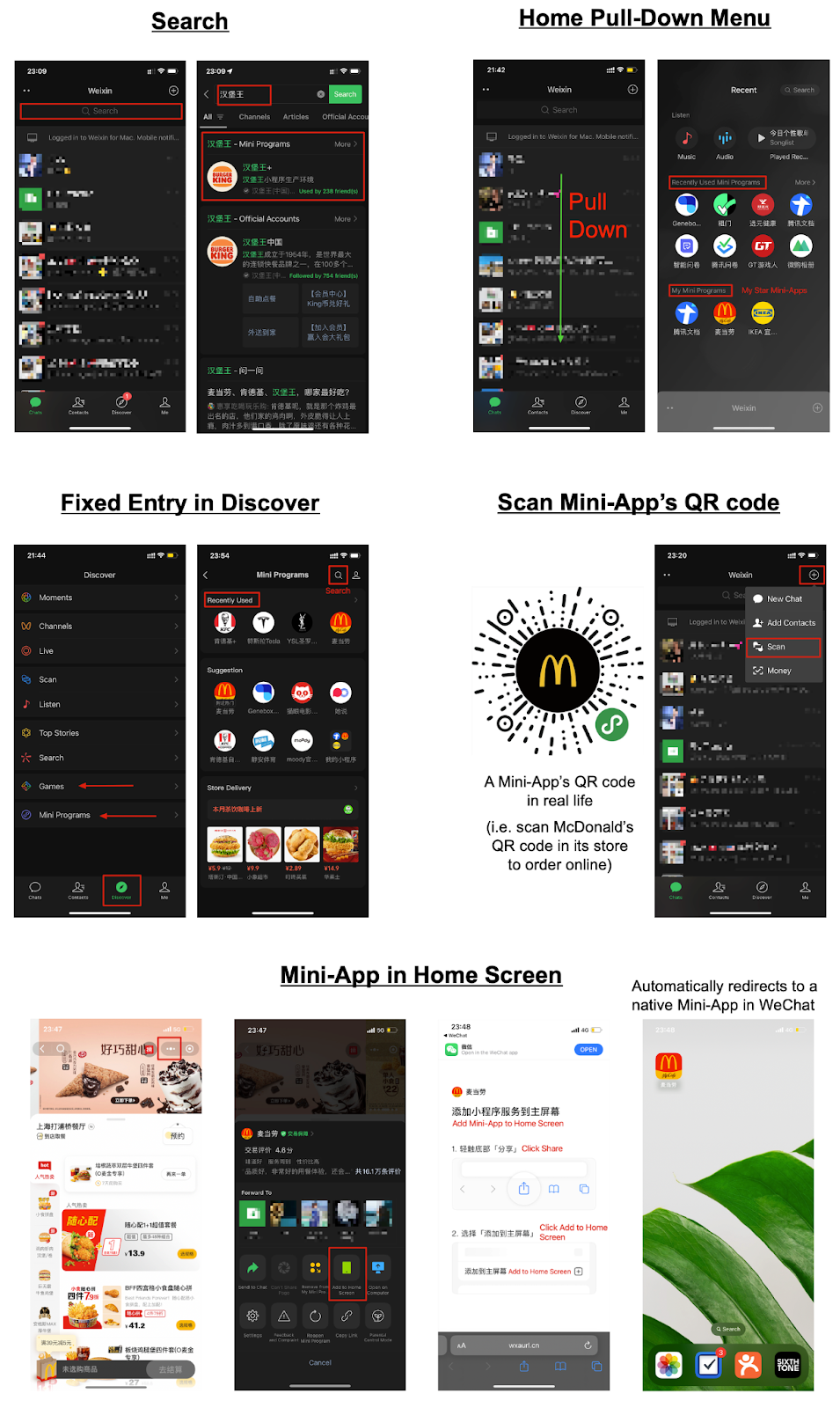
Though Mini-App in WeChat itself cannot proactively reach out to users, there are numerous ways available for users to access a Mini-App within and outside WeChat.
| Exhibit: Main Ways to access a WeChat Mini-App |
 |
| Source: WeChat App |
Besides, In Exhibit below, there are other ways for users to passively access a Mini-App, via group sharing, channel’s article, moments (like posts feed in FB) and video feed (like Tik-Tok). In these scenarios Mini-App acts as a connector within WeChat’s ecosystem, usually heading to transactions.
| Exhibit: Mini-App acts as a connector within WeChat’s ecosystem, usually heading to transactions |
 |
 |
 |
 |
| Source: WeChat App |
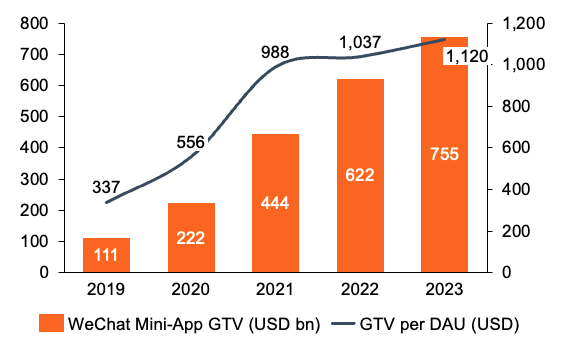
- As the key facilitators of transactions on WeChat, Mini-App is experiencing fast-paced growth, with an annual average increase of 78.2% in GTV (Gross Transaction Volume)
With a take-rate of 0.6%, WeChat’s revenue from transactions volume of USD 755 bn through Mini-App could reach USD 4.5 bn in the year 2023.
55% of the GTV is attributed to e-commerce activities, while 25% originates from Online-to-Offline (O2O) services, such as car hailing and food delivery, which may be due to the mature digitalization of real-life infrastructure in China. The per-user GTV within WeChat has consistently risen, reaching an annual figure of USD 1,120.
| Exhibit: WeChat Mini-App GTV | Exhibit: WeChat Mini-App GTV by Categories | |
 |  | |
| Source: Goldman Sachs | Source: GF Securities |
- Mini-App’s adoption surges, achieving high user engagement on WeChat
2.1 Mini-App’s surging adoption
Since its launch in early 2017, The DAU of Mini-App has skyrocketed to 674 million, representing a remarkable 79% of WeChat’s total DAU.
| Exhibit: Growth of WeChat Mini-App DAU |
 |
| Source: WeChat Open Class, QuestMobile, Goldman Sachs |
In late Dec 2017, Mini-App has seen the first milestone after its launch, with its DAU achieved a stepwise significant increase, due to the following two key updates:
- Introduction of its first batch of Mini-Game and Splash Screen Exposure to one Mini-Game called Jump Jump, after the WeChat version upgrade
- Adding Pull-Down Menu feature, with which user can simply access Mini-App by just pulling down the chat page
| Exhibit: WeChat Mini-App DAU booming at the end of the year 2017 |
 |
 |
| Source: QuestMobile, Jefferies, WeChat App |
For an in-depth exploration of Mini-App development, including the flywheel effect, interface updates and monetization strategies,etc., there will be an upcoming exclusive research report.
| Exhibit: Flywheel of WeChat Mini-App development |
 |
| Source: Kenny Analytics |
2.2 Mini-App’s growing user engagement
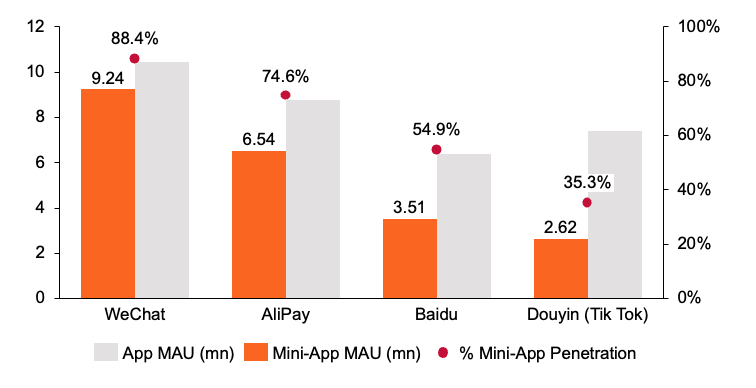
WeChat surpasses other major Chinese super apps in Mini-App integration, showcasing its strength in fostering user adoption and engagement, particularly as a social networking platform.
| Exhibit: % Mini-App Penetration in several main-stream App of China |
 |
| Source: QuestMobile, Changjiang Securities |
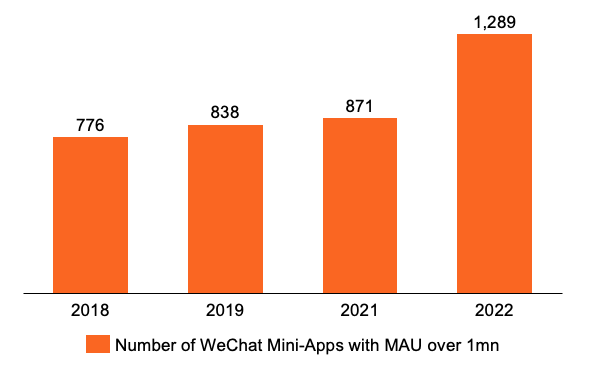
WeChat has established a self-reinforcing ecosystem: a stronger platform attracts more developers, which in turn boosts user adoption and engagement, thereby enhancing the ecosystem further. This virtuous cycle has led to over 1,000 WeChat Mini-Apps exceeding 1mn MAU, demonstrating the platform’s significant impact.
| Exhibit: Number of WeChat Mini-Apps with MAU over 1mn |
 |
| Source: QuestMobile, UBS |
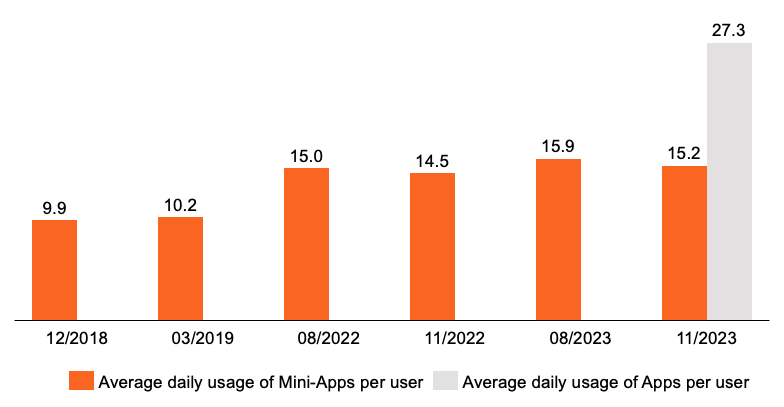
For the average Chinese mobile internet user, Mini-Apps are now used more than half as much as traditional apps daily, signifying that Mini-Apps have evolved into a critical element of China’s mobile internet landscape. This shift underscores their growing significance and the changing patterns of digital interaction among users.
| Exhibit: Average daily usage of Apps and Mini-Apps for a Chinese mobile internet user |
 |
| Source: QuestMobile, UBS |
- Businesses across various sectors are actively embracing Mini-App to tap into the potential traffic within WeChat ecosystem
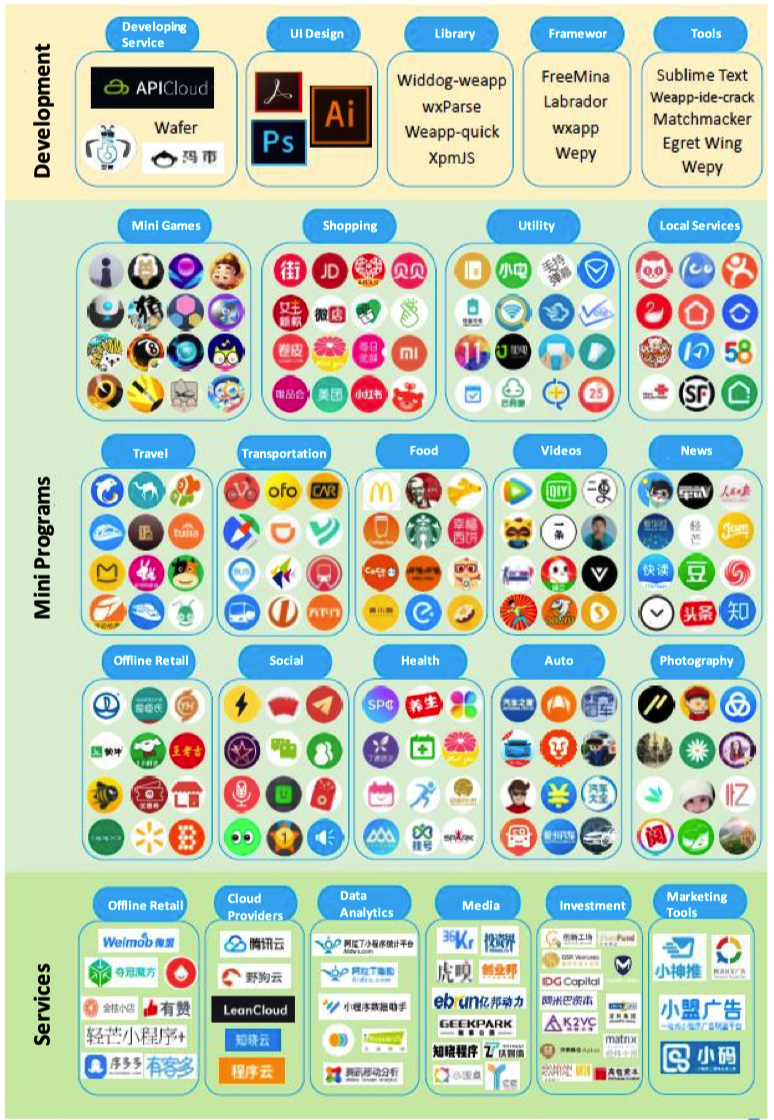
As more and more developers from various sectors flow into the Wechat Mini-App, the ecosystem is maturing rapidly, enabling users to find most of the services they need within Wechat.
| Exhibit: Wechat Mini Program Ecosystem & Representative Mini Programs |
 |
| Source: aldwx.com |
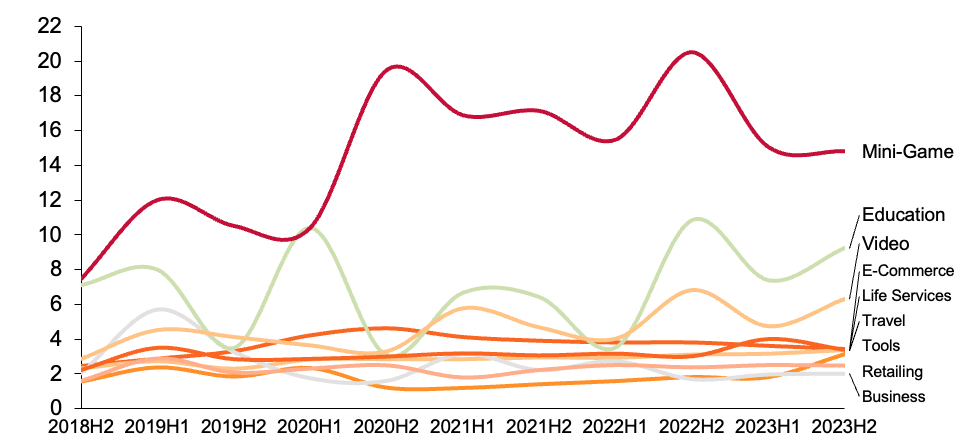
Within all the categories, Mini-Game holds a significant stance, whether in terms of engagement time or usage frequency.
| Exhibit: Wechat Mini-App daily user time spent | Exhibit: Wechat Mini-App daily user frequency | |
 |  | |
| Source: aldwx.com | Source: aldwx.com |
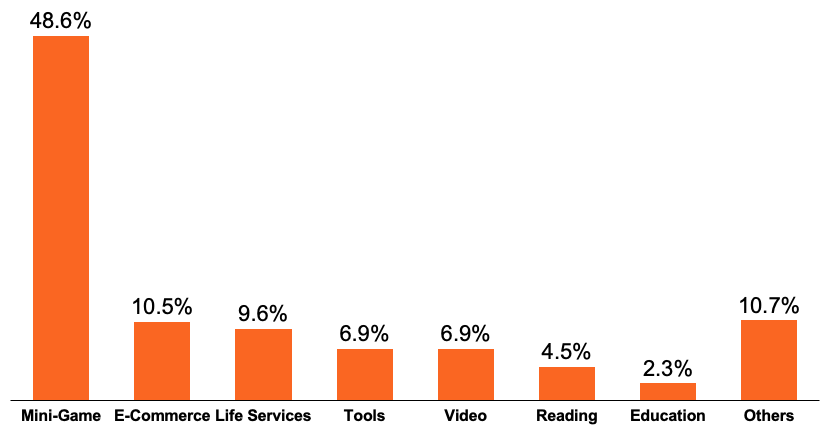
Among the top 100 Mini-Apps by MAU:
- 31% belong to the life services category, illustrating their pivotal role in daily activities in China, such as mobile top-ups, utility bill payments, ride-hailing, and food delivery
- Finance-related Mini-Apps, including lending, insurance, and merchant payment solutions, constitute 12%
- E-commerce Mini-Apps, featuring platforms like JD.com and Pinduoduo (Alibaba has been banned to develop their Mini-apps in WeChat before mainly due to its payment competition with Tencent), as well as online supermarkets like Walmart, make up 10%
- Although Mini-Games represent only 7%, this does not diminish their importance; it just indicates that individual Mini-Game do not achieve mass adoption as extensively as Mini-Apps in other categories
However, Mini-Game continues to be the most rapidly growing category. This is evident as nearly half of the Mini-Apps launched in 2023 were Mini-Games, showcasing Mini-Game’s burgeoning popularity and development within the ecosystem.
| Exhibit: Top 100 Mini-Apps % by Categories (in terms of MAU) | Exhibit: Launched Mini-Apps % by Categories in 2023 | |
 |  | |
| Source: QuestMobile | Source: QuestMobile. Mini-Apps with MAU over 10k represented |
- WeChat Mini-Game: An Overview
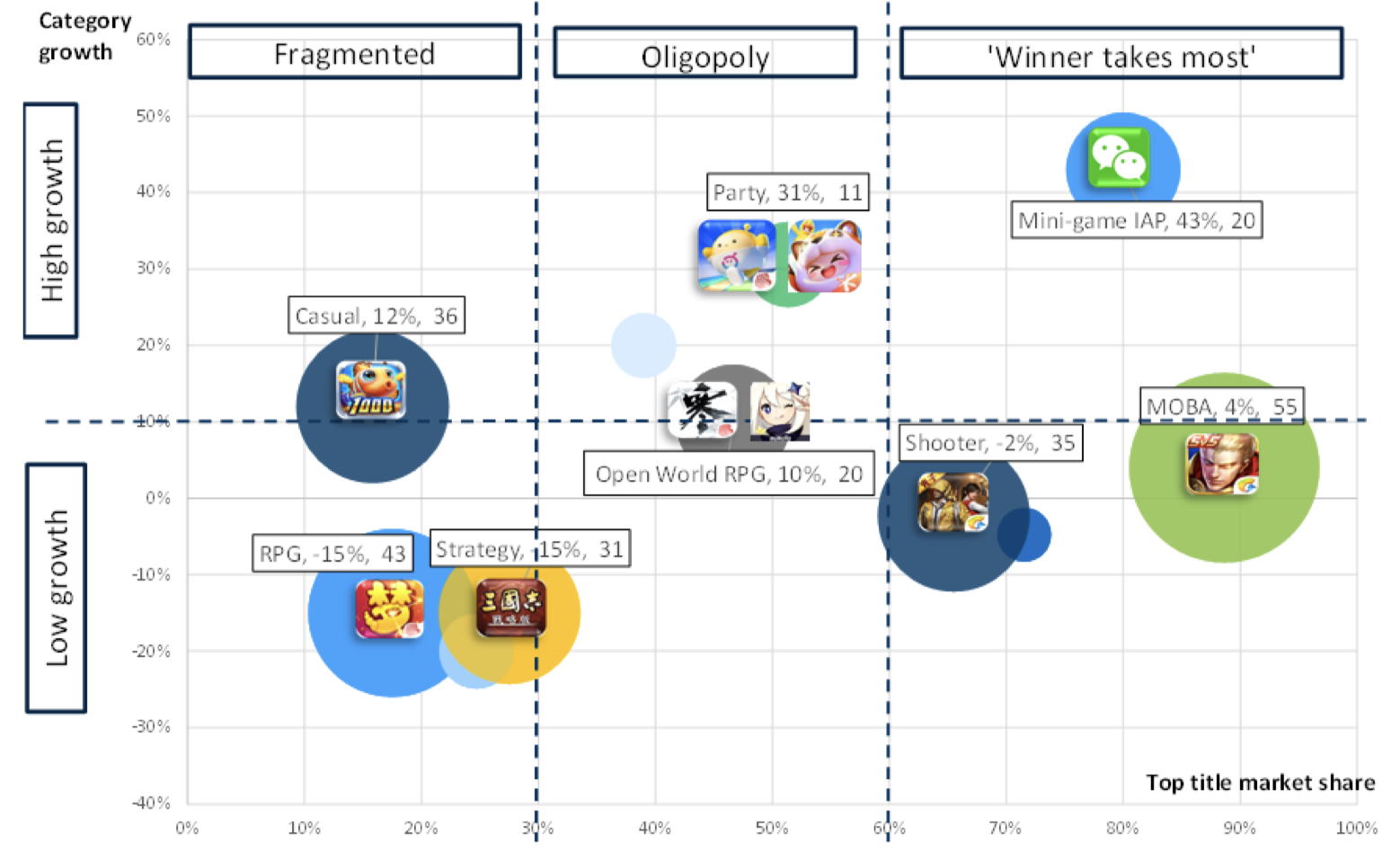
- In the realm of China mobile gaming genres, Mini-Game stands out for its exceptional growth
Mini-Game boasts a 43% yoy increase in revenue, amounting to 20bn RMB from IAP (In-App Purchases), thanks to WeChat’s robust Mini-App traffic-purchasing system, which will be discussed in the following report.
| Exhibit: 2023 China mobile games by genre *X-axis denotes market share concentration to the top 1 game; Y-axis denotes yoy growth in 2023; Each box contains: genre types, % yoy growth, bubble size refers to revenue size in 2023 (Rmb bn) |
 |
| Source: SensorTower, Goldman Sachs |
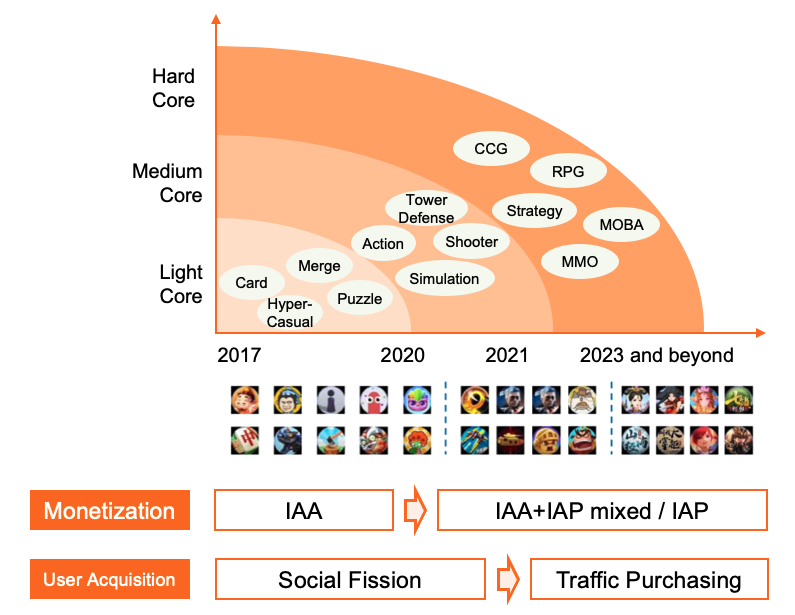
- The development of WeChat Mini-Games can primarily be summarized across three key dimensions: game genre, user acquisition, and monetization
- With the technical enhancement of WeChat Mini-Game (i.e. storage capacity and engine optimization), mid to hardcore games have increasingly been integrated into the platform. The variety of Mini-Games has expanded from hyper-casual and puzzle genres to include more complex simulation, strategy, and MMO games, reflecting a broader scope of gaming experiences available within the WeChat ecosystem
- For user acquisition, WeChat Mini-Games initially leveraged social fission from 2018 to 2019 and gradually shifted to a maturing ad system of traffic-purchasing since late 2022 (this would be a significant challenge point for Telegram)
- In the meantime, the monetization model for WeChat Mini-Games has gradually transitioned from IAA(In-App Advertising) to mixed model of IAA and IAP (In-App Purchases) or IAP solely
| Exhibit: The Development of WeChat Mini-Game |
 |
| Source: WeChat Open Class |
Finally, we can understand WeChat Mini-Game performance through Four Exhibits below:
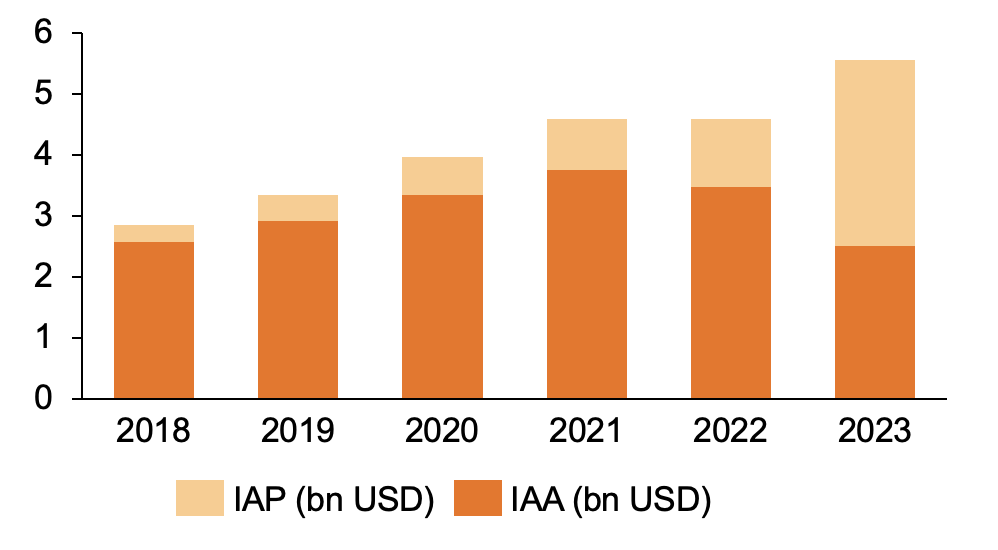
- In 2023, WeChat Mini-Game yields revenue over 5.6bn USD for Tencent, with IAP (In-APP-Purchase) the key growth driver, which has exceeded IAA (In-APP-Ad) and notably constituted over 50% of the total. The reasons will be discussed in the following report
- WeChat Mini-Game is experiencing a steady user penetration and ARPU expansion, in 2023 primarily due to its precision traffic-purchasing ads system (which Telegram doesn’t have)
- Among the entire mobile gaming audience, 75% engage with Mini-Games, yet their ARPU is only 28% as of that of the entire mobile gaming, indicating a high engagement but lower monetization rate for Mini-Games
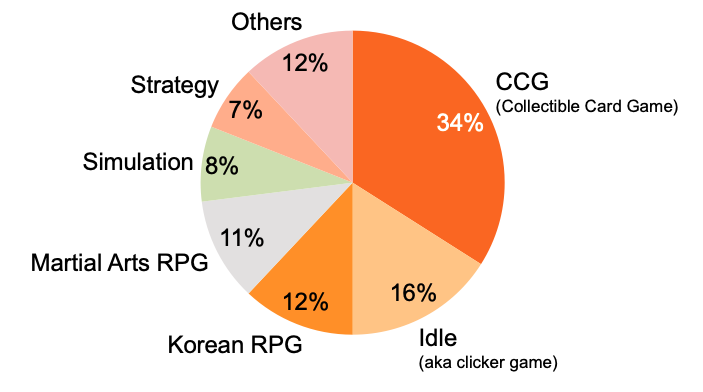
- CCG(Collectible Card Game) and idle games remain the dominant genres in WeChat Mini-Game in term of revenue contribution
| Exhibit: Tencent’s Revenue from Mini-Game | Exhibit: MAU and ARPU of WeChat Mini-Game | |
 |  | |
| Exhibit: WeChat Mini-Game User vs Total Game User | Exhibit: WeChat Mini-Game’s Revenue by Genre | |
 |  | |
| Source: CNG & GPC, Goldman Sachs | ||
Technology Perspective
Technology continues to transform industries through artificial intelligence, cloud computing, automation, cybersecurity, digital platforms, and data-driven decision making. As organizations increasingly adopt digital solutions, understanding emerging technologies becomes essential for businesses, professionals, and consumers. DGM News regularly covers these developments through expert analysis, technology news, and educational resources.
Innovation Outlook
Rapid advances in artificial intelligence, automation, machine learning, cloud infrastructure, and digital transformation continue reshaping global industries. Monitoring these developments helps organizations adapt to changing technologies, improve efficiency, and prepare for future innovation.
Did you know?
Artificial Intelligence is expected to influence nearly every major industry over the coming decade, from healthcare and finance to transportation, manufacturing, education, and entertainment.
AI, Machine Learning, Deep Learning and Generative AI Explained
Google AI Updates
About DGM News
DGM News is an independent digital publication delivering the latest Technology News, AI News, and FinTech News. We provide expert insights on startups, innovation, cybersecurity, software, business, gadgets, cloud computing, artificial intelligence, and emerging technologies. Our mission is to publish informative, accurate, and regularly updated content that helps readers stay informed in today's rapidly evolving digital landscape.
Since our editorial focus includes technology, artificial intelligence, and financial technology, we continuously expand our coverage as new innovations emerge.
Editorial Standards
Every article published on DGM News undergoes editorial review before publication. We prioritize factual accuracy, clarity, transparency, and reader value while following responsible digital publishing practices.
Research Methodology
Our editorial team researches publicly available information from official announcements, technical documentation, research publications, developer resources, reputable industry reports, and trusted public sources whenever applicable. Information is reviewed to improve clarity and accuracy before publication.
Fact-Checking Policy
We make reasonable efforts to verify factual information before publishing. Articles are reviewed for accuracy, consistency, and relevance. If significant developments occur after publication, content may be revised to reflect updated information.
Update Policy
Technology evolves rapidly. Articles may be reviewed and updated periodically to reflect software releases, AI developments, security advisories, regulatory updates, product launches, and other important industry changes.
Source Verification
Whenever possible, DGM News reviews information using official company announcements, technical documentation, research publications, government resources, publicly available reports, and reputable industry references before updating articles.
Editorial Independence
DGM News maintains editorial independence in all publishing decisions. Editorial content is produced independently and is intended to provide balanced, informative, and reader-focused coverage without influence from advertisers or commercial partnerships.
AI Usage Disclosure
Artificial intelligence tools may assist with research organization, grammar improvement, formatting, or editorial workflows. Every article is reviewed by human editors before publication to help maintain quality, clarity, and factual accuracy.
Corrections Policy
Accuracy is important to us. If readers identify outdated information or factual inaccuracies, they are encouraged to contact our editorial team. Verified corrections are reviewed and incorporated whenever appropriate.
Reader Feedback
Reader feedback helps improve our journalism. We welcome suggestions, corrections, and constructive feedback through our Contact page to continuously improve the quality of our reporting.
Last Editorial Review
This article follows the DGM News editorial review process and may be updated periodically as new information becomes available.
Why Trust DGM News?
DGM News is committed to publishing technology journalism that emphasizes accuracy, transparency, editorial independence, and regularly updated information. Our editorial process is designed to provide readers with reliable coverage of technology, AI, fintech, startups, and digital innovation.
DGM News Resources
Topics We Cover
Artificial Intelligence • AI Tools • Machine Learning • FinTech • Cybersecurity • Cloud Computing • Programming • Software Development • Gadgets • Mobile Technology • Business Technology • Startups • Digital Marketing • Blockchain • Cryptocurrency • Science • Innovation • Consumer Technology • Enterprise Technology • Automation