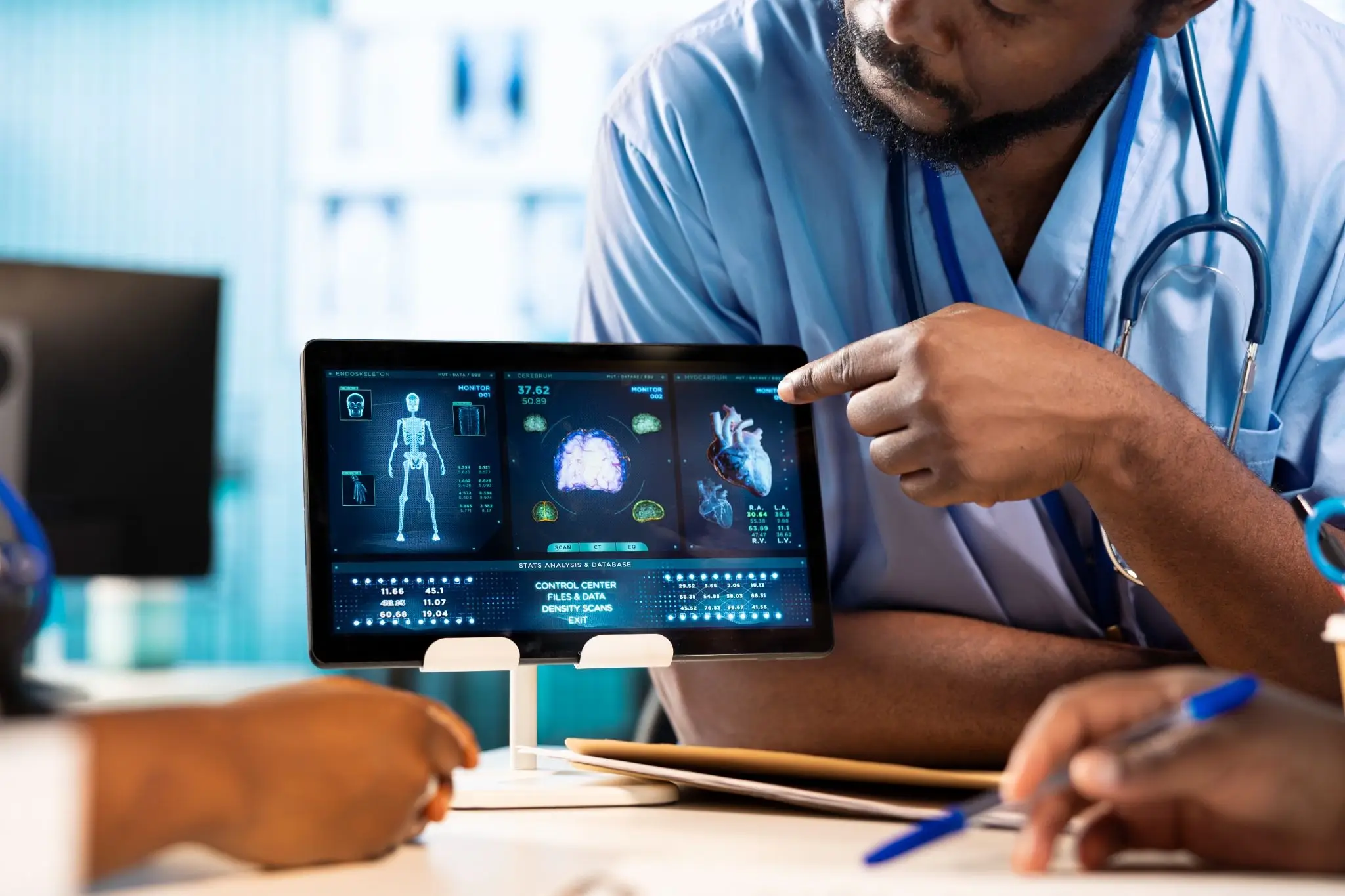
Remote monitoring software really fills the waiting time and it really has transformed the delivery of healthcare outside the walls of the hospital.
What Is Remote Patient Monitoring Software?
Typically referred to as RPM software, remote patient monitoring software is a digital solution that allows a practitioner to monitor a patient’s health condition from any location in the world a patient may be in, from their living room to their office, to a small town three hours from the nearest specialist.
The concept is simple; patients wear or use medical devices that measure blood pressure, blood sugar, heart rate, oxygen levels, and so on; and everything automatically makes its way to the care team’s software platform.
How RPM Software Works
It’s not as complex as it sounds the way it works. The medical devices connect with the RPM platform via Bluetooth, cellular, or Wi-Fi, with the patient setup with one or more devices. Each time the person reads, the data is transmitted from the device to the software, where it is stored, sorted and accessed by the patient’s provider. When something appears amiss, the system alerts you to it or flags it as a warning before it becomes a widespread issue.
Devices Connected with RPM Software
Over the past few years the number of devices that communicate with RPM software has increased significantly. Any device that allows blood glucose monitoring, pulse oximetry, digital blood pressure devices, smart scales, ECG patches, or even wearable fitness trackers can be integrated into the right platform. Patients with more complex conditions may be using three or four devices simultaneously, others may just use one.
Benefits of Remote Patient Monitoring Software
Real-Time Patient Monitoring
The most important new function that RPM software can provide that you just can’t get from a patient visit is its ability to present a real-time view of the patient’s health status between visits. The care team can view trends over days or weeks instead of a single reading in a doctor’s office on a Tuesday afternoon, which is much more valuable when they’re trying to figure out if the treatment is working.
Better Chronic Disease Management
RPM software is essentially creating a feedback loop between the patient and their healthcare team, for long-term care for something like Type 2 Diabetes or hypertension. Medication changes may occur more rapidly, lifestyle changes are more easily monitored, and the patient is not necessarily left all alone to deal with a condition that does not require days off.
Key Features of Remote Patient Monitoring Software
HIPAA Compliance
A good RPM platform should be developed with HIPAA security at its core. Patient information is confidential and the software that processes it needs to adhere to high security standards, such as encryption, access restrictions and data storage and transmission protocols. HIPAA compliance is not an option when it comes to checking out platforms if you’re a healthcare professional.
EHR Integration
A good RPM software integrates seamlessly with the clinic or hospital’s EHR system, ensuring that patient information is not contained within an app that no one is aware of or remembers to check. If the vital automatically flow into the EHR, then providers will have everything under one roof, and won’t have to manually type in all of the data, thus saving time and helping to minimize the risk of data errors.
Automated Alerts and Notifications
If the patient’s reading is deemed by the care team to go over a certain limit, the software automatically alerts them, the provider, or both, without the patient having to do anything at all. One of those features that sounds easy but is really effective: Catch a problem at 2am rather than the next appointment.
AI and Predictive Analytics
These newer RPM platforms are integrating AI functionality that doesn’t only predict past events from a patient’s data, but also anticipates future events. This kind of predictive ability can help providers get a leg up on serious health events for high-risk patients in particular.
How RPM Software Helps Healthcare Providers
Enhanced Workflow Efficiency
Providers can see more patients, but have less to do, as the software does the work of collecting data and presents the readings that do need their attention. Normal cases remain normal and the urgent cases are flagged immediately.
Better Patient Engagement
Real-time viewing of patient data is one factor that can help increase a patient’s engagement with their healthcare. If a person can see their blood pressure is going down when they change their diet, they are more likely to continue that change, because they know that the change is having an effect.
How to Choose the Right Remote Patient Monitoring Software
Scalability
A program that performs well with 50 patients may break down when used with 500. Before you stick your foot in your mouth, you should ask vendors about the performance of their system as volumes of patients increase and whether the price goes up in a realistic manner for your practice.
Ease of Use
If the software is not user friendly, staff won’t use it regularly and patients will not continue. Something that can be forgotten during a demo but becomes apparent in no time at all after go-live is a clean and intuitive user interface on both the clinical side and the patient-facing side.
Future of AI in Remote Patient Monitoring Software
The trajectory of where it’s going is clearly toward a system that goes beyond alerting, a platform that can make suggestions about what to do, a model of disease progression, and providing a provider with a much earlier warning about a deteriorating patient.
When combined with continuous biometric data and machine learning models trained using a population of patients, these advances are truly transforming the possibilities of outpatient care. While it’s not ready for all use cases, many claimed it was a few years back, it’s closing at a rate faster than most people thought it could.
Conclusion
Among these tools is remote patient monitoring software, something an office or health system can’t exist without when they begin to use it to its full extent. It bridges the gap between appointments, helps to avoid unnecessary hospital admissions and helps providers and patients have a clearer picture of what is going on with a patient’s health on a day-to-day basis.
The next step for any healthcare provider interested in creating or expanding an RPM program and/or a patient interested in learning more about RPM is to connect with vendors who understand their patient population and assess how their platform supports the features that are important to your workflow.