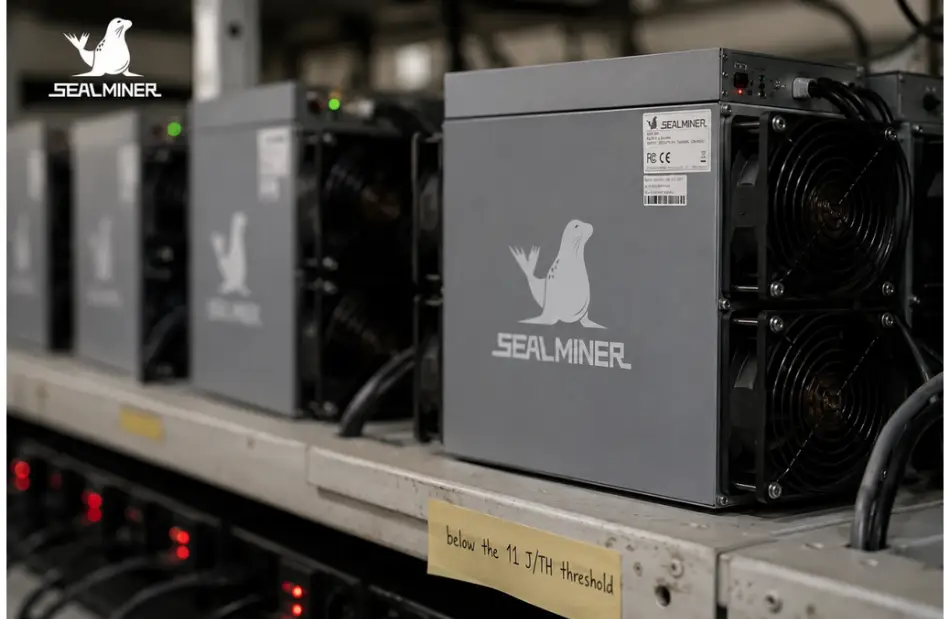
Bitdeer’s recently released SEALMINER A4 series has drawn noticeable attention from miners watching the next efficiency jump. But beyond the launch buzz, the real question is how these machines hold up when power, cooling, rack space, and maintenance costs are all counted.
Bitcoin mining in 2026 is being judged less by headline hashrate and more by margin preservation. Network difficulty remains demanding, older hardware loses room for error faster, and power costs still decide which fleets stay profitable during weaker market periods.
Efficiency as a New Cost Variable in Bitcoin Mining
For miners and infrastructure investors, J/TH now sits near the center of the cost model because it influences shutdown price, site selection, and fleet replacement timing.
A miner with lower J/TH converts more electricity into usable hashrate. That matters most when revenue per terahash softens or when local power contracts become less favorable. By hitting this mark, the A4 Pro Air stands as the only air-cooling miner on the global market to drive power efficiency below the 11 J/TH threshold—a milestone that fundamentally changes what traditional airflow infrastructure can achieve.
SEALMINER A4 Specifications in an Operating Context
Mining economics depend on the full hardware system, not only chip claims. While proprietary silicon forms the baseline, the business case also comes from power delivery, thermal management, and rack format.
Three Models for Different Facility Designs
l SEALMINER A4 Ultra Hydro: 9.45 J/TH, 886 TH/s
l SEALMINER A4 Pro Hydro: 10.9 J/TH, 680 TH/s
l SEALMINER A4 Pro Air: 10.9 J/TH, 336 TH/s
That combination of data matters for operators measuring rack density and power conversion losses.
Lower J/TH Is Only Useful When the System Stays Stable
The A4 Ultra Hydro also has an additional performance angle. Official social disclosure states that laboratory-tested high-performance mode can reach up to 1 PH/s while maintaining about 10 J/TH efficiency. That should be read as a mode-specific result rather than the normal published operating point. For procurement teams, the more relevant point is that the default spec already lands below 10 J/TH. The higher mode is interesting, but long-run purchasing decisions still depend on steadiness, serviceability, and power discipline.
Where Infrastructure Geometry Generates Cost Advantages
Most miner comparisons stop at hashrate and wattage. That misses another cost layer: moving, racking, and activating thousands of machines. In the comparison table, SEALMINER A4 Ultra Hydro is a 9.45 J/TH miner that carries 886 TH/s in a 2U, 21 kg body. Whatsminer M73S+ is also 2U, but offers 570 TH/s at 30 kg and 12.5 J/TH. Antminer U3S23H reaches 1,160 TH/s, yet needs a 3U, 42 kg frame. Whatsminer M79S provides 985 TH/s at 37 kg and 13.5 J/TH. The table can stay as a quick reference; the business point is that efficiency, rack format, hashrate, and shipping weight need to be read together.
2U and 21 kg Improve Hashrate Transport Density
A fairer way to compare logistics is not machine count, but Hashrate Transport Density, meaning how much hashrate each kilogram of machine weight carries. On this basis, A4 Ultra Hydro reaches 42.19 TH/s per kg, ahead of M73S+ at 19.00 TH/s per kg, U3S23H at 27.62 TH/s per kg, and M79S at 26.62 TH/s per kg.
This is where the A4 Ultra Hydro becomes more interesting for fleet buyers. A heavier 3U machine may still look strong in raw hashrate, but more weight and volume can make every shipment, rack move, and installation step more expensive. By cutting unit weight to 21 kg while keeping 886 TH/s, the 2U design turns each shipped kilogram into more usable hashrate.
Comparative Cost Modeling Across Key Corridors
Using A4 Ultra Hydro and U3S23H as the comparison pair, the freight table shows the same cost pattern across several shipment origins:
(*Note: Baseline modeling compiled using commercial DHL carrier rates as of May 2026. Real-world shipping fees vary by regional customs and commercial volume contracts.)
Thailand shows the clearest gap: A4 Ultra Hydro records an estimated 32.85% reduction in logistics cost per TH over the 3U alternative. Even the smaller Vietnam gap matters at fleet scale: shipping 1,000 2U units can save nearly $270,000 in total logistics cost compared to 1,000 3U units.
The on-site impact is also clear. A 21 kg miner is easier for single-person handling, while a 42 kg 3U unit often needs two workers or lift support during rack installation. Across thousands of units, that difference can cut manpower, speed up deployment, and bring machines online faster.
Industry Outlook
Unlike a number of other offerings on the market today, the SEALMINER A4 series does not win by focusing on a single key metric. Instead, it is a platform that consolidates a number of very expensive problems in industrial mining today. Taken together, the series points to where mining hardware is heading: not merely toward more compute, but toward better compute economics across power, space, and deployment.
Technology Perspective
Technology continues to transform industries through artificial intelligence, cloud computing, automation, cybersecurity, digital platforms, and data-driven decision making. As organizations increasingly adopt digital solutions, understanding emerging technologies becomes essential for businesses, professionals, and consumers. DGM News regularly covers these developments through expert analysis, technology news, and educational resources.
Innovation Outlook
Rapid advances in artificial intelligence, automation, machine learning, cloud infrastructure, and digital transformation continue reshaping global industries. Monitoring these developments helps organizations adapt to changing technologies, improve efficiency, and prepare for future innovation.
Did you know?
Artificial Intelligence is expected to influence nearly every major industry over the coming decade, from healthcare and finance to transportation, manufacturing, education, and entertainment.
AI, Machine Learning, Deep Learning and Generative AI Explained
Google AI Updates
About DGM News
DGM News is an independent digital publication delivering the latest Technology News, AI News, and FinTech News. We provide expert insights on startups, innovation, cybersecurity, software, business, gadgets, cloud computing, artificial intelligence, and emerging technologies. Our mission is to publish informative, accurate, and regularly updated content that helps readers stay informed in today's rapidly evolving digital landscape.
Since our editorial focus includes technology, artificial intelligence, and financial technology, we continuously expand our coverage as new innovations emerge.
Editorial Standards
Every article published on DGM News undergoes editorial review before publication. We prioritize factual accuracy, clarity, transparency, and reader value while following responsible digital publishing practices.
Research Methodology
Our editorial team researches publicly available information from official announcements, technical documentation, research publications, developer resources, reputable industry reports, and trusted public sources whenever applicable. Information is reviewed to improve clarity and accuracy before publication.
Fact-Checking Policy
We make reasonable efforts to verify factual information before publishing. Articles are reviewed for accuracy, consistency, and relevance. If significant developments occur after publication, content may be revised to reflect updated information.
Update Policy
Technology evolves rapidly. Articles may be reviewed and updated periodically to reflect software releases, AI developments, security advisories, regulatory updates, product launches, and other important industry changes.
Source Verification
Whenever possible, DGM News reviews information using official company announcements, technical documentation, research publications, government resources, publicly available reports, and reputable industry references before updating articles.
Editorial Independence
DGM News maintains editorial independence in all publishing decisions. Editorial content is produced independently and is intended to provide balanced, informative, and reader-focused coverage without influence from advertisers or commercial partnerships.
AI Usage Disclosure
Artificial intelligence tools may assist with research organization, grammar improvement, formatting, or editorial workflows. Every article is reviewed by human editors before publication to help maintain quality, clarity, and factual accuracy.
Corrections Policy
Accuracy is important to us. If readers identify outdated information or factual inaccuracies, they are encouraged to contact our editorial team. Verified corrections are reviewed and incorporated whenever appropriate.
Reader Feedback
Reader feedback helps improve our journalism. We welcome suggestions, corrections, and constructive feedback through our Contact page to continuously improve the quality of our reporting.
Last Editorial Review
This article follows the DGM News editorial review process and may be updated periodically as new information becomes available.
Why Trust DGM News?
DGM News is committed to publishing technology journalism that emphasizes accuracy, transparency, editorial independence, and regularly updated information. Our editorial process is designed to provide readers with reliable coverage of technology, AI, fintech, startups, and digital innovation.
DGM News Resources
Topics We Cover
Artificial Intelligence • AI Tools • Machine Learning • FinTech • Cybersecurity • Cloud Computing • Programming • Software Development • Gadgets • Mobile Technology • Business Technology • Startups • Digital Marketing • Blockchain • Cryptocurrency • Science • Innovation • Consumer Technology • Enterprise Technology • Automation