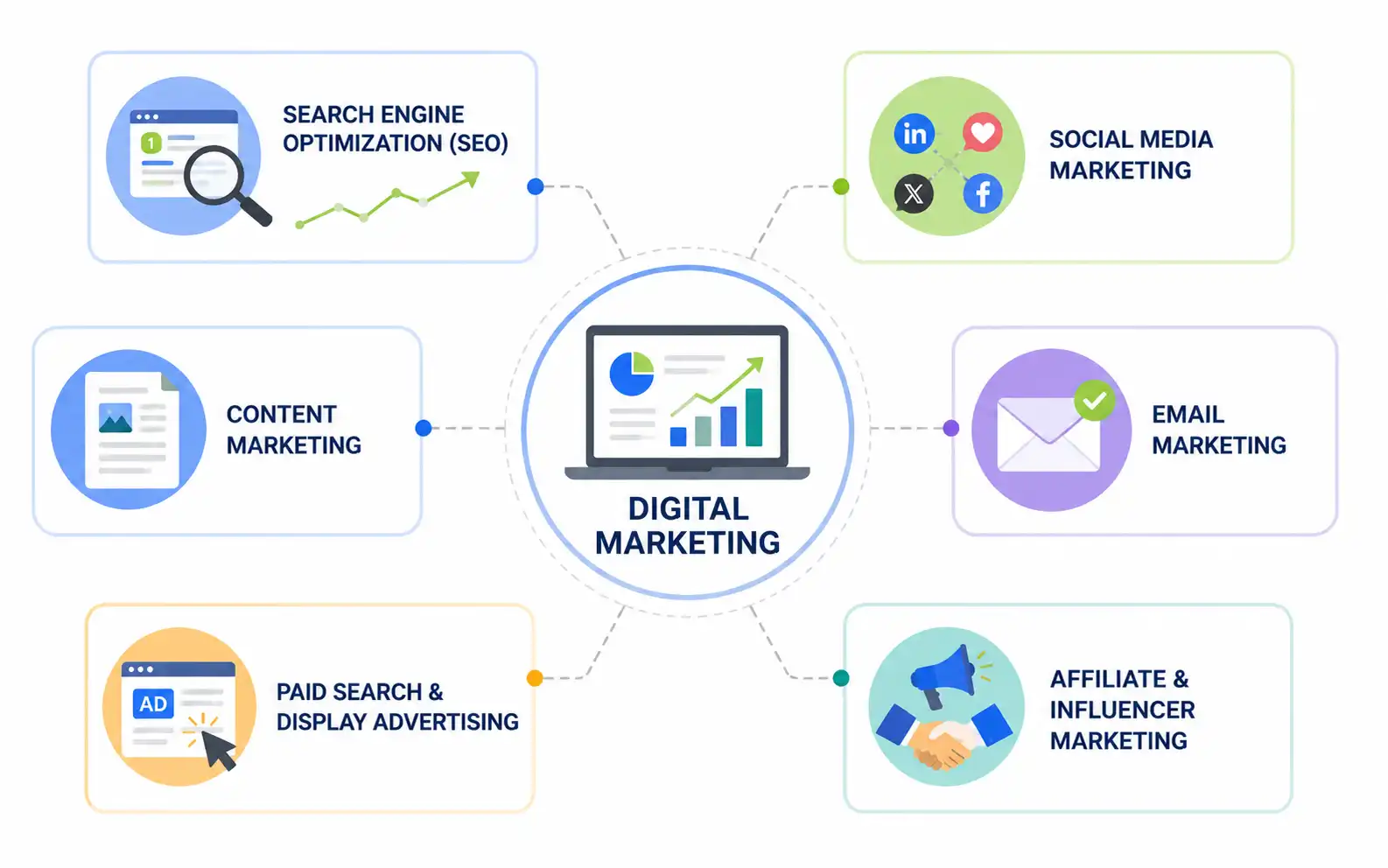
Digital marketing covers a wide range of channels, tactics, and strategies.
Most businesses don’t need all of them.
What they need is clarity on which channels fit their audience, their goals, and the stage of growth they’re in. Getting that wrong means spending budget on channels that generate noise instead of the pipeline.
This overview breaks down the main types of digital marketing, how each one works, and what it’s actually good for, so you can make smarter decisions about where to focus.
Quick Note: Digital marketing is the use of online channels to reach, attract, and convert customers. It spans search, content, social, email, paid media, and more. The channels that deliver results depend on your audience, buying cycle, and whether you need short-term demand capture or long-term brand authority.
What Is Digital Marketing?
Digital marketing is any marketing activity that happens online.
That covers everything from a blog post ranking on Google to a retargeting ad following a prospect around the web after they visited your pricing page.
What makes digital marketing different from traditional marketing isn’t just the medium. It’s the measurability. Every click, open, scroll, and conversion leaves a data trail. That means you can test faster, cut what isn’t working, and double down on what is.
Working with a Content Marketing Agency in India that understands how these channels connect is often the fastest path to building a digital marketing strategy with real traction, rather than running isolated experiments that don’t compound.
Note: Digital marketing isn’t a single tactic. It’s a system of channels that work better together than in isolation. Search drives discovery. Content builds trust. Email converts and retains. Paid media accelerates what’s already working organically.
The Core Types of Digital Marketing Channels
- Search Engine Optimization (SEO)
SEO is the practice of making your content rank higher in search engines for queries your target audience types. It covers keyword research, on-page content structure, technical site health, and building authority through backlinks.
What it’s good for: long-term, compounding traffic. A well-optimized page keeps bringing in visitors for months or years without additional spend. The tradeoff is time. SEO takes three to six months before traction shows.
What is digital marketing in SEO terms? It’s the backbone. Most of the other channels benefit from a strong organic search presence because it validates your brand for every prospect who looks you up after seeing an ad or a referral.
- Content Marketing
Content marketing means creating and distributing articles, guides, case studies, videos, and other formats that attract your target audience and move them toward a decision.
It’s not just blogging. A well-executed content strategy maps assets to every stage of the buying journey: awareness content that brings in search traffic, comparison content that captures mid-funnel researchers, and proof content (case studies, ROI calculators) that closes late-stage buyers.
Content marketing and SEO are the same motion in practice. Content gives SEO something to rank. SEO gives content an audience.
- Paid Search and Display Advertising
Paid search (Google Ads, Microsoft Ads) puts your brand in front of people searching for solutions right now. You bid on keywords and pay per click. Display advertising shows banner ads across a network of websites, usually used for awareness or retargeting.
Paid search is fast. It can drive traffic the day you launch a campaign. That’s its strength and its weakness. The traffic stops the moment the budget does.
The smart play: use paid search to capture demand while organic search builds momentum, then reduce paid spend as organic starts to cover the same queries.
- Social Media Marketing
Social media marketing spans organic posting and paid social ads across platforms like LinkedIn, Instagram, X, and Meta.
For B2B companies, LinkedIn is usually the highest-ROI social channel. It’s where buyers and decision-makers spend professional time, and it’s the only platform where you can target by job title, company size, and industry with precision.
Organic social builds brand presence over time. Paid social accelerates reach and can target specific buyer personas with content they wouldn’t otherwise find.
- Email Marketing
Email is still one of the highest-converting digital marketing channels, particularly for nurture and retention. A subscriber list is an owned audience. Unlike social followers, you’re not renting access through an algorithm.
Effective email marketing isn’t about blasting a list. It’s about segmenting by behavior and intent, then sending content that matches where each segment is in the buying journey. Someone who downloaded a pricing guide gets different emails than someone who just signed up for a newsletter.
- Affiliate and Influencer Marketing
Affiliate marketing pays a commission to partners who send you customers. Influencer marketing pays (or trades value with) individuals who promote your product to their audience.
Both work better in B2C than B2B, but there are B2B use cases: industry newsletter sponsorships, podcast partnerships, and community-driven referrals all follow the same underlying logic.
Must Read: The types of digital marketing that compound over time (SEO, content, email) build durable assets you own. Channels that stop when the spend stops (paid search, paid social) are tools for acceleration, not a foundation. A sustainable digital marketing strategy needs both, weighted by how much runway you have.
How Digital Marketing Works as a System
Understanding what digital marketing services really mean is understanding how the channels connect, not just how each one works in isolation.
Here’s the flow that most effective B2B digital marketing strategies follow:
- Attract: SEO and content pull in prospects who are researching your category.
- Capture: Landing pages, lead magnets, and gated content convert that traffic into contacts.
- Nurture: Email and retargeting ads keep your brand present as prospects continue their research.
- Convert: Case studies, comparison content, and sales-ready conversations close the deal.
- Retain: Ongoing email, community, and content keep customers engaged and reduce churn.
Each channel feeds the next. A blog post ranks in search, brings in a new visitor, gets them to sign up for a newsletter, and starts a nurture sequence. That’s digital marketing working the way it’s supposed to.
FAQs
1. What is digital marketing and how does it work?
Digital marketing is the use of online channels (search, content, social, email, and paid media) to attract, engage, and convert customers. It works by meeting buyers at the right channel and moment in their research, then guiding them toward a decision.
2. What are the main types of digital marketing channels?
The main types include SEO, content marketing, paid search, display advertising, social media marketing, email marketing, and affiliate or influencer marketing. Each serves a different purpose in the buying journey and works best when connected to the others.
3. What is a digital marketing strategy?
A digital marketing strategy is a plan that defines which channels to use, what audience to target, and what goals each channel serves. A strong strategy connects channels so they reinforce each other rather than operating as separate, unrelated campaigns.
4. Which types of digital marketing channels deliver the best ROI?
For B2B companies with longer sales cycles, SEO and content marketing typically deliver the highest long-term ROI because the traffic compounds. Email delivers strong conversion rates on engaged lists. Paid search delivers fast results but requires ongoing spend to sustain.