
QUICK ANSWER BOX
If you are also giving CIPD level 3 assignments, then you have come to the right place. There are 5 biggest challenges that most learners face, such as balancing full-time work with study, shifting from descriptive to analytical writing, mastering Harvard referencing, understanding command words in assessment briefs, and managing deadlines. While each level has its own difficulty and challenge, over 30% of first submissions do not pass, the main reason is that their assignments lack analytical depth. That is why getting expert support early is the most effective fix.
Table of Contents
- Challenge 1 — Balancing Office Work With CIPD Study
- Challenge 2 — Shifting From Descriptive to Analytical Writing
- Challenge 3 — Harvard Referencing Done Right
- Challenge 4 — Decoding What the Brief Actually Wants
- Challenge 5 — The Referral Spiral at Level 5 and Level 7
- The One Fix That Covers All Five Challenges
- FAQs
- Key Takeaways
Top Challenges CIPD Learners Face And How to Overcome Them
Split-screen comparison image showing a UK HR professional confident at work during the day, contrasted with the same person looking stressed late at night trying to start a CIPD assignment.[1]
You signed up for your CIPD qualification because you wanted to increase your expertise level as an HR professional. You definitely did not sign up for the 11 PM panic rewrites, the headache of Harvard referencing, or that dreaded referral email landing three days before your next submission.
Over 160,000 professionals study CIPD annually in the UK. The reality is, most of them hit the exact same walls. At the end of the day, you are still tired, overworked, and guessing what the assessors actually want. Here is exactly what those walls are, and how to get past every single one of them.
Challenge 1 — Balancing Office Work With CIPD Study
The vast majority of people doing this are working full-time alongside their studies.
The specific pressure point here is that CIPD assessors want practical workplace evidence. It’s deeply ironic that the very job that gives you the evidence is taking up all the time you need to sit down and write about it. The fix isn’t to just “study when you can.” You have to block study time like a non-negotiable meeting.
| CIPD Level | Weekly Study Hours | Biggest Time Pressure | Practical Fix |
| Level 3 | 8–10 hours | Academic writing, first time doing it | 2 fixed weekly sessions of 2–3 hours |
| Level 5 | 10–12 hours | Analytical depth on top of full workload | Draft early, allow 2-week writing buffer |
| Level 7 | 12–15 hours | Postgraduate-level critical evaluation | Break each assignment into 5-day sprints |
Challenge 2 — Shifting From Descriptive to Analytical Writing
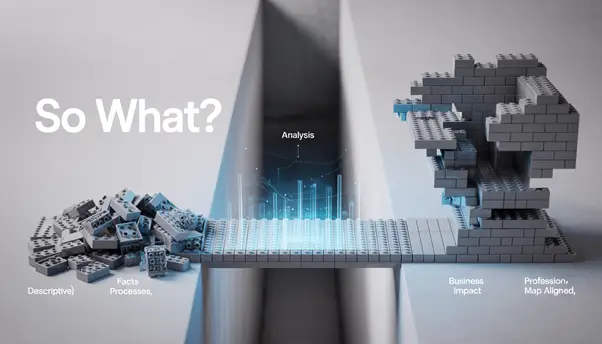
A conceptual 3D render visualization comparing simple stacked “Descriptive” grey bricks (what HR does) to a complex, structured “Analytical” built model (why it matters) connected by a bridge of academic analysis.[2]
This is where the wheels usually come off. You know how HR works. So, naturally, you describe what you do. But assessors don’t want description; they want you to evaluate, compare, and justify using the CIPD Profession Map.
Description says “what HR does.” Analysis says “why it matters and what the evidence actually proves.” If you can’t answer “so what?” then you are just describing the situation.
| Writing Type | Example Sentence | Assessor Response |
| Descriptive | “HR is responsible for the selection and then the recruitment in any company.” | Does not meet analytical criteria, refer |
| Analytical | “Effective recruitment enables performance; CIPD shows structured hiring lowers turnover by 20%.” | Meets learning outcome, pass |
Making this shift is harder than it sounds when you’ve been talking in workplace shorthand for years. That’s why our CIPD assignment writing services at cipdassessment.com write every answer analytically, mapped perfectly to your exact brief.
Challenge 3 — Harvard Referencing Done Right
Referencing is an absolute pain, but it’s non-negotiable. The most common mistake learners make is dumping a reference list at the end of the document. In-text citations throughout the body of your text are mandatory.
The second mistake? Using only the CIPD Knowledge Hub. Assessors flag this as surface-level research. You need at least two peer-reviewed sources per assignment.
| Source Type | In-Text Format | Most Common Mistake |
| CIPD publication | (CIPD, 2025) | Only source used assessors penalise this |
| Journal article | (Smith, 2024) | Missing in-text only in reference list |
| UK legislation | Employment Rights Act 1996 | Written like a normal citation, wrong format |
| ACAS guidance | (ACAS, 2025) | Not included at all, missed credibility |
Challenge 4 — Decoding What the Brief Actually Wants
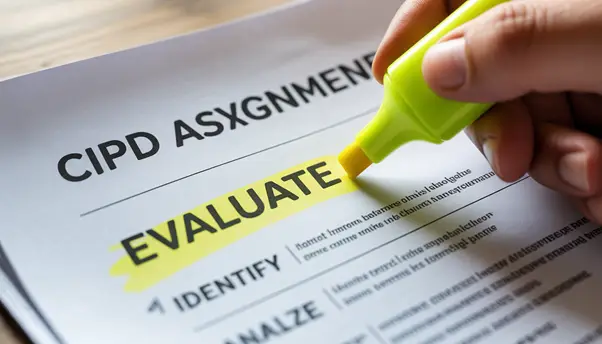
Macro close-up shot of a hand using a yellow highlighter to mark the command word “EVALUATE” on a printed CIPD assessment brief.[3]
Most referrals happen because learners fundamentally misunderstand the question. The brief says “evaluate” and the learner “identifies”.
Command words dictate your entire approach, not the topic itself. Highlight the command word before you write a single sentence.
| Command Word | What Assessors Want | What Most Learners Submit |
| Identify | Named, specific answers | Vague general statements |
| Explain | Reason + example | Definition only |
| Analyse | Break down + “so what” | Description + list |
| Evaluate | Weigh strengths/weaknesses | One-sided argument |
| Critically evaluate | Multiple perspectives + judgement | Theory summary only |
Challenge 5 — The Referral Spiral at Level 5 and Level 7
Here’s the truth. Over 30% of Level 5 and Level 7 first submissions do not pass. It usually comes down to analytical depth.
When you get a referral, you lose a minimum of 10–15 hours rewriting it. That creates a cascade effect. It ruins your confidence and crushes your time for the next module. Level 7 is postgraduate-equivalent. It requires a completely different writing register, strategic, board-level, and critically evaluated. If you are at this stage, securing specialist CIPDlevel 7 assignment writing help[4] early is the absolute fastest way to close the gap between what you know practically and what assessors need to see academically.
| Scenario | Time Cost | Emotional Cost | Outcome |
| First submission — going alone | 15–25 hours writing | High anxiety at submission | 30%+ referral rate at L5/L7 |
| First submission — expert draft | 1–2 hours briefing | Confidence in submission | Consistent first-time pass |
| Post-referral resubmission | +10–15 hours rewriting | Confidence hit + deadline pressure | Delayed progression |
The One Fix That Covers All Five Challenges
All five of these challenges share a root cause: the massive gap between how working professionals communicate and how CIPD assessors demand you write.
That gap isn’t about intelligence or your HR knowledge. It’s purely about academic formatting applied to an HR context. Expert CIPD assignment support closes that gap instantly. It doesn’t do the thinking for you; it builds the correct academic framework around what you already know. With 11+ years, 1,500+ UK students, and a 4.9/5 rating, that is the proof that this fix works.
FAQs
Q1: What is the hardest part of CIPD assignments?
Analytical writing is the hardest adjustment for most CIPD learners.
Q2: How do CIPD students manage work and study together?
Most successful CIPD learners treat study time like a fixed workplace commitment. They block 2 to 3 sessions per week rather than studying “when possible.” Weekly study hours range from 8–10 at Level 3 to 12–15 at Level 7.
Q3: Is CIPD Level 7 as hard as a Master’s degree?
Yes. CIPD Level 7 sits at RQF Level 7, making it equivalent to postgraduate study. Assignments require board-level strategic framing and critical evaluation of multiple perspectives. UK employers typically prefer Level 7 over an MSc HRM.
Q4: Can I get same-day help with a CIPD assignment?
Yes. cipdassessment.com offers 24-hour urgent CIPD assignment support for learners with early deadlines.
Key Takeaways + Get Expert Support
- The 5 core CIPD challenges: time pressure, analytical writing, referencing, brief decoding, and referral spirals.
- Over 30% of Level 5 and Level 7 first submissions do not pass due to a lack of analytical depth.
- Description isn’t analysis. Every single paragraph needs a “so what?” before it counts.
- Harvard referencing requires in-text citations throughout the document, not just a list at the end.
- Getting expert support before your submission prevents referrals. Getting it after costs you 10–15 extra hours.
You did not start your CIPD to spend your weekends rewriting referrals. cipdassessment.com has helped 1,500+ UK HR professionals get past every one of these challenges first time, at Level 3, 5, and 7.
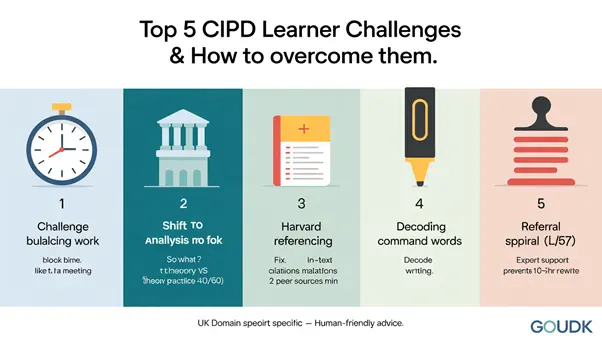
A modern vector infographic summarizing the top 5 challenges for CIPD learners (work balance, analysis, referencing, command words, referral spiral) and their quick fixes, including in-text citation requirements and the need for analytical depth at Level 5 and 7.[5]