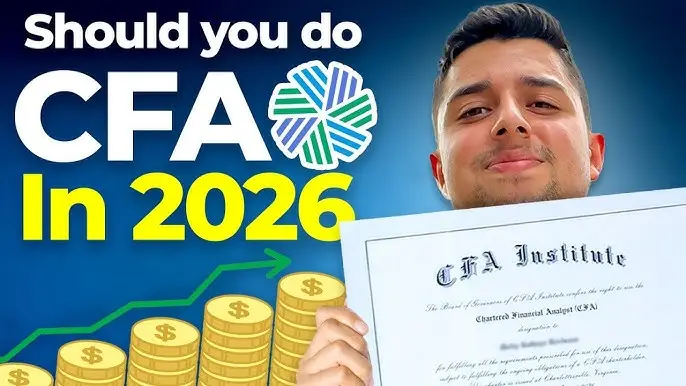
Finance as a career has many routes, but few carry the weight that the chartered financial analyst course does globally. Whether you want to work in investment banking, portfolio management, or equity research, this qualification consistently shows up as a preferred credential by top hiring firms. In India, the interest in CFA has grown steadily, with more candidates registering each year through the CFA Institute.
This article covers everything you need to know before you register, including fees, exam windows, the CFA syllabus, career paths, and realistic timelines for 2026.
What Is the Chartered Financial Analyst Course?
The chartered financial analyst course is a graduate-level finance program offered by the CFA Institute, headquartered in the United States. It’s for professionals who want to become experts in ethics, financial reporting, investment analysis, and portfolio strategy.
The program has three levels, and each level must be cleared sequentially. A candidate cannot appear for Level II without passing Level I. The same rule applies between Level II and Level III.
The CFA Institute reported that globally, fewer than 20% of candidates who start the program complete all three levels. That number reflects both the difficulty and the value attached to the credential in the finance industry.
Who Can Apply for the CFA Course in India?
To register for the chartered financial analyst course, you must meet at least one of the following:
- Hold a bachelor’s degree (or be in the final year of your undergraduate program when registering for Level I)
- Have 4,000 hours of professional work experience in a relevant field
- Have a combination of work experience and education that totals 4,000 hours
There is no age restriction. Students from commerce, economics, mathematics, engineering, and even law backgrounds have pursued the CFA successfully.
CFA Exam Structure and Schedule in 2026
The CFA Institute conducts exams multiple times a year. In 2026, Level I has four exam windows, while Level II and Level III each have two windows.
- Level I Exam Windows in 2026 – February, May, August, November
- Level II Exam Windows in 2026 – May, August
- Level III Exam Windows in 2026 – February, August
All exams are computer-based and held at designated test centers across India, including Mumbai, Delhi, Bengaluru, Chennai, Hyderabad, Pune, and Kolkata.
CFA Syllabus: What You Will Study Across Three Levels
The CFA syllabus covers ten core topic areas. The weight given to each topic shifts depending on the level.
| Topic Area | Level I Focus | Level II Focus | Level III Focus |
| Ethical and Professional Standards | High | High | High |
| Quantitative Methods | Medium | Medium | Low |
| Economics | Medium | Medium | Low |
| Financial Statement Analysis | High | High | Low |
| Corporate Issuers | Medium | Medium | Low |
| Equity Investments | Medium | High | Medium |
| Fixed Income | Medium | High | High |
| Derivatives | Low | Medium | Medium |
| Alternative Investments | Low | Medium | Medium |
| Portfolio Management and Wealth Planning | Low | Medium | High |
Level I tests your conceptual grasp of each topic. Level II shifts to item sets and case-based questions that require application of the CFA syllabus to real scenarios. Level III is heavily focused on portfolio management and includes both constructed response (essay-style) and multiple choice questions.
The CFA Institute updates the CFA syllabus every year. For 2026, the institute has continued its emphasis on climate and ESG considerations within the portfolio management and equity sections.
How Long Does the CFA Course Take?
The CFA Institute recommends at least 300 hours of study per level. Most candidates spread their preparation over six to nine months per level.
If you clear each level on the first attempt, the minimum total time from starting Level I to completing Level III is about two and a half years. In reality, a lot of people take four to five years to finish, even if they fail or have a lot of other things to do.
Here is a rough timeline for someone starting in 2026:
| Level | Exam Window | Preparation Period |
| Level I | May 2026 | October 2025 to April 2026 |
| Level II | May 2027 | August 2026 to April 2027 |
| Level III | August 2028 | November 2027 to July 2028 |
This is a best-case timeline. The actual length depends on how many hours you study, how much work you have to do, and whether you need to take the test again.
Common Job Roles for CFA Charterholders in India
| Role | Average Annual CTC in India (2026 estimate) |
| Research Analyst | INR 6 to 14 LPA |
| Portfolio Manager | INR 15 to 35 LPA |
| Investment Banker | INR 12 to 30 LPA |
| Risk Manager | INR 10 to 20 LPA |
| Wealth Manager | INR 10 to 22 LPA |
Salaries vary by city, firm size, and years of experience. Mumbai and Bengaluru continue to offer the highest packages for CFA professionals in India.
Building Your Preparation Strategy
The CFA syllabus across all three levels covers a large volume of material. Most successful candidates use a mix of the official curriculum, question banks, and mock exams.
For Level III, you have to read the official CFA Institute curriculum because essay-style answers require you to know why you made certain portfolio choices. For Level I and Level II, third-party prep companies often have study plans that are better organized and help you save time.
If you live in Mumbai, Pune, or Delhi, you might want to join a CFA study group in your area. This can help you stay on track and talk about ideas, especially for the math parts of the CFA syllabus.
Conclusion
The chartered financial analyst course remains one of the most respected credentials in global finance, and its relevance in India has only grown with the expansion of domestic capital markets, AMCs, and foreign institutional investment. The cost, effort, and time are real, but for candidates who stay consistent, the career payoff is measurable.
If you want to study for the CFA exam with help that fits with your schedule and the most up-to-date CFA syllabus, Zell Education has structured programs for candidates at all three levels, taught by teachers who have worked in the field.
Technology Perspective
Technology continues to transform industries through artificial intelligence, cloud computing, automation, cybersecurity, digital platforms, and data-driven decision making. As organizations increasingly adopt digital solutions, understanding emerging technologies becomes essential for businesses, professionals, and consumers. DGM News regularly covers these developments through expert analysis, technology news, and educational resources.
Innovation Outlook
Rapid advances in artificial intelligence, automation, machine learning, cloud infrastructure, and digital transformation continue reshaping global industries. Monitoring these developments helps organizations adapt to changing technologies, improve efficiency, and prepare for future innovation.
Did you know?
Artificial Intelligence is expected to influence nearly every major industry over the coming decade, from healthcare and finance to transportation, manufacturing, education, and entertainment.
AI, Machine Learning, Deep Learning and Generative AI Explained
Google AI Updates
About DGM News
DGM News is an independent digital publication delivering the latest Technology News, AI News, and FinTech News. We provide expert insights on startups, innovation, cybersecurity, software, business, gadgets, cloud computing, artificial intelligence, and emerging technologies. Our mission is to publish informative, accurate, and regularly updated content that helps readers stay informed in today's rapidly evolving digital landscape.
Since our editorial focus includes technology, artificial intelligence, and financial technology, we continuously expand our coverage as new innovations emerge.
Editorial Standards
Every article published on DGM News undergoes editorial review before publication. We prioritize factual accuracy, clarity, transparency, and reader value while following responsible digital publishing practices.
Research Methodology
Our editorial team researches publicly available information from official announcements, technical documentation, research publications, developer resources, reputable industry reports, and trusted public sources whenever applicable. Information is reviewed to improve clarity and accuracy before publication.
Fact-Checking Policy
We make reasonable efforts to verify factual information before publishing. Articles are reviewed for accuracy, consistency, and relevance. If significant developments occur after publication, content may be revised to reflect updated information.
Update Policy
Technology evolves rapidly. Articles may be reviewed and updated periodically to reflect software releases, AI developments, security advisories, regulatory updates, product launches, and other important industry changes.
Source Verification
Whenever possible, DGM News reviews information using official company announcements, technical documentation, research publications, government resources, publicly available reports, and reputable industry references before updating articles.
Editorial Independence
DGM News maintains editorial independence in all publishing decisions. Editorial content is produced independently and is intended to provide balanced, informative, and reader-focused coverage without influence from advertisers or commercial partnerships.
AI Usage Disclosure
Artificial intelligence tools may assist with research organization, grammar improvement, formatting, or editorial workflows. Every article is reviewed by human editors before publication to help maintain quality, clarity, and factual accuracy.
Corrections Policy
Accuracy is important to us. If readers identify outdated information or factual inaccuracies, they are encouraged to contact our editorial team. Verified corrections are reviewed and incorporated whenever appropriate.
Reader Feedback
Reader feedback helps improve our journalism. We welcome suggestions, corrections, and constructive feedback through our Contact page to continuously improve the quality of our reporting.
Last Editorial Review
This article follows the DGM News editorial review process and may be updated periodically as new information becomes available.
Why Trust DGM News?
DGM News is committed to publishing technology journalism that emphasizes accuracy, transparency, editorial independence, and regularly updated information. Our editorial process is designed to provide readers with reliable coverage of technology, AI, fintech, startups, and digital innovation.
DGM News Resources
Topics We Cover
Artificial Intelligence • AI Tools • Machine Learning • FinTech • Cybersecurity • Cloud Computing • Programming • Software Development • Gadgets • Mobile Technology • Business Technology • Startups • Digital Marketing • Blockchain • Cryptocurrency • Science • Innovation • Consumer Technology • Enterprise Technology • Automation