The average UK business owner can describe their electricity bill in reasonable detail. Unit rate. Standing charge. The non-commodity charges that get itemised in the small print. The VAT and the Climate Change Levy. The renewal date and the broker who handles it.
Ask the same business owner to describe their water bill in the same detail and the explanation usually trails off after “we pay it quarterly.” The water bill arrives, gets approved, gets paid, and disappears into the same accounts-payable batch as every other recurring invoice. The structure of what’s actually being charged for, and where the money inside that bill is recoverable, is the part that gets skipped.
This is not a small omission. Commercial water bills in England and Scotland have more moving parts than most operators realise, and several of those parts are routinely overcharged in ways that nobody catches because nobody looks. Working with a specialist like Utility Bidder on the water side of utilities procurement is partly about finding a better retailer and partly about the bill audit that happens alongside the switch, which is where the larger recoveries often live.
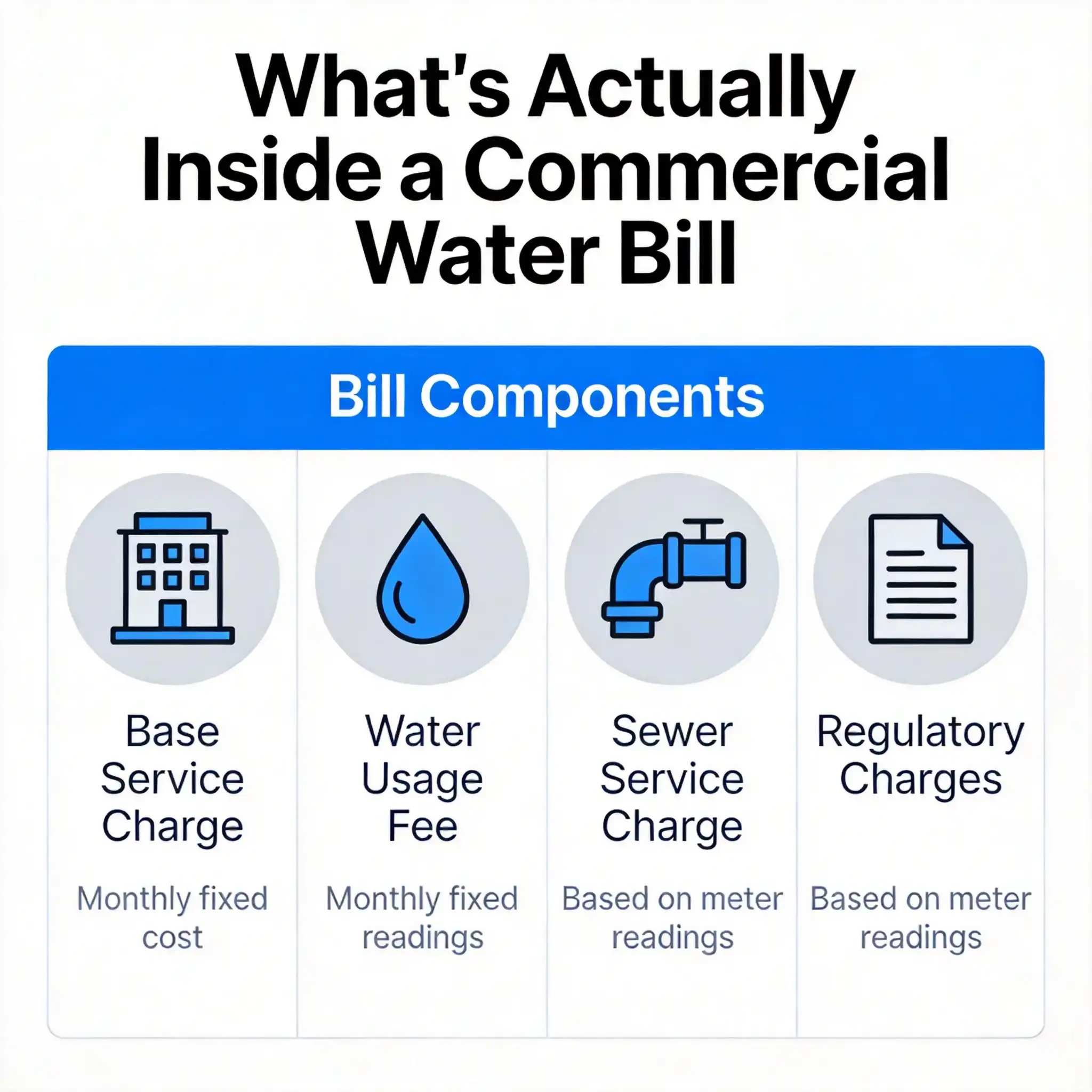
So what is actually in a commercial water bill? Five components, roughly.
Wholesale water charges. The cost of the actual water entering the site. Set by the regional water company’s regulator-approved tariff. Identical regardless of which retailer the business uses. Calculated by metered volume multiplied by a per-cubic-metre rate, with a small standing charge in most regions. This is the largest portion of most water bills and the part that isn’t directly negotiable.
Wholesale sewerage charges. The cost of taking wastewater away from the site. Again set by the regional water and sewerage company. Calculated on the assumption that what comes in goes out, which sometimes overstates the actual sewerage volume and produces an opportunity for adjustment if the business can demonstrate that a meaningful percentage of the incoming water is going somewhere other than the sewer (irrigation, evaporation in cooling processes, manufacturing absorption, certain food and beverage uses).
Surface water drainage charges. The cost of rainwater that falls on the site and drains into the public sewer system. Calculated based on the site’s drainage area, usually estimated from the property footprint. This is the component that produces the largest single overcharge category in the UK commercial water market, because many sites have on-site drainage arrangements (soakaways, ponds, permeable surfaces, attenuation tanks) that mean little or no rainwater actually reaches the sewer system. A site eligible for a surface water drainage rebate may also be eligible for backdated recovery of years of historic overcharges, which is occasionally a substantial cash recovery.
Retail charges. The portion that covers billing, customer service, meter reading, and the retailer’s margin. This is the part of the bill that’s actually negotiable. The wholesale charges pass through. The retail margin is what different retailers compete on. The spread between the highest and lowest retail margins in the active commercial water retailer panel is meaningful, particularly for higher-consumption sites.
Trade effluent charges. Applicable only to businesses that discharge water with specific contamination profiles (food processing, certain manufacturing, laundries, some healthcare operations). Calculated using the Mogden formula, which incorporates measured contamination levels in the discharged effluent. These charges are based on assumed contamination that may not match actual current operations, particularly if production processes have changed.
Where does the money actually leak out of these five components?
The most common leak is surface water drainage charges on sites that shouldn’t be paying them, or should be paying less. The estimate of drainage area on the bill is usually made by the water company, sometimes decades ago, and rarely updated when the site changes. Buildings get extended. Car parks get resurfaced. Drainage gets reconfigured. The bill keeps charging the original area. A site survey often reduces the chargeable drainage area significantly, and the rebate can be backdated for up to six years in most regions.
The second common leak is meter accuracy and meter reading. Estimated bills are common on commercial sites, particularly small ones. The estimates tend to drift upward over time. A manual meter reading compared to the most recent bill often shows a discrepancy that’s been quietly accumulating for several quarters. The reconciliation produces either a credit on the next bill or a refund cheque, depending on how large the gap has grown.
The third common leak is the retail margin on the active contract. Sites still on default supply from the incumbent regional water retailer (somewhere between 30 and 40 percent of eligible sites are, despite the market having opened in 2017) are paying the default retail margin, which is usually higher than what’s available on a competitively procured contract. Switching to a competitively priced retailer typically reduces the retail charge portion of the bill by 5 to 12 percent.
The fourth common leak is meter sizing. Some sites have meters sized for higher consumption than they actually use, which results in a standing charge higher than necessary. A meter downsizing, where appropriate, reduces the standing charge.
The fifth common leak is trade effluent classification for businesses subject to those charges. The Mogden formula relies on assumed contamination levels. If the business has invested in pre-treatment, changed its production mix, reduced certain inputs, or installed monitoring that can demonstrate lower-than-assumed contamination, the trade effluent calculation can be reduced.
A few practical things worth knowing if you are planning to look at your business water bill seriously for the first time:
Pull the last twelve months of bills before doing anything. The pattern in the data, including any unexplained jumps in consumption or estimated bills, is usually the first place the audit opportunity becomes visible.
Read the actual meter today. Compare it to the latest bill. If the bill is estimated rather than read, the discrepancy may already be material.
Look at the surface water drainage charge as a separate line item. If the site has any on-site drainage features, this is the highest-probability place to find a rebate.
Check the renewal date on the current retail contract. Many businesses don’t know when their water contract ends or whether they’re still on default supply. A retail switch is generally the largest ongoing saving opportunity, separate from the audit recoveries.
Decide whether to do this internally or use a broker. The exercise of doing all of this in-house takes a finance or facilities person somewhere between 8 and 30 hours, depending on the complexity of the site. A specialist broker handles most of this on a contingency basis (a share of the savings recovered), which removes the internal time cost in exchange for the share of savings.
Commercial water bills are one of the few remaining operating cost categories where the typical UK business hasn’t applied the same procurement discipline it now applies to electricity, gas, telecoms, and most other recurring costs. The reason is mostly that the bills are smaller and less attention-grabbing. The savings on a per-site basis are real but modest. The savings on a multi-site portfolio basis are usually meaningful enough to justify the exercise. Nine years into the open market, the businesses that haven’t yet looked are the ones still funding the leak.
Technology Perspective
Technology continues to transform industries through artificial intelligence, cloud computing, automation, cybersecurity, digital platforms, and data-driven decision making. As organizations increasingly adopt digital solutions, understanding emerging technologies becomes essential for businesses, professionals, and consumers. DGM News regularly covers these developments through expert analysis, technology news, and educational resources.
Innovation Outlook
Rapid advances in artificial intelligence, automation, machine learning, cloud infrastructure, and digital transformation continue reshaping global industries. Monitoring these developments helps organizations adapt to changing technologies, improve efficiency, and prepare for future innovation.
Did you know?
Artificial Intelligence is expected to influence nearly every major industry over the coming decade, from healthcare and finance to transportation, manufacturing, education, and entertainment.
AI, Machine Learning, Deep Learning and Generative AI Explained
Google AI Updates
About DGM News
DGM News is an independent digital publication delivering the latest Technology News, AI News, and FinTech News. We provide expert insights on startups, innovation, cybersecurity, software, business, gadgets, cloud computing, artificial intelligence, and emerging technologies. Our mission is to publish informative, accurate, and regularly updated content that helps readers stay informed in today's rapidly evolving digital landscape.
Since our editorial focus includes technology, artificial intelligence, and financial technology, we continuously expand our coverage as new innovations emerge.
Editorial Standards
Every article published on DGM News undergoes editorial review before publication. We prioritize factual accuracy, clarity, transparency, and reader value while following responsible digital publishing practices.
Research Methodology
Our editorial team researches publicly available information from official announcements, technical documentation, research publications, developer resources, reputable industry reports, and trusted public sources whenever applicable. Information is reviewed to improve clarity and accuracy before publication.
Fact-Checking Policy
We make reasonable efforts to verify factual information before publishing. Articles are reviewed for accuracy, consistency, and relevance. If significant developments occur after publication, content may be revised to reflect updated information.
Update Policy
Technology evolves rapidly. Articles may be reviewed and updated periodically to reflect software releases, AI developments, security advisories, regulatory updates, product launches, and other important industry changes.
Source Verification
Whenever possible, DGM News reviews information using official company announcements, technical documentation, research publications, government resources, publicly available reports, and reputable industry references before updating articles.
Editorial Independence
DGM News maintains editorial independence in all publishing decisions. Editorial content is produced independently and is intended to provide balanced, informative, and reader-focused coverage without influence from advertisers or commercial partnerships.
AI Usage Disclosure
Artificial intelligence tools may assist with research organization, grammar improvement, formatting, or editorial workflows. Every article is reviewed by human editors before publication to help maintain quality, clarity, and factual accuracy.
Corrections Policy
Accuracy is important to us. If readers identify outdated information or factual inaccuracies, they are encouraged to contact our editorial team. Verified corrections are reviewed and incorporated whenever appropriate.
Reader Feedback
Reader feedback helps improve our journalism. We welcome suggestions, corrections, and constructive feedback through our Contact page to continuously improve the quality of our reporting.
Last Editorial Review
This article follows the DGM News editorial review process and may be updated periodically as new information becomes available.
Why Trust DGM News?
DGM News is committed to publishing technology journalism that emphasizes accuracy, transparency, editorial independence, and regularly updated information. Our editorial process is designed to provide readers with reliable coverage of technology, AI, fintech, startups, and digital innovation.
DGM News Resources
Topics We Cover
Artificial Intelligence • AI Tools • Machine Learning • FinTech • Cybersecurity • Cloud Computing • Programming • Software Development • Gadgets • Mobile Technology • Business Technology • Startups • Digital Marketing • Blockchain • Cryptocurrency • Science • Innovation • Consumer Technology • Enterprise Technology • Automation