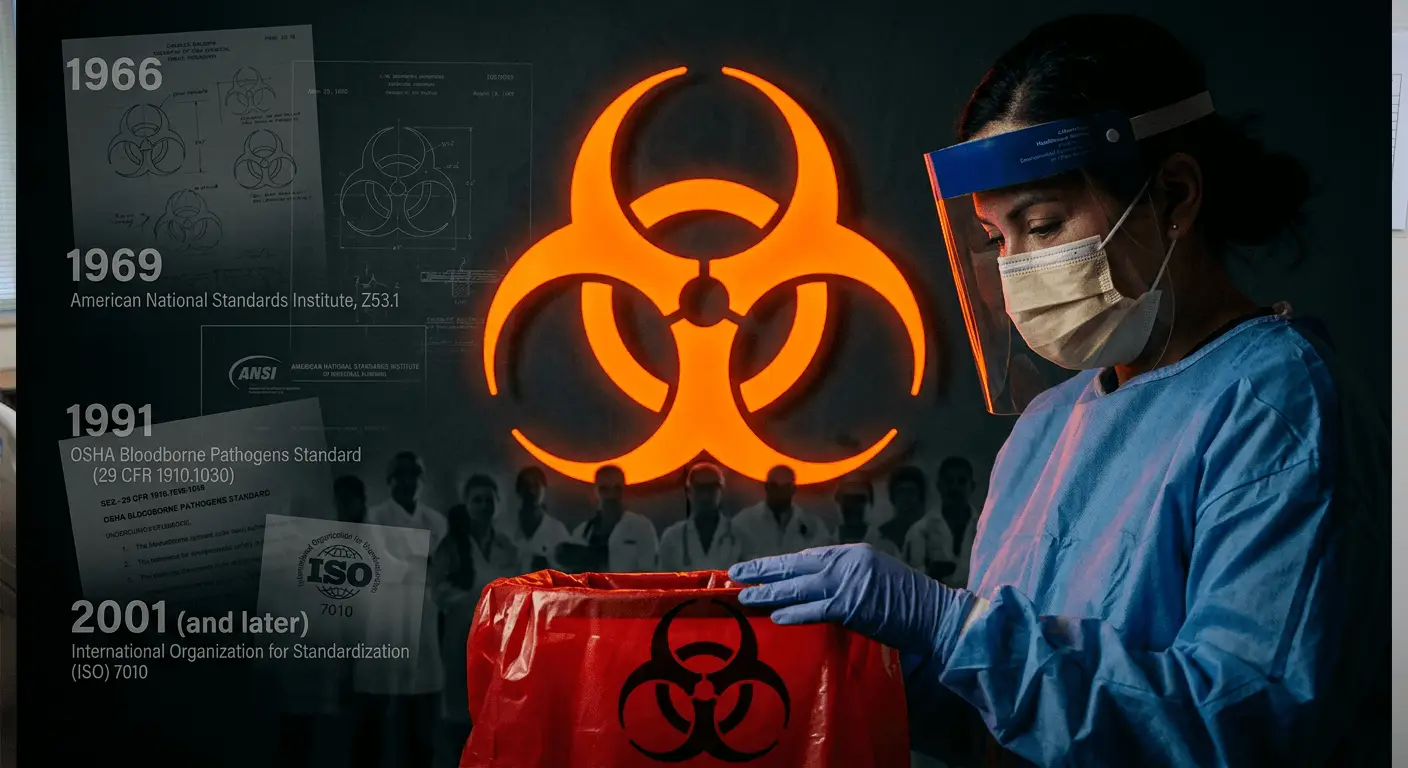
For employers managing workplaces where biological hazards are present — whether in healthcare, research, waste management, janitorial services, or industrial settings — labeling is not a formality. It is a core part of how risk gets communicated before an incident occurs. When labels are missing, incorrect, or inconsistent, the chain of information that protects workers from exposure breaks down. That breakdown has direct consequences: employees handle materials without adequate precaution, emergency responders make decisions without full information, and organizations face citations that carry real financial and operational weight.
As of 2025, OSHA’s standards on biohazard labeling remain among the most actively enforced areas of workplace safety compliance. Employers across a wide range of industries are being held to consistent and detailed expectations. Understanding what those expectations are — and why they are structured the way they are — is the starting point for any organization that handles potentially infectious or biological materials.
What OSHA Actually Requires When It Comes to Biohazard Labeling
The osha biohazard label requirements that govern US workplaces are primarily drawn from the Bloodborne Pathogens Standard under 29 CFR 1910.1030, which applies to any employer whose workers have occupational exposure to blood or other potentially infectious materials. This standard does not simply ask that a biohazard symbol be placed on a container. It specifies where labels must appear, what color and design elements are required, which containers and equipment must be labeled, and when alternative methods such as color-coded bags or containers are acceptable substitutes.
Understanding these requirements in full detail requires going deeper than a checklist. Employers should review the regulatory text directly and consult structured compliance resources, such as this breakdown of osha biohazard label requirements, which outlines the standard’s application across common workplace scenarios. That foundation matters because partial compliance — labeling some containers but not others, or using non-compliant color schemes — does not satisfy the standard and can still result in violations during an inspection.
The Role of the Biohazard Symbol and Color Standard
OSHA’s Bloodborne Pathogens Standard requires that warning labels include the fluorescent orange or orange-red biohazard symbol, with lettering and symbols in a contrasting color. This is not an aesthetic preference. The color and symbol combination exists because it must be immediately recognizable under variable conditions — different lighting environments, stressful situations, and by workers who may not be reading fine print in the moment. The visual signal carries the warning when words alone might not be seen or processed in time.
Labels must be affixed directly to containers used to store or transport regulated waste, contaminated equipment, refrigerators and freezers holding blood or infectious materials, and other specimens. They must be attached in a manner that prevents their loss or unintentional removal. Labeling that can peel off during regular handling or storage conditions does not meet the intent of the standard, even if it was technically present at some earlier point.
When Color-Coded Containers Are Permitted as an Alternative
The standard does allow for certain alternative methods, and this is an area where employers sometimes encounter confusion. Red bags or red containers may be substituted for labels in facilities where all employees have received training on the meaning of the color-coded system. This exception exists to support settings like hospitals and clinical labs where volume and workflow make individual labeling of every container impractical. However, the alternative is only valid when that universal training and consistent system are actually in place — it is not a blanket permission to skip labeling.
If a facility sends contaminated materials outside of its walls — for transport, disposal, or processing by another organization — labeling requirements reapply. The receiving party cannot be assumed to operate under the same internal color-coding system, so the universal label is required to communicate the hazard across organizational boundaries.
Which Employers and Industries Are Covered Under the Standard
OSHA’s Bloodborne Pathogens Standard covers any employer in a workplace where one or more employees have occupational exposure to blood or other potentially infectious materials as a result of their job duties. This is broader than many employers initially assume. Healthcare is the obvious sector, but the standard also applies to first responders, tattoo and body art studios, funeral homes, research laboratories, correctional facilities, and certain janitorial and maintenance operations where workers clean up after injuries or bodily fluid incidents.
Employers who do not routinely work with medical or biological materials, but whose workers may be called upon to respond to an exposure event — such as maintenance staff in a large office building — may still fall within the standard’s scope depending on the nature of their duties and whether those duties are formally assigned. OSHA evaluates coverage based on reasonably anticipated exposure, not just incidents that have actually occurred.
Exposure Control Plans and Their Connection to Labeling
Biohazard labeling requirements exist within a larger compliance framework. Employers covered by the Bloodborne Pathogens Standard are required to develop and maintain a written Exposure Control Plan, which documents how the employer identifies workers at risk, what engineering and work practice controls are in place, how PPE is selected and used, and how training is delivered. Labeling is one component of this plan — it is the communication layer that supports everything else.
A well-constructed exposure control plan makes labeling requirements consistent throughout the organization. It defines which containers require labels, who is responsible for applying them, how labels are inspected and maintained, and what happens when a label is damaged or missing. Without that documented framework, labeling practices tend to drift — individual workers make their own judgments about when and how to label, which creates uneven protection across the workforce.
Common Compliance Failures and Why They Persist
OSHA enforcement data consistently shows that biohazard labeling violations are among the most common citations issued under the Bloodborne Pathogens Standard. The reasons for these failures are rarely about ignorance of the law. More often, they reflect operational gaps — new employees who were not trained on labeling procedures, supply chain disruptions that left a facility without compliant labels, or a gradual drift in practice that was never caught during internal audits.
Another common failure involves secondary containers. When contaminated specimens are moved from their original container into a secondary one — a bag, a transport box, or a storage bin — the secondary container also requires a label. This step is frequently missed in high-volume environments where speed and workflow take priority over administrative details. The regulatory standard does not make exceptions for volume or time pressure, which means facilities that process large quantities of materials are often the ones most exposed to this type of violation.
Label Condition and Maintenance Over Time
A label that was compliant when applied may become non-compliant over time if it fades, tears, or becomes obscured. This is particularly relevant in environments where containers are handled repeatedly, stored in temperature-variable conditions, or cleaned with chemical agents that degrade adhesive materials. Employers who select labeling materials without considering the physical environment in which they will be used often find that their labels do not hold up through the expected lifecycle of the container.
OSHA does not specify exact durability standards for label materials, but the requirement that labels be attached in a way that prevents loss or unintentional removal implies that employers must select materials appropriate to the use environment. A label that fails in normal use conditions is effectively no label at all from an enforcement perspective.
Training as the Foundation for Label Compliance
Labels only work when the people handling labeled materials understand what those labels mean and what actions they require. OSHA mandates that employers provide training to covered workers at the time of initial assignment and at least annually thereafter. That training must include an explanation of the labeling and color-coding system, how it functions within the organization’s exposure control plan, and what workers should do when they encounter a missing or damaged label.
According to OSHA’s Bloodborne Pathogens guidance, training must be interactive and allow employees to ask questions. A printed handout or an automated online module alone does not satisfy this requirement. The interactive element is intended to ensure that workers actually understand the material rather than simply receiving it.
Documentation of Training and Label Audits
Employers who want to demonstrate compliance during an inspection need records. Training records must include the date training was provided, the content covered, and the names of employees who attended. Beyond training, maintaining a log of internal audits — including reviews of labeling practices across work areas — gives employers the documentation needed to show that compliance is actively managed rather than assumed.
Internal audits are also the mechanism by which labeling drift gets caught early. A quarterly walkthrough of storage areas, waste containers, and equipment can identify labeling failures before they become inspection findings. That proactive approach is consistently more effective than corrective action after a citation.
Conclusion: Labeling as Operational Infrastructure, Not Paperwork
Biohazard labeling is most effective when it is treated as part of the operational infrastructure of a workplace — something that is built into procurement decisions, training schedules, equipment maintenance, and daily workflows — rather than as an administrative requirement that sits separately from how work actually gets done.
Employers that approach the osha biohazard label requirements from that operational perspective tend to have more consistent outcomes. Labels are present where they need to be. Workers know what they mean. Containers are maintained properly. When something goes wrong, the chain of communication is intact and the organization can demonstrate that it took its obligations seriously. That consistency is not just about avoiding citations. It reflects a baseline standard of care for the people who do the work, and it is achievable for any employer willing to treat it as a genuine operational priority rather than a compliance checkbox.