The landscape of web development services has undergone a tectonic shift in 2026. We have moved past simple autocomplete into the era of Agentic Development, where AI does not just suggest code but orchestrates entire feature deployments. For businesses and agencies, the challenge is no longer finding an AI tool, but choosing a stack that offers velocity with governance.
According to the 2026 Web Development Industry Report, the global market for these services has reached $82.4 billion, driven largely by AI-first infrastructure. Today, 84% of professional developers have integrated AI into their daily workflows, with many reporting that AI now generates or assists with up to 90% of their codebase. For businesses, the challenge is no longer finding a developer, but choosing a service stack that offers velocity with security.
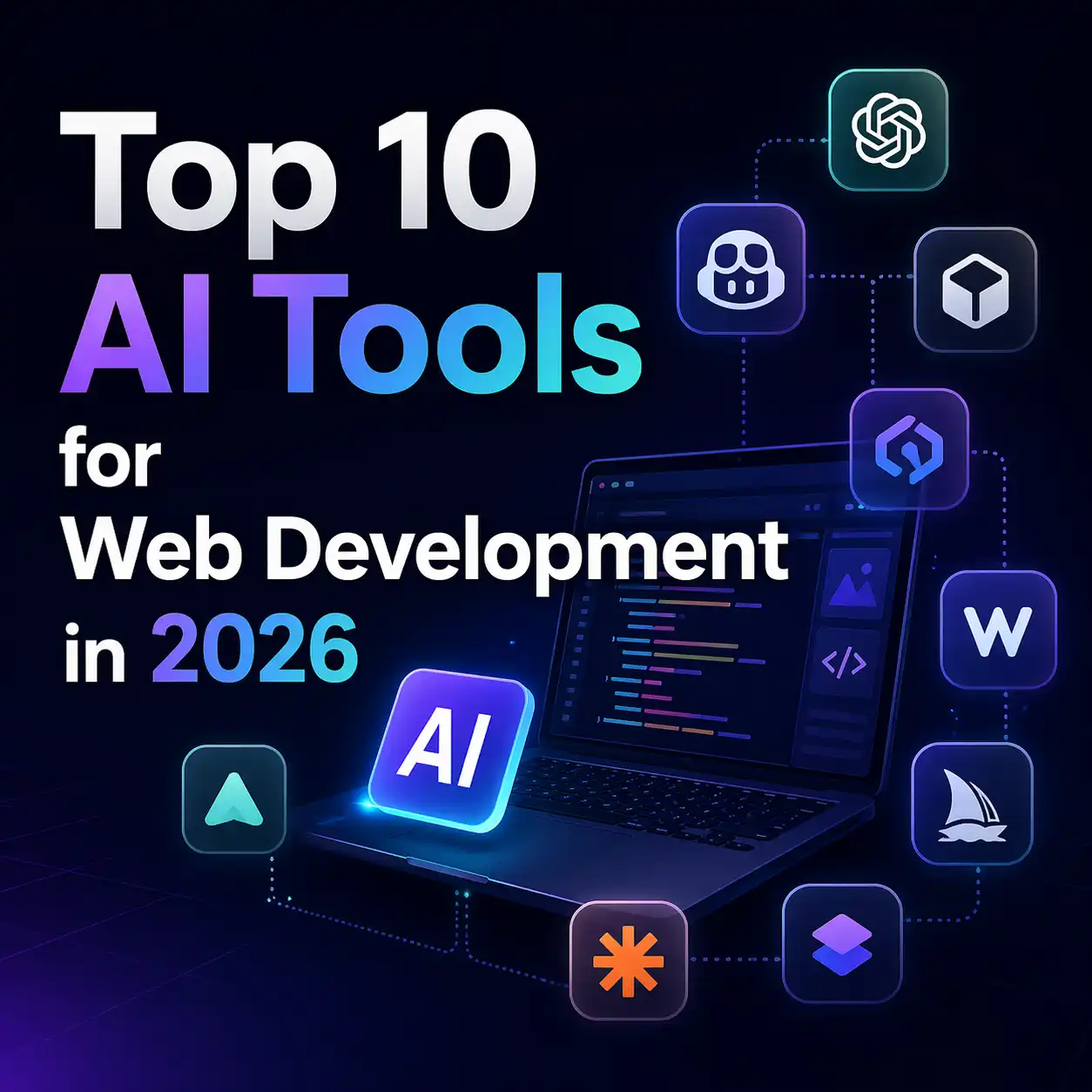
Top 10 AI Tools for Web Development Services in 2026
To outrank competitors and satisfy modern search algorithms, you need a workflow that addresses Logic, Design, and Operations. These ten tools currently dominate the sector:
1. Cursor: The Agentic IDE
Cursor has reached a milestone of 1 million daily active users. Unlike generic LLMs, it indexes your local codebase using a “shadow git” system, allowing it to predict edits across hundreds of files simultaneously. Its 2026 Composer mode can scaffold entire full-stack features while maintaining your specific architectural patterns.
2. v0 by Vercel: The Generative UI Standard
For frontend web development services, v0 is the gold standard for turning a “vibe” into production-grade React components. It is specifically optimized for Vercel’s infrastructure, ensuring UI components are styled with Tailwind CSS and ready for immediate deployment.
3. Claude Code: The Context Powerhouse
Anthropic’s terminal-first AI has seen a 6x increase in adoption this year. With a massive 1-million-token context window, it can ingest entire legacy codebases to identify hallucinations and provide 99.9% accurate logic fixes for multi-file bugs.
4. GitHub Copilot: The Enterprise Integration Leader
With over 20 million users, Copilot remains the leader for large-scale teams. Its 2026 Extensions feature allows it to interact directly with Jira, Sentry, and Azure DevOps, creating a unified feedback loop between error logs and code fixes.
5. Hygraph: The Agentic CMS
Hygraph has redefined content management by building AI agents into the fabric of operations. Its agents autonomously handle localization, SEO metadata, and content-variant testing, freeing developers to focus purely on high-level architecture.
6. Framer AI: The Prototype-to-Production King
Framer remains the tool of choice for marketing-heavy sites. Its AI generates responsive, high-converting landing pages that bridge the gap between Figma designs and live performance in minutes.
7. Tabnine: The Privacy-First Choice
For enterprises with strict data sovereignty needs, Tabnine is the safest option. It offers locally-hosted, private models that are never trained on your proprietary code, meeting the highest security KPIs.
8. Lovable: The MVP Accelerator
Designed for the Vibe Coding movement, Lovable allows founders to build full-stack web apps through a conversational interface. It handles the boilerplate while the human manages the product vision and user experience.
9. WeWeb: The Professional Visual Builder
WeWeb allows teams to build complex dashboards visually while maintaining backend freedom. You can connect to any database via AI-generated logic without being locked into a proprietary stack.
10. Fathom: The AI Documentation Assistant
Fathom bridges the communication gap by recording technical meetings and automatically generating Technical Requirements Documents (TRDs) that push directly into your project management software.
How AI Improves Web Development Services
The integration of AI is not just about writing code faster; it is about data-driven precision:
- Reduced Human Error: AI agents now run continuous visual regression tests, catching 90% of UI bugs before the manual QA phase begins.
- Performance Optimization: Every $1 invested in UX yields a projected 100x return, and AI tools now automate image optimization and server-load analysis to hit sub-2-second load times.
- Accessibility by Default: AI builders now output semantic HTML that is pre-optimized for AI Overviews (AEO) and WCAG compliance.
Why Is Choosing the Right Tool Important?
Successful web development services in 2026 avoid “Tool Fatigue” by selecting a stack based on three critical criteria:
- Workflow Integration: Does the tool slide into your current IDE or CI/CD pipeline without friction?
- Scalability: Can the tool handle a project with 10,000+ files as easily as it handles a small MVP?
- Governance: Does the tool allow for human-in-the-loop validation, or does it operate as a “black box”?
Frequently Asked Questions
What is the best AI tool for a beginner in web development services?
Lovable or Replit Ghostwriter are the best starting points. They offer a conversational interface that teaches you the logic of coding while the AI handles the syntax.
How does AI impact the ROI of web development services?
AI reduces the “Time to Market” by up to 40%, allowing businesses to pivot faster and test features in real-time without massive overhead costs.
Is AI-generated code secure for professional services? Security varies significantly. Tabnine and Amazon Q offer the highest standards for enterprise security, ensuring code remains private and compliant with global regulations.