The design phase of a new residential project is an incredibly rewarding stage of the property journey. It is the exact window where your abstract lifestyle aspirations, creative vision boards, and functional requirements begin to take shape on a blueprint. However, for many property owners, this phase can also introduce unexpected financial friction. Without careful management, a beautiful initial concept sketch can evolve into a complex, over-engineered architectural plan that far exceeds your realistic borrowing limits.
This financial disconnect frequently occurs when design and construction are treated as completely separate pipelines. Traditional volume building tracks often utilize pre-drawn templates engineered for perfectly flat, uniform plots of land. When a family attempts to adapt these rigid catalog plans to address a sloping gradient, navigate narrow urban layouts, or include custom material specifications, the initial pricing models can quickly break down.
Maintaining strict budget control requires a process that coordinates design choices with technical estimation from day one. Partnering with professional adelaide custom builders changes the pre-construction phase into a transparent, managed collaboration.
Implementing these five specific pre-construction secrets ensures you can design a home that fits your lifestyle perfectly while maintaining complete control over your budget.
1. Execute Your Detailed Selections Upfront Before Contract Execution
The most common cause of budget issues in residential building is the post-contract selection shock. In standard mass-market construction tracks, buyers are often asked to sign a building agreement based on a low, promotional “base price” that includes only standard baseline fixtures and finishes. The detailed selections process—where you choose kitchen appliances, cabinetry, tapware, electrical layouts, and internal tiling formats—is routinely delayed until weeks after the contract is executed and the deposit is paid.
When you discover that the standard specifications do not align with your expectations, upgrades become necessary. Because these adjustments are finalized after you are legally committed to the contract, the pricing for upgrades can increase quickly, leading to costly post-signing variations.
To protect your budget, look for a building partner that utilizes a comprehensive upfront selection framework. By finalizing every interior finish, electrical component, and joinery profile during the active design loop, your selections are priced accurately before you sign a binding agreement. This concurrent estimating loop ensures your design concept remains aligned with your budget.
2. Engineer for Subterranean Reality: Address Reactive Clay and Footing Liabilities Early
A significant source of unexpected cost in any new build occurs completely below the ground surface. Many property owners focus their budget planning entirely on visible elements like benchtops and external facades, leaving themselves exposed to unexpected earthwork and foundation expenses.
The soil profiles across the plains, hills, and surrounding coastal regions feature highly reactive clay beds. These clays absorb water and swell during wet winter periods, then shrink significantly during dry summer cycles, placing considerable physical stress on concrete foundations.
Volume builders typically base their initial pricing on an assumed flat, Class M soil profile. When the subsequent soil test and contour survey reveal highly reactive Class H or E clay, the buyer faces expensive post-contract variations for extra concrete and steel reinforcements.
A professional custom home builder eliminates this financial risk by conducting comprehensive soil profiling and contour surveys before completing your construction contract. This ensures that the structural footings are engineered precisely for your block’s soil conditions. Factoring these requirements into your initial site costs protects your budget from unexpected foundation adjustments during excavation.
3. Map PlanSA Setbacks and Council Overlays Directly Into Your Early Floor Plan Sketches
Navigating building regulations successfully is essential for keeping your project on schedule and budget. Every residential plan must satisfy the guidelines of South Australia’s centralized Planning and Design Code via the PlanSA portal.
While this centralized system standardizes core assessment pathways, individual local government zones apply strict overlays that directly affect your design boundaries.
If you are executing an urban infill project or building in established suburbs like Unley, Burnside, or Prospect, forcing a standard catalog home onto the block can lead to planning challenges. Standard templates often conflict with strict rules regarding:
- Maximum Site Coverage Ratios: The maximum percentage of the allotment that the home’s footprint can occupy.
- Boundary Setbacks: The minimum distance required between your external walls and property lines to maintain streetscape consistency.
- Privacy & Overlooking Overlays: Restricting upper-level window alignments to prevent overlooking adjacent yards.
Attempting to modify a finished drawing to satisfy a strict council assessment panel can result in costly, time-consuming design revisions mid-way through the council review phase.
A custom design handles these regulations by building compliance into the initial design phase. Your builder evaluates setbacks, site coverage, and character guidelines from day one, minimizing the need for costly post-submission revisions and creating a smoother path to development approval.
4. Leverage Solar Passive Design Geometry to Achieve 7-Star Efficiency Affordably
All new residential construction must meet a minimum 7-star energy rating through the Nationwide House Energy Rating Scheme (NatHERS), alongside satisfying a strict “Whole-of-Home” energy budget. Achieving this standard can become expensive if you attempt to retrofit a poorly oriented house design with high-end mechanical additions or commercial thermal upgrades.
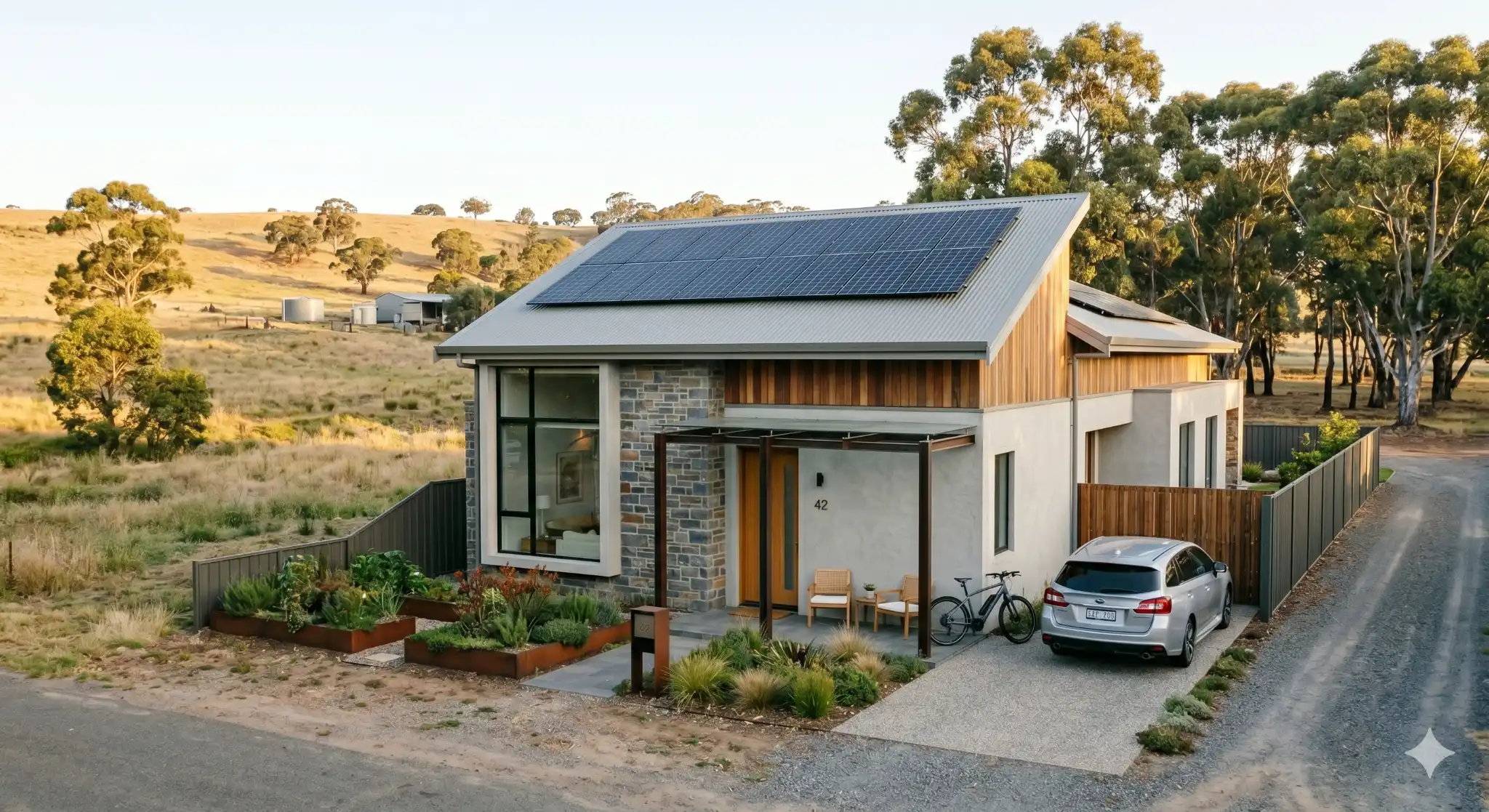
A custom builder utilizes solar passive design principles to achieve these standards naturally through the layout of the home. By analyzing your block’s orientation early in the design phase, your builder positions primary living areas along the northern boundary to capture natural winter warmth.
They calculate exact eave overhangs to block out harsh summer sun, position windows to encourage natural cross-ventilation, and place high-density insulation precisely where it is needed. Designing with the local climate in mind allows you to meet strict energy standards without relying entirely on expensive mechanical upgrades, helping keep your project on budget and ensuring low ongoing energy costs for the life of the building.
5. Convert Open-Ended Provisional Sums into a Verified Fixed Contract Framework
Achieving true budget control requires transparency in how your building agreement is put together. You must ask your builder for a clear breakdown of open-ended allowances, known as Prime Cost items and Provisional Sums.
- Prime Cost Items: Financial allowances for fixtures or finishes (such as custom joinery, stone surfaces, or premium tapware) that have not been finalized before signing. If your final choice costs more than the contract allowance, you must pay the difference.
- Provisional Sums: Estimated costs for labor and materials for tasks that cannot be fully priced until work begins (such as complex excavation or retaining walls on a sloping site).
If a builder uses low, unrealistic allowances in their initial contract, the client often faces unexpected variation invoices during construction.
A custom design approach focuses on contract certainty by completing detailed engineering checks and selecting specific materials during the pre-construction phase. This allows open-ended allowances to be converted into a comprehensive fixed contract, ensuring you know the final cost of your home before construction starts.
The Strategic Financial Advantage of Transparent Custom Procurement
The design phase should be a collaborative process where your budget and lifestyle requirements are managed together. Budget blowouts are rarely caused by the cost of premium materials themselves; instead, they are often the result of unforeseen site complications, regulatory changes, and unexpected post-contract variations.
By choosing the right builder in adelaide, you can replace financial uncertainty with a structured, transparent design workflow. Completing comprehensive geotechnical soil profiling, incorporating local council code parameters early, and finalizing your material selections before contract signing ensures that every dollar of your construction budget is spent efficiently. This professional, proactive planning protects your personal cash reserves and transforms your creative concepts into an enduring, high-performing home tailored precisely to your family and your land.